
Teachers address MLSD elementary schedules, activities
NANCE BESTON | Hagadone News Network | UPDATED 6 months, 2 weeks AGO
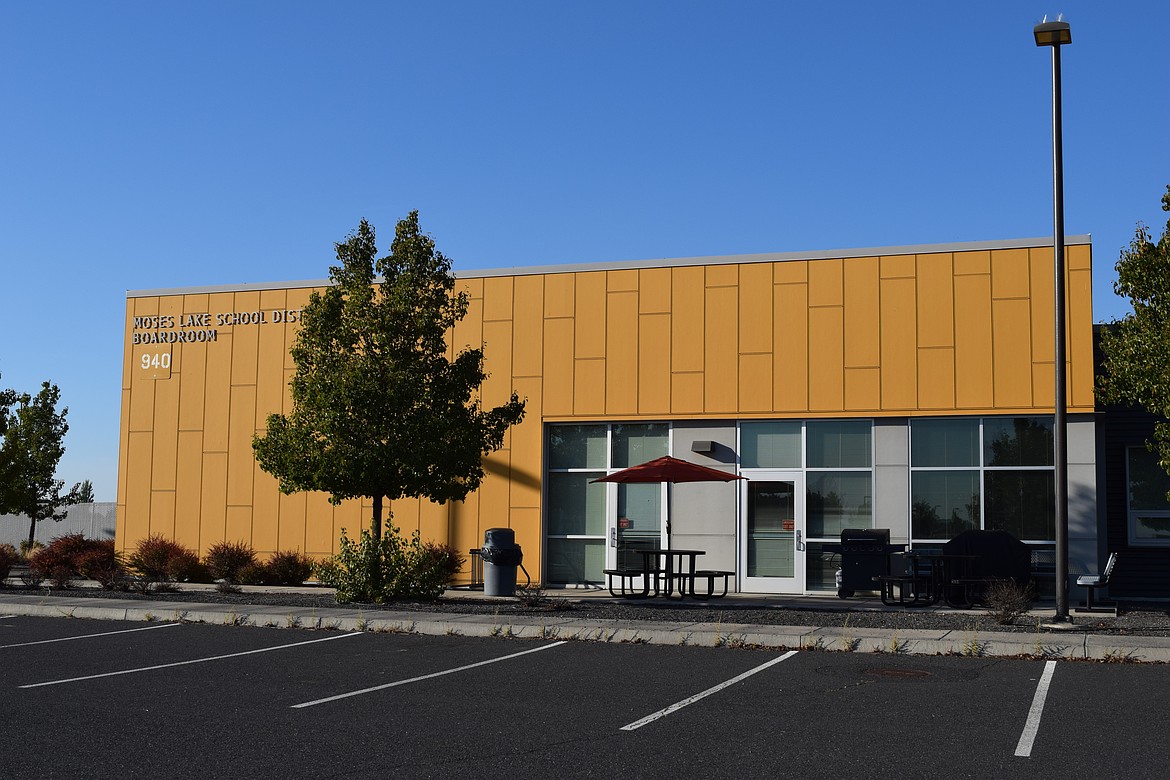
Teachers and community members filled the Moses Lake School District Boardroom located behind CB Tech last week. Teachers joined the meeting to voice a request to start school earlier, in some instances, to ensure students had more access to classroom time and education.
R. HANS MILLER/COLUMBIA BASIN HERALD
MOSES LAKE – At the Moses Lake School District Board meeting on September 18, concerns were brought to the board from district staff and community members regarding lingering reductions in elementary school schedules and the implications for student learning, particularly in areas such as physical education, music, library access and special education services.
Superintendent Carol Lewis said, despite the cuts, the district will be within state-mandated guidelines for instructional time for students.
“The decision to maintain the elementary schedule for the 25-26 school year provides promised fiscal stability for the school district, and we will not make a plan that intentionally spends more money than we project to bring in,” Lewis said. “Additionally, we made promises to add staff and programs at our middle and high schools; it would not have been equitable to focus the entirety of available money only on elementary programs while maintaining all cuts at the secondary level, especially when we know significant enrollment loss was experienced due to cut programs at the high school level.”
Levy failure
The district reduced elementary schedules last year by 30 minutes to save money during the budget shortfall. This also included a reduction in staffing for PE, music and library time for students.
“The loss of a levy always impacts a school district for two years because levies are collected on a calendar year, and school years always span two calendar years,” Lewis said. “I would like to remind the entire community that we always knew the 24-25 school year, and the current 25-26 school year would be impacted by the levy failure.”
Lewis said that although the district is unable to go back on the overspending in 2022 through 2024, they will be able to bring back more programming that was reduced after the levy is fully collected. Levy revenues will begin early next calendar year.
“We are in a position to restore programming in a way that is much more equitable than it was while finally addressing longstanding, noncompliant practices such as inappropriately requiring paraeducators to plan and deliver instruction for library and computer lab and the fact that we were not meeting the PE instructional requirements in nearly all of our schools for many years prior to the levy failure,” Lewis said.
Reduced hours
Heather Whittall, president of the Moses Lake Education Association, said teachers are struggling under current schedules.
"Last year was tough for our members and our classified colleagues," Whittall said. "We were asked to shoulder the burden of financial cuts while maintaining high-quality student instruction and care for our youngest learners."
Despite their efforts to advocate for restoration of the full school day, which Whittall said was promised post-levy passage, the district continued the shortened schedule into the 2025-26 school year.
Lewis said staff were informed several times that the schedule would not go back to what it was.
“Under the 24-25 schedule, which was 30 minutes less per day that students were at school, elementary kids actually spent more time with their certificated teachers each week than they did during the 23-24 school year, and this continues into the 25-26 school year,” Lewis said. “The plan is, and has always been, to add 1/2 hour to the elementary schedule in the 26-27 school year, but in a way that also helps meet the PE and music instructional goals of the state and the district while providing equitable access to these programs across all schools.”
Library time will also be increased with that change, she said.
PE, music and library time
The reduced access to physical education, music, and library time has become a focal point of concern among educators and parents alike, according to MLEA representatives who spoke Thursday. Not all MLEA members who commented were classroom teachers.
Stevi Kast, a fourth-grade teacher at North Elementary, spoke on the missing enrichment activities, stressing the importance of a full educational experience. Kast said Tuesday she had received an email from a parent saying her son was singing one of the songs she teaches to help students learn about geography.
“We sing and teach in my class, or we sing and include body movements to help us remember,” Kast said. “His mother sent me an email thanking me for including music in his learning. She said he struggles with memorizing but when things are presented by song, he remembers better.”
Kast said she would be able to teach her students better with a stronger music program.
Liz Pray, a school nurse and parent, said music and PE are both vital for students' mental health..
“I can tell you with absolute certainty, PE, music and library are not extras,” Pray said. “They are essential supports for the well-being and growth of every child. We are in the middle of a youth mental health crisis – anxiety, depression and stress are rising sharply, even in our elementary schools. Kids need tools to cope, to regulate and define belonging. That's exactly what these programs provide.”
Pray said PE provides students with a daily health break. Music lowers cortisol levels, citing it as a form of therapy. Then, libraries are safe, calm spaces for students.
“Cutting these programs and shortening our school day have taken away some of the strongest protective factors that we have for our kids' mental health,” Pray said.
Lewis said the district has been working on restoring these programs; however, it is a two-year plan, which was indicated on levy information.
“The amount of elementary PE teachers is equal to what it was prior to the reduction in staff, and our Executive Director of Teaching and Learning has worked with OSPI, all principals, and PE teachers to ensure we are moving toward the 100-minute per week requirement as soon as possible,” Lewis said.
She said last year, some students were only scheduled to receive around 30 minutes of physical education time. This year, every student is scheduled to receive an average of 58 minutes of PE per week.
“A top priority will be to increase the amount of scheduled elementary PE time for every student to as close to 100 minutes as possible by the 26-27 school year,” Lewis said.
Special education
The discussions also touched on challenges faced by special education students due to the current scheduling.
Christina White pointed out the detrimental effects shortened school days have on her students.
"My students are not receiving the targeted personalized interventions they need to thrive," she said.
Moreover, she said many students who previously benefited from one-on-one support are now placed in whole-group settings, hindering their learning.
"A predictable schedule helps (special education students) regulate their emotions, manage transitions, and remain engaged," Pray said.
The current schedules result in increased behavioral challenges, White said.
"Time is not just minutes on a clock. Time is access, access to instruction, access to therapies," White said.
Lewis said that although hours have changed, all special education students have an Individualized Education Program in place. The IEP determines specific services, including time required in special education settings and general education settings.
“Our special education directors, principals, teachers, and paraeducators take great care to ensure each and every IEP is followed, and we hire enough staff to ensure all IEPs are followed,” she said. “As you may recall, ensuring adequate special education staffing was the number one priority as we worked through the budget shortfall in the summer of 2024. Ensuring appropriate special education services will always remain a top priority for the district.”
Contract
Whittall said she gave board members a petition signed by over 350 educators, representing more than 90% of MLEA members, about immediate action being taken on restoring the thirty minutes of educational time.
"We are definitely united in our belief that this decision is no longer acceptable or defensible," she said regarding reduced elementary education hours.
Lewis said the district has made two offers to MLEA that would restore the schedule during the current school year rather than next year.
“One offer asks that MLEA find the money to restore the schedule by making reductions to contract benefits, and one option brings the kids to school 30 minutes more per day without any additional cost,” Lewis said.
To date, MLEA has not accepted either the Aug. 21 offer or the Sept. 2 offer.
ARTICLES BY NANCE BESTON
1 arrested after Highway 17 stop; detectives recover fentanyl, firearms
MOSES LAKE — The Moses Lake Street Crimes Unit conducted a traffic stop on Highway 17 near Randolph Road and executed a search warrant Friday morning as part of an ongoing narcotics investigation.

4th-year drought declaration in WA, subtle effects in the Columbia Basin
EPHRATA — Washington’s fourth straight year of drought is expected to hit some regions hard, but in Grant and Adams counties, the impacts will look different – quieter, less visible and centered underground. Statewide, the Department of Ecology issued an emergency drought declaration after a warm winter left Washington with about half its usual snowpack, raising concerns about low summer streamflows, stressed fish populations and heightened wildfire risk. Seven of the past 10 years have included drought somewhere in the state. “If you look at our mountains, the challenge we are facing is clear,” Gov. Bob Ferguson said during a press conference Wednesday. “We’re taking emergency action to protect fish, farmers and communities across Washington.”

Sleep Diagnostic Center to close after doctor’s sentencing
MOSES LAKE — The Central Washington Sleep Diagnostic Center announced it will be closing its doors effective April 30. This includes locations in Moses Lake, Spokane Valley, Brewster and Wenatchee. The announcement follows the March 25 guilty plea from Dr. Eric Edward Haeger, 57, in United States District Court to adulterating and misbranding medical devices with the intent to defraud or mislead, according to a statement from the U.S. Attorney’s Office. “The adulterations by Dr Haeger show a dangerous disregard for the safety of his patients,” Washington Attorney General Nick Brown said in a statement. “This is a win for patient safety, for protecting public dollars from fraud, and for ensuring citizens of Washington get necessary healthcare. This case exemplifies the great work our team is doing in collaboration with our federal partners to fight fraud and protect Washingtonians.”