
Whitefish economic update: Summer visitation remains strong
Zac Anderson | Whitefish Pilot | UPDATED 1 year AGO
Tourism remains a cornerstone of Whitefish’s economy—43% of all jobs are at least partially reliant on visitor spending.
While visitation brings substantial benefits to Whitefish—excellent restaurants and unique shops are possible because of visitor spending— businesses also depend on consistent local support, especially in the off season.
Once again, Glacier National Park has been a powerful economic engine for Whitefish and the Flathead Valley. As of mid-July, Glacier visitation was up 7% over the previous year.
Across the state, core travel metrics held firm: lodging tax collections rose 2%, airport deboardings climbed 5%, and Yellowstone National Park also experienced increased visitation, up 3% year-over-year according to the Montana Office of Tourism and Business Development.
Meanwhile, Canadian visitation slowed significantly, with traffic at Montana’s 14 Canadian ports down 13% on average, dampening summer activity in border-dependent towns across Montana. Canadian spending was down 20% in Whitefish, however, strong domestic demand and the enduring appeal of Glacier National Park resulted in an overall increase in total visitor spending in July and August.
The City of Whitefish collected $6,978,640 in resort tax collections in fiscal year 2025, an increase of nearly 5% year over year. Based on travel data from Explore Whitefish’s data partner Zartico, visitor spending is 58% of all spending toward local businesses in Whitefish. Therefore, it is estimated that visitors will contribute just over $4,000,000 towards property tax relief, infrastructure, housing initiatives, bike and pedestrian pathways, parks and other local improvements.
Visitors to Whitefish are only part of the picture. Another significant growth factor is the influx of new residents and second homeowners, boosting local demand. According to U.S. Census data, Flathead County gained over 10,100 residents since 2020, the largest county-level population increase in Montana. At the same time, Kalispell’s population grew nearly 25% since 2020, making it the fastest-growing city in the state. This convergence of steady visitation, combined with significant growth of new residents, underscores the importance of managing growth and tourism carefully.
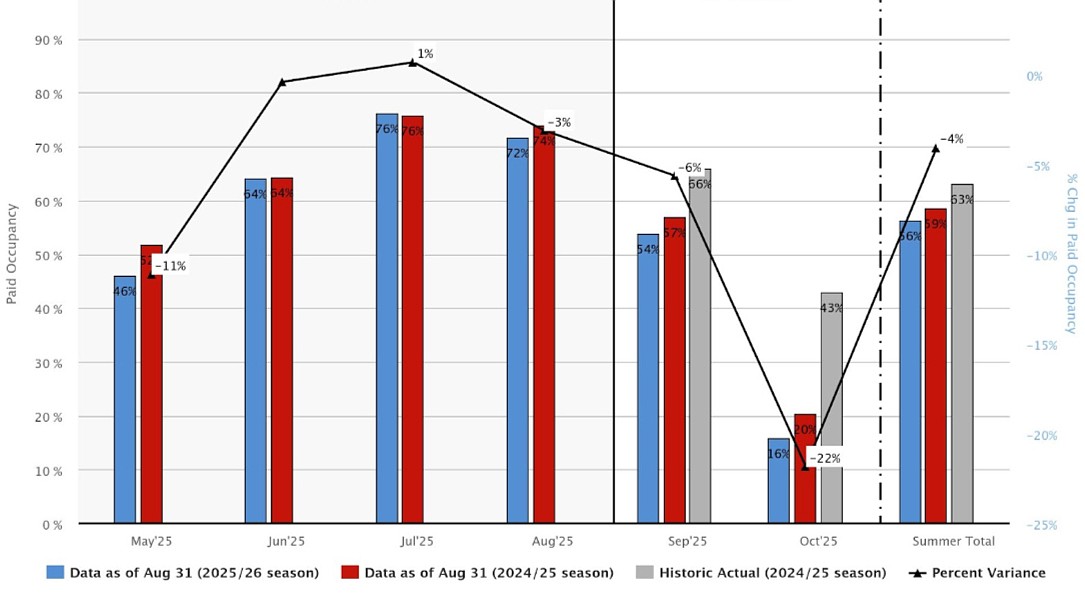
Performance metrics for Whitefish lodging remained steady. According to Destimetrics, a company that tracks lodging data, both traditional hotels and short-term rentals maintained stable occupancy—76.22% for hotels and 80% for short-term rentals in July, well above the national average of 68.5%. However, short-term rental rates surged, with average daily rates rising 26.6% to $672 versus $531 in July 2024. In contrast, traditional lodging average daily rates increased more moderately—up 9.5% to $364, from $332 a year earlier.
Nationally, however, the tourism landscape is more mixed amid economic uncertainty. Although American leisure travel remains resilient—U.S. travel spending nudged up slightly (+0.2%) in July, buoyed by strong domestic air traffic and consumer demand. International inbound travel remains weak, with overseas arrivals down 3.1% year-over-year according to the U.S. Travel Association dashboard. Notably, enplanements at Glacier Park International Airport were up nearly 12% in July, outpacing the rest of Montana.
In summary, while the broader economic environment may pressure many travelers to cut back, Whitefish continues to be a popular summer destination—buoyed by Glacier National Park’s enduring appeal and strong local demand from new residents and second homeowners.
At the same time, the combination of national travel headwinds and local growth underscores the importance of thoughtful, strategic planning. The community’s long-term success depends not just on maintaining visitor interest, but on ensuring that growth aligns with the values of residents and the carrying capacity of local resources. This is where proactive tourism management plays a critical role—balancing the benefits of a visitor economy with the protection of the community character and quality of life that make Whitefish such a desirable place to live and visit.
This article was provided through the partnership between Explore Whitefish (the Whitefish Convention and Visitors Bureau) and the City of Whitefish Sustainable Tourism Management Plan Committee.
The Committee, working closely with local stakeholders, is committed to sharing transparent and timely information on the state of tourism in our community. The Sustainable Tourism Management Plan’s goals are to foster collaboration, improving visitor education, managing impacts on infrastructure and natural resources, and ensuring that tourism continues to provide broad benefits to local residents.
By communicating openly about challenges and opportunities, they aim to build trust, inform decision-making, and keep Whitefish on a sustainable path as both a vibrant community and a world-class destination.
 A look at occupancy rates for traditional lodging/hotels this summer, plus projections for the fall. Data from Destimetrics, and graph provided by Explore Whitefish/STMP.