
Coeur d'Alene Charter grad turned marine biologist publishes memoir
KAYE THORNBRUGH | Hagadone News Network | UPDATED 1 year AGO
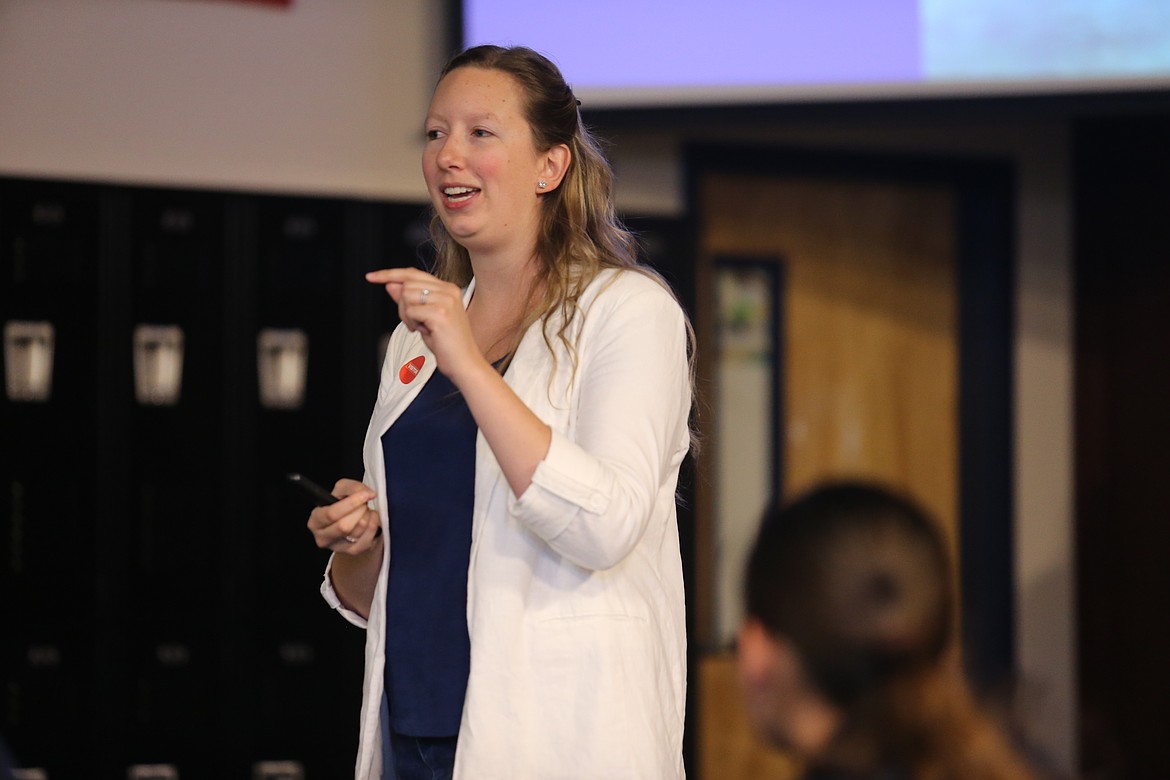
Rachel Jordan, a 2013 Coeur d'Alene Charter Academy graduate, spoke with Charter students Friday about her work as a marine biologist.
KAYE THORNBRUGH/Press
Kaye Thornbrugh is a second-generation Kootenai County resident who has been with the Coeur d’Alene Press for six years. She primarily covers Kootenai County’s government, as well as law enforcement, the legal system and North Idaho College. | September 29, 2025 1:09 AM
COEUR d’ALENE — Rachel Jordan remembers the moment she decided to become a marine biologist.
She was sitting in Mike McCormack’s 10th-grade biology class at Coeur d’Alene Charter Academy, listening to her teacher talk about the research he conducted as a graduate student and how he learned that corals change their growth patterns based on sunlight exposure.
“I was so enamored with these stories that he told about corals that when my mom picked me up from school that day, I got into the car, told her all the coral stuff and got so excited that I started crying,” she said.
It was then that she knew what her path would be.
After graduating from high school in 2013, Jordan went on to earn a bachelor’s degree in ecology from Seattle Pacific University, conducting field research at Blakely Island Field Station in the San Juan Islands. She continued her studies at James Cook University in Australia, where her thesis research focused on feeding baby corals chemicals as growth supplements.
In addition to working as a coral biologist for the U.S. National Park Service, Jordan has worked in marine aquaculture research, organic chemistry laboratories and veterinary research facilities.
Jordan’s memoir, “If the Ocean Has a Soul,” was published this summer by Tyndale House Publishers. She visited Coeur d’Alene Charter Academy on Friday to speak with students about her career as a marine biologist and her new journey as an author.
Before he became a teacher, Mike McCormack was a marine biologist. In the late 1980s, he was involved in early studies about coral reef bleaching in the Caribbean.
“It really left an impression on me,” he said.
McCormack said he shares that experience with his students as an example of how science is done in the real world. In doing so, he changed the trajectory of Jordan’s life.
Seeing his former student share her work with current students, knowing he helped her on this path, brought a smile to McCormack’s face.
“That’s the ultimate reward for a teacher,” he said.
Science and math didn’t come naturally to Jordan; she recalled struggling with the subjects in school. But her desire to become a scientist and study corals was so great that she refused to give up.
“I worked so hard to become the scientist I wanted to be,” she told a crowd of students.
Jordan’s Christian faith is a big part of her life. In her book, she examines the natural world through a spiritual lens, considering what the ocean and sea creatures reveal about God and how humans might heal a damaged environment.
“People have this impression that faith and science don’t fit together,” she told the Press. “In that case, I’m a walking contradiction.”
For Jordan, science and scripture are not opposed — both are means of knowing the world and how it came to be. She said she feels that God called her to her career in science.
Jordan said she was inspired to write “If the Ocean Has a Soul” in order to fill the gap in how many people think about faith and science, as well as to share the important work of marine scientists.
In her presentation to students, Jordan emphasized the importance of corals to the physical and economic health of the world. Many different creatures flock to the ecosystems that corals create.
“If you lose the corals, you lose the fish, you lose the sea cucumbers, you lose the sharks,” she said. “There are over a billion people on our planet who rely on seafood as their primary source of food. If we lose corals, a lot of people go hungry.”
As a coral ecologist, Jordan’s work included health monitoring and coral restoration amid the spread of stony coral tissue loss disease, a highly lethal disease affecting coral along the Florida Keys and elsewhere in the Caribbean Sea.
“Corals are having a hard time,” she said. “That’s partly why it’s so important that we understand their value and we study them. They’re really incredible animals.”
ARTICLES BY KAYE THORNBRUGH
Stateline shooter pleads guilty to manslaughter
A DoorDash driver who fatally shot a pedestrian during a road rage incident near Stateline Speedway has pleaded guilty to voluntary manslaughter, though whether a judge will accept the pretrial settlement offer in the case remains to be seen.
Stateline shooter pleads guilty to manslaughter
Prosecutors originally charged Edsel Johnson with first-degree murder
A DoorDash driver who fatally shot a pedestrian during a road rage incident near Stateline Speedway has pleaded guilty to voluntary manslaughter, though whether a judge will accept the pretrial settlement offer in the case remains to be seen.
Kootenai County history revealed
Community members get close-up look at time capsule contents
Liz Boutin is no stranger to historical artifacts. A museum professional and fine artist, Boutin said she's handled Egyptian and Greek items that date back to antiquity. But she had a new experience this summer, after local historical preservationists retrieved a 100-year time capsule from inside the outer wall of the old Kootenai County courthouse.