
Legion begins refurbishing highway fatality markers
MONTE TURNER | Hagadone News Network | UPDATED 6 months, 1 week AGO
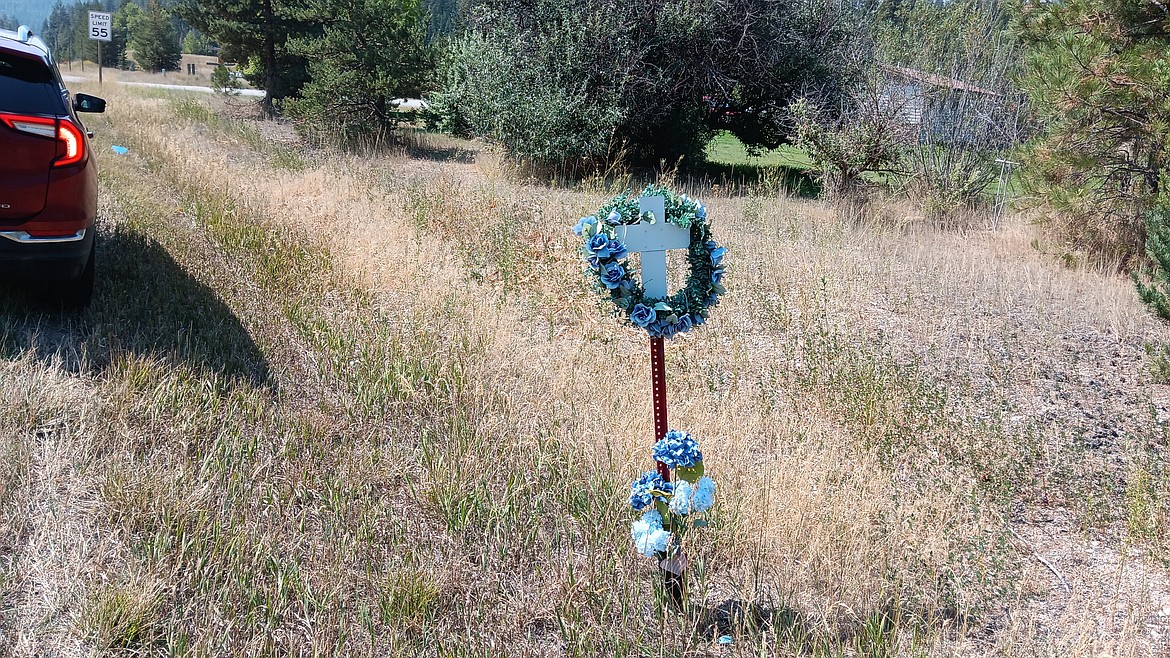
Fatality Markers on Montana highways and interstates are not to be decorated. The markers serve as a public safety message, reminding drivers to “Please Drive Carefully” and can be removed if they continually become shrines or memorials. (Monte Turner/Mineral Independent)
Ray Welch American Legion Post 13 in St. Regis is responsible for maintaining fatality markers along Interstate 90 from Lookout Pass to mile marker 77, just east of Alberton, as well as along Montana 135 from St. Regis to the Sanders County line.
Post 13 Commander Vince Triplett said members are beginning their annual refurbishment of the markers.
“It takes a few weeks for our team of volunteers to complete the work, and our goal is to have it finished in time for our Memorial Day cleanup on I-90,” Triplett said.
The post also maintains a 1-mile stretch of I-90 just outside St. Regis, a task that takes a full day each year ahead of the unofficial start of summer.
“Our members keep an eye on it year-round, but during this annual cleanup we call for all hands-on deck to pick up trash,” he said. “Every year we ask ourselves how people can be so careless with garbage, because the amount we collect never seems to decrease.”
Post 13 invites area veterans to attend its monthly meetings, held at 4 p.m. on the first Monday of each month at its headquarters, located at 55 Mill Creek Road. The group is also seeking volunteers for its annual flag disposal ceremony on Flag Day, June 14, held in partnership with the Superior VFW.
“We don’t just pick up garbage and repair Fatality Markers,” Triplett added. “We also enjoy camaraderie and strive to be a positive, steady presence in the community.”
The American Legion’s fatality markers, often referred to as white crosses, are found throughout Montana along state and federal highways, secondary and Forest Service roads, and even city streets. This is the only program of this kind in the United Staes.
One marker is erected for each fatal traffic accident. Two white crosses on the same post indicate that two people died in that accident.
The program is intended as a highway safety initiative rather than a memorial. Still, many families place wreaths or other decorations on the crosses in remembrance of loved ones. While these tributes are understandable, covering the markers can diminish their visibility and defeat the program’s purpose.
The markers serve as a public safety message, reminding drivers to “Please Drive Carefully.” Each cross stands as a sobering reminder of a life lost on Montana’s roads. Turning a Fatality Marker into a shrine is considered a violation of Montana Department of Transportation guidelines, which require the markers to remain clearly visible and uniform.
While the American Legion does not remove nearby memorial items, the DOT may do so. Not all highway fatalities are marked. Some families request that no marker be placed due to the intensity of their grief.
Additionally, not all of Montana’s 134 American Legion posts participate in the program, and some areas lack a local post altogether. For these reasons, there are stretches of highway where fatal accidents have occurred without corresponding markers.
Markers may also be removed when highways are reconstructed and conditions that contributed to the accident are corrected. In cases where markers are repeatedly covered or altered, they may also be removed.
Responsibility for erecting and maintaining the markers falls to local American Legion posts, each of which is assigned a specific area. Posts receive annual instruction sheets outlining specifications for constructing and placing the crosses. Ongoing maintenance is emphasized both in these guidelines and at Legion meetings. Importantly, no tax dollars are used in the fabrication, installation, or upkeep of the markers.
Since the White Cross Program began more than 73 years ago, it is estimated that more than 3,300 markers have been placed along Montana’s roads representing, collectively, a “cemetery” spanning more than five acres.
The program has received widespread recognition and praise, including from the Montana Highway Patrol and Mothers Against Drunk Driving. Every Montana governor since 1953 has endorsed the effort.
The program has also drawn national attention, with coverage on television stations across the country and in regional media outlets. Articles have also appeared in publications such as the Boston Globe, Washington Post, Spokesman-Review, and Seattle Times. Each year, the Montana Governor’s Office, the Department of Transportation, and American Legion headquarters in Helena receives numerous inquiries about the White Cross Program. These inquiries come from across the United States, as well as from Canada and other countries, reflecting the program’s broad impact and interest.
ARTICLES BY MONTE TURNER
West End Fire to turn up the heat with chili cookoff fundraiser
What better place to enjoy a bowl of full-blown, mega-scorching-hot chili than at a fire station stocked with wildfire equipment, fire extinguishers and a building full of professionally trained firefighters, EMTs and Quick Response personnel?

Senior center cooks up hot dishes with a side social fun
There’s something about a good home-cooked meal that can bring people through the door, and at the Superior Senior Citizens Center, head cook Jessica Williams seems to have figured out the recipe.
Montana-Idaho border reconfigured after survey retraces original state lines
The Bureau of Land Management has completed its official resurvey of the Montana-Idaho boundary near Lookout Pass, going back to the original survey monuments and retracing the line that was established more than 120 years ago.