
Rediscovering home: Making tough calls
BRUCE MOATS Mineral Independent | Valley Press-Mineral Independent | UPDATED 1 day, 5 hours AGO
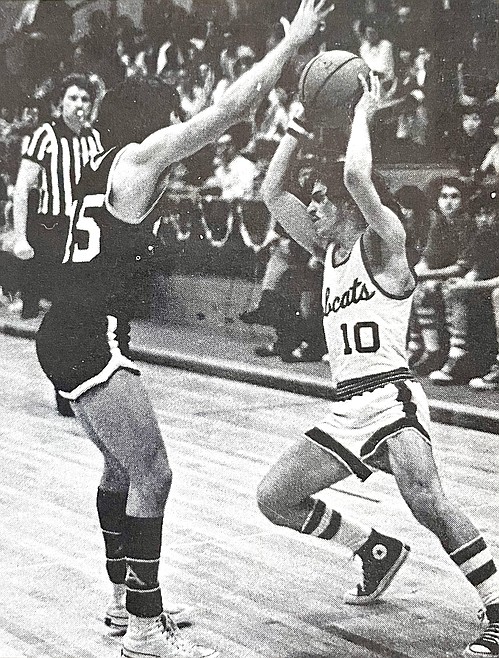
Columnist Bruce Moats against Alberton's Dave Rankin.
Dixon’s sharp-shooter had the unfortunate habit of turning toward the basket and taking a step when he launched his shot.
A pesky, short guard from Superior kept positioning himself at the end of that step, drawing five charges and sending him to the bench. That pesky guard was me.
The charge call was obvious in the case above, but often it is the hardest call for a basketball official to make. A fine line exists between whether the defender was set before the offensive player made his move. The Montana Officials Association is actively trying to help officials make that fine distinction, as well as pursuing consistency in refereeing across the state.
Even in junior varsity and freshmen games, let alone varsity, “people expect that consistency,” said Brian Michelotti, executive director of the Montana High School Athletics Association. The association oversees the Montana Officials Association. “Not all referees are equal.
Some are better than others, just like players. We just try to help them be the best they can be.”
A person must pass a rules examination to become an official. Montana officials have three levels -- apprentice, certified and master. An official must serve a minimum of two years at each level before requesting an upgrade to the next level. Apprentices must have a 60 percent pass rate on the rules exam, certified -- 80 percent, and master -- 85 percent.
Veteran official Rob Tesch saw that once an official reached the masters level, there was nothing more to be done. He saw the need for continuing education aimed at greater consistency across the state.
Michelotti said Tesch is the rules interpreter in the state for basketball.
“He has forgotten more basketball than I would ever know.”
“I believe officiating is probably the only profession where there's not any continuing education required,” Tesch said, as quoted by MontanaSports.com. in 2021. “Once you become a master official, you don't have to do anything else. So I think with the evolution of the dribble drive, the outside game, 3-pointers, we need to revamp our guidelines and what we need to do as officials to get better looks at plays.”
Players are allowed to place their hands on the sides of the ball, while we were restricted to the top of the ball. The ability to push the ball makes the dribble drive more effective. But it has led to more physical play by defenders, making the game harder to call.
Montana officials must attend up to six study clubs a year, depending on the sport. The officials do a variety of things in the study clubs.
They schedule games for the next couple weeks. While rule changes are discussed, the focus is on mechanics, and rule interpretations. Most importantly, the officials “watch a lot of film on themselves.”
As an example of a critic of his or her mechanics that an official might hear: “If you would have moved just a little this way, you would have had a little better view of that play,” Michelotti related.
In Correct Call Camps, the officials will referee high school players participating in off-season camps. The officials critique their performances in unofficial games through classroom instruction and on-the-court evaluations by experienced officials.
I was glad to hear these critiques as my experience teaches that the mistakes made by officials tend to be of the same kind. Film study can benefit them just as it does players. I recently heard one color announcer say officials “must find a balance” in the physicality in today’s game. Officials find that balance differently, sometimes even within a game, making consistency even more difficult to achieve.
Refereeing of post defense is a trouble spot, particularly with college ball. A 1918 memo from the head of NCAA officiating scolded his charges for waiting four, five or six bumps before making a call. He offered sound advice – if the offensive player dislodges the defender then it is an offensive foul. If the defender dislodges the offensive player, then that player should go to the free throw line. It seems his memo may have been lost in the mail.
Finding enough folks to officiate is more a matter of retention than of recruiting. The commitment is great and can be difficult for officials, especially those with kids. Games now require three officials as opposed to the two in my playing days. Now that girls basketball switched from the fall to the winter, and play along with the boys, games start in the middle of the afternoon and end eight, nine hours later. That doesn’t count travel time. Fan behavior certainly hasn’t helped.
When the MHSA saw the fees were trailing other states, it enacted a six-year plan. Every other year, the fees were raised by five dollars until reaching the current level of $80 a varsity game, and $55 for lower level games. This gave schools time to adjust their budgets. The officials also receive mileage. “We encourage them to travel together when they can to save schools money.”
Full disclosure – I might not have always been on my best behavior when critiquing a particular call. I grew up as a member of the infamous “zoo” fans at the University of Montana back in the 1970s. We cherished the opportunity to encourage the referees to “keep it fair” with our loud disagreement. A little accountability is good for anyone.We were once given a technical before the game with Idaho State. We had thrown potatoes on the floor just before the start of the last game with the Bengals. The conference warned if we did it again, we would be assessed a technical. So, some decided to throw out boxes of instant mashed potatoes. I recall we got the tech anyway.
(Pardon the interruption: When the university moved the students from one side of the court and banished them to under a basket, it took away much of the spirit, and advantage, the Griz fans and players enjoyed then.)
My refereeing experience is limited to town team basketball. I will always remember calling a foul on a former high school player I had covered in my journalism career, and his angry reaction. I was surprised because I thought his foul was obvious to the entire gym.
The thought of that experience creeps to mind when I return to my seat after sharing my opinion of a call.