
IDFG brings fishers home to North Idaho
CAROLINE LOBSINGER | Hagadone News Network | UPDATED 6 months, 3 weeks AGO
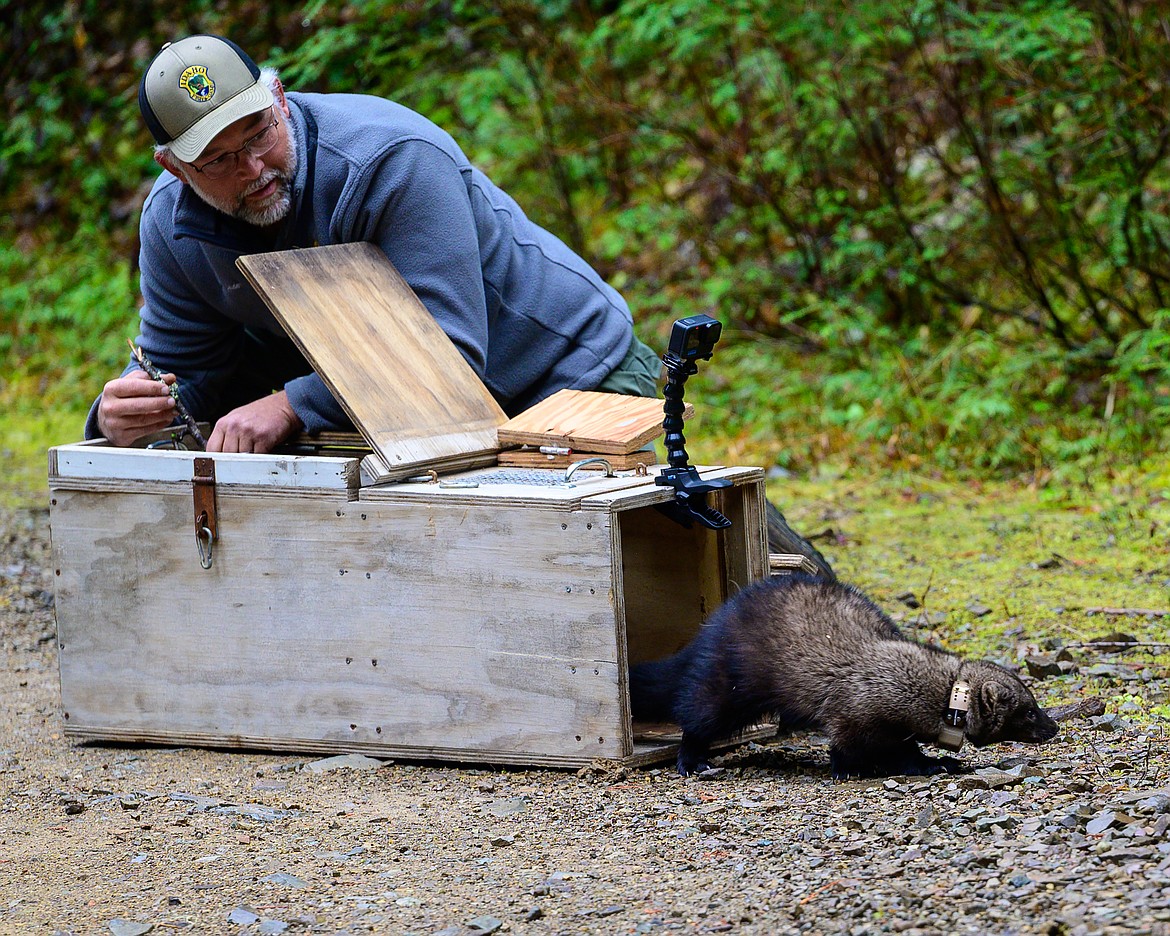
Idaho Department of Fish & Game regional biologist Joel Sauder releases a fisher into its new home in the Unit 4 area of the Coeur d'Alene Mountains recently.
Photo courtesy IDAHO DEPARTMENT OF FISH & GAME
I grew up in the Tri-Cities, Wash., and have always loved to write. I attended the University of Washington, where I earned a double major in journalism and political science, with an area of emphasis in history. I am the fifth out of six kids — don't believe any of the stories that my siblings tell. To be able to tell others stories and take photos for a living is a dream come true — and I considered myself blessed to be a community journalist. When I am not working, I enjoy spending time with family and friends, hiking and spending time outdoors, genealogy, reading, and watching the UW Huskies and the Seattle Seahawks. I am a servant to my cat, Frankie, who yes, will eat anything and everything in sight … even wedding cookies. | April 4, 2026 1:00 AM
The first phase of the Idaho Department of Fish and Game’s fisher restoration project is complete. The project aims to restore the long-bodied mammals to their native habitat throughout Idaho.
“They used to be widespread across the state, and historically, for a variety of reasons, they were extirpated from different parts of the state,” IDFG regional biologist Joel Sauder said in a video released as part of a press release about the project.
In North Idaho, a total of 11 fishers were released into Unit 4 of the Coeur d’Alene Mountains, including seven males and four females. Fish and Game, along with partners, plans to continue the project for one to two more years, with the goal of moving up to 30 fishers.
Mid-level predators, fishers help regulate prey populations such as snowshoe hares and squirrels, among others. With the reintroduction, Fish and Game officials said they’re hoping to create a new population of fishers, reinforcing biodiversity and helping regulate prey populations in the state’s forests.
The Coeur d’Alene Mountains in the Panhandle contain good fisher habitat, but the area currently supports only a very small and isolated number of animals, Fish and Game officials said. The department recently initiated the project to increase the local fisher population and improve connectivity between fisher populations in the Cabinet Mountains to the north and the St. Joe, Clearwater, Nez Perce fisher population to the south.
The project will also gather information on movements and sites used for resting and denning, Fish and Game officials said. This information will be used to develop forest management strategies to benefit fishers and other wildlife. Fishers rely on mature forested habitats, requiring large trees and snags for resting and denning.
After their capture, the fishers were taken to a temporary holding facility, where they were housed, fed and monitored to minimize stress. Before being released, animals were anesthetized, processed for biological samples and then fitted with satellite GPS collars to track their movements and habitat use.
The fishers were then woken from the anesthesia, loaded into boxes, taken to their new habitats and released.
“To watch them come out of the cages and just be wild and just immediately take to the habitat was exciting,” Dave Bobbitt, a Fish and Game commissioner, said. “And to be part of something that perpetuates wildlife for future generations.”
The project has been a collaborative effort with other groups, such as the Idaho Trappers Association, which began live-trapping for fishers in early November and continued through mid-December. Participating trappers were reimbursed through an Idaho Fish and Game Commission Community Challenge Grant. In addition, trappers were also reimbursed by the Upper Snake River Trappers, the National Trappers Foundation and the Montana Trappers Association.
“This project is a great example of proactive wildlife conservation, spanning multiple partners,” Sauder said. “This is probably the preeminent project that I’ve been involved with in my 20-year career.”
The project aims to ensure healthy fisher populations for future generations, Fish and Game officials said.
“So with this reintroduction, we’re hoping to create a new population here. We hope it’s going to work. We believe the habitat’s right here. We believe there’s prey here, but they’ve got to get out there and survive on their own,” Sauder said. “My hope for this project in the future is this makes their populations more healthy and robust. Just knowing that these secretive creatures are roaming out there doing their thing gives me hope and happiness living in Idaho.”
ARTICLES BY CAROLINE LOBSINGER

Wellness fair puts focus on health
The Wellness & Connection Fair is bringing together local health and wellness professionals together in Sandpoint for a day of presentations, activities and community resources.

BCSD pays share of ISBT shortfall
District opts to make lump sum payment
Boundary County School District paid $217,000 to cover its share of the Idaho School Benefit Trust's $13 million shortfall.

Deadline extended for 'Valor' stories
The Valor publication is gathering photos, military service details and personal stories from Boundary County veterans and military families. Featured profiles highlight local service members' contributions, achievements and sacrifices across generations.