
Eureka! Flathead Valley students have their moment at state science fair
HILARY MATHESON | Hagadone News Network | UPDATED 4 hours, 40 minutes AGO
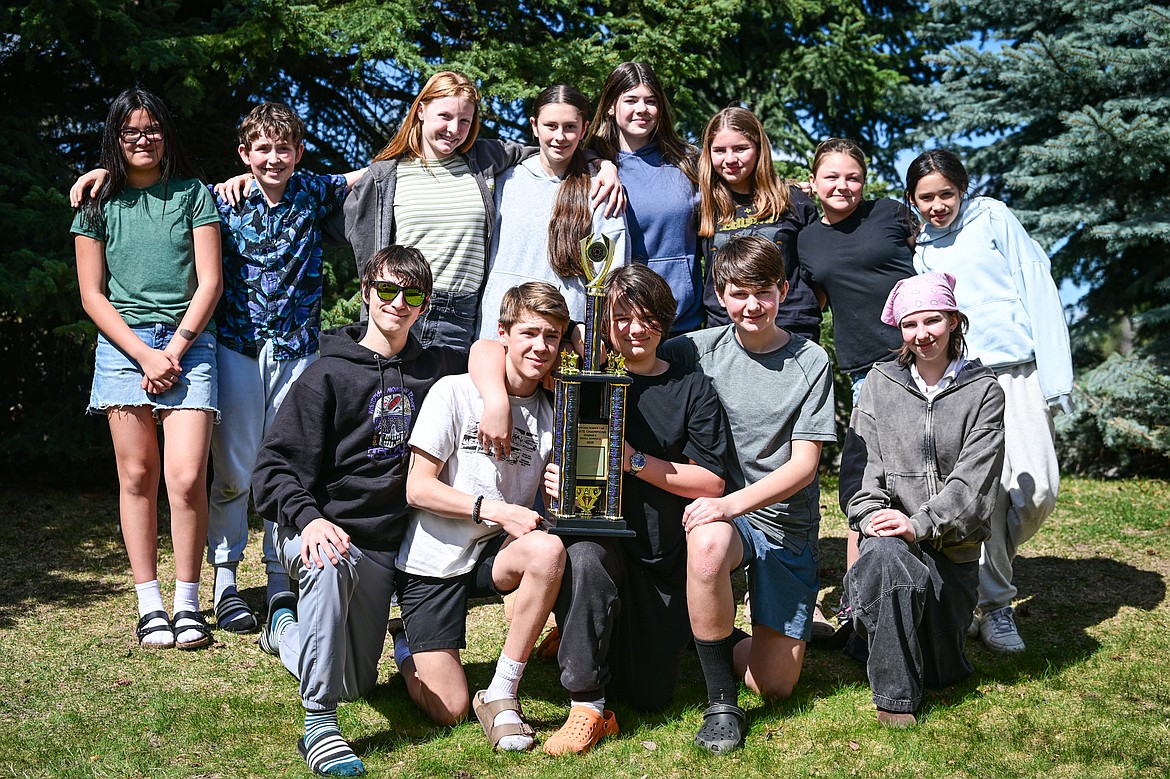
Kalispell Montessori students won first place for their outstanding performance as a small school competing in Division II at the Montana Science Fair held March 30 at the University of Montana. (Daily Inter Lake)
Casey Kreider
EDUCATION REPORTER Hilary Matheson covers education for the Daily Inter Lake. Her reporting focuses on schools, students, and the policies that shape public education across Northwest Montana. Matheson regularly reports on school boards, district decisions and issues affecting teachers and families. Her work examines how funding, enrollment and state policy influence local school systems. She helps readers understand how education decisions affect students and communities throughout the region. IMPACT: Hilary’s work provides transparency and insight into the schools that serve thousands of local families. | April 10, 2026 12:00 AM
Flathead Valley students displayed their fortitude for the scientific method at the Montana Science Fair with Kalispell Montessori School bringing home the first-place Division II trophy for its outstanding performance among the small middle schools competing.
Kalispell Montessori received the award based on the number of middle school students competing and the number of gold ribbons awarded. This year, 14 students chose to compete at the state science fair — the most to date for the private school, according to teachers David Cummings and Bethany Boland. Cummings thinks last year was the first time students competed at the state level.
“I think probably the fact that we had a number of kids go last year, who had a great experience ... encouraged a lot of people who did well at county this year, to say I want to continue on with state,” he said.
The March 30 competition, held at the University of Montana, featured 274 physical and biological science projects designed and researched by 326 high school and middle school students from around the state. There are no requirements to compete at state, but students who compete, typically do well at their respective county level science fairs, with Kalispell Montessori students describing the projects and the judges, many of whom were industry professionals or professors, as top notch.
More than 200 volunteer judges evaluated each project, awarding gold, silver and bronze ribbons. The top three placements were also named at each grade level in the physical and biological categories. Some students also received special awards, scholarships and monetary prizes.
LOCAL WINNERS included Aubrey How of Trinity Lutheran School, who received the Peterson Grand Award for placing first among the seventh-grade biological science projects. Her project, Fungi Fighting Plastic, also earned the University of Montana Department of Environmental Studies Award for Division II (middle school) and the Robbie Flynn Mycology Award.
Russell Preble of Smith Valley School also received a Peterson Grand Award for placing first in the sixth-grade physical science category. In sixth grade biological science, Sam Bell of Columbia Falls Jr. High placed second. In sixth-grade physical science, Kalispell Montessori’s Teegan Huber and Camden Prince placed third.
All students mentioned also received gold ribbons.
During an April 7 interview with some of the Kalispell Montessori competitors, the students said they were faced with six judges who asked more technical questions about their research. The students agreed that the feedback they received at the county level helped them to finesse their presentations whether it was adding visuals to project boards or honing their public speaking skills.
Doing a science project and research paper is a requirement at Kalispell Montessori, unleashing their curiosity and testing their ideas through the scientific method.
The Montessori students covered a variety of topics in their research projects. One group built a thermoelectric generator; another tested water filtration systems (UV-based purifiers performed the best, according to project partners Ezra Mejia and Tessa Nichols-Pagel) while other students researched topics such as greenhouse gases and circuits.
Huber and Prince, who researched the thermal effect of light color, hypothesized that red light would radiate the most heat, which was confirmed by their experiment, Prince said. Huber said they went into the project knowing that all lights don’t radiate heat the same.
“And we wanted to dig deeper into which colors and like why it happens,” Huber said.
“We knew that, like, a lot of people use red light, but we wanted to see if it actually was the best one to radiate heat. And we tested red, blue, green and white,” she added.
Conducting repeatable experiments is a crucial part of the scientific method.
“The idea is that someone could go and follow your procedure and repeat your results,” Kalispell Montessori student Dino Ferrazzano said. “So, say someone needs to use whatever you’re doing in the real world, they could look at your procedure and your materials and replicate results, or at least replicate the results in a less than 1% margin.”
For his research project, Mycoremediation, Ferrazzano explored how mushrooms can be used to break down pollutants such as oil or methylene blue dye, by releasing an enzyme called laccase.
“It [laccase] breaks down the aromatic rings in lignin molecules,” he said, explaining that lingnin is found in the cell walls of wood. "And aromatic rings are in other pollutants, like textile dyes and motor oil,” Ferrazzano said.
“I tested it with methylene blue dye, and at 50 parts per million concentration of methylene blue dye, it broke down,” he noted.
Ferrazzano was succinct in his response to why he enjoys competing in science fairs.
“I think it’s fun to win,” he said.
Huber agreed, adding that it’s a joy to compete with peers with similar interests and enthusiasm for science.
“I also think it’s fun what you get to learn, but, yeah, winning is also quite valuable to me,” she said with a smile.
Following are local results:
Sixth grade biological science
Second place
Sam Bell, Dinner to Dirt to Dinner, Columbia Falls Jr. High, gold ribbon
Silver ribbons
Ella Kozik, To Wash or Not to Wash, Trinity Lutheran School
Selah Schwartz, Funky Fungus, Trinity Lutheran School
Lulu Wickline, From Thrill to Chill, Trinity Lutheran School
Bronze ribbons
Benjamin Hebert, Ballin' with Science, Smith Valley School
Gabriel Hunt, Moldy Massacre, Smith Valley School
Aivee Kiewatt, Thermal Effect of Light Color, Kalispell Montessori
Sixth grade physical science
First place
Russell Preble, Popcorn Problem, Smith Valley School, Peterson Grand Award, gold ribbon.
Third place
Teegan Huber and Camden Prince, Thermal Effect of Light Color, Kalispell Montessori, gold ribbon
Gold ribbons
Kory Bauer, Rip or Resist, Trinity Lutheran School
Lena Bauer, Mama Mia Spaghetti, Trinity Lutheran School
Silver ribbons
Cullen Bauer, That's So Cool, Trinity Lutheran School
Nora Rasmussen, What Material Absorbs the Most Spilled Liquid, Trinity Lutheran School
Epic Wright, Fizzy Facts, Smith Valley School, Silver Ribbon
Seventh grade biological science
First place
Aubrey How Fungi Fighting Plastic, Trinity Lutheran School, Peterson Grand Award, gold ribbon, University of Montana Department of Environmental Studies Award, Robbie Flynn Mycology Award.
Gold ribbons
Dino Ferrazzano, Mycoremediation, Kalispell Montessori
Sidney Heidecker, The Power of Chocolate, Smith Valley School
Silver ribbons
Ethan Burns, The Doughy Dilema, Trinity Lutheran School
Seventh grade physical science
Gold ribbons
Levi Boedeker and Henry Lemire, From Candles to Volts, Kalispell Montessori School
Aiden Ofstad, Gasses Under Glass, Kalispell Montessori, Gold Ribbon
Silver ribbons
Mabel Adams, Dirty to Clean in Seconds, Helena Flats School
Caius Bochman, Contest of the Sport Drinks, Trinity Lutheran School
Reed Brady, Deflategate, Smith Valley School
Steele Gislason, Bear-y Big Science with Osmosis, Smith Valley School
Lane McLean, Soda Vs. Powder: The Rise and Fall of a Cookie, Helena Flats School
Sloane Sapot, Short Circuit, Kalispell Montessori School
Eighth grade biological science
Silver ribbons
Jonathan Hunt and Keith Scrima, The Milk Myth, Smith Valley School
Londyn Hutcherson, Mind in Melody: How Music Affects Memory, Somers Middle School
Eighth grade physical science
Gold ribbons
Ingrid Aiken and Aurora Wyrick, The Stroop Effect, Kalispell Montessori
Ezra Mejia and Tessa Nichols-Pagel, Filter Fanatic, Kalispell Montessori
Silver ribbons
Sally Eichner and Stella Harris, H2O-NO, St. Matthew's Catholic School
Charles Hagemeier, Bust that Rust, Trinity Lutheran School
Daniel Hebert, Ballistic Barn, Smith Valley School
Tristan Robbins, Double Trouble, St. Matthew's Catholic School
Bronze ribbons
Nolan Sutton, Foul Shot, Smith Valley School
High school medicine and health sciences
Silver ribbons
Katrina Bochman, The Effect of Processed Food on Mealworm Mass, Length and Development, Flathead High School
Reporter Hilary Matheson can be reached at 406-758-4431 or [email protected]. If you value local journalism, pledge your support at dailyinterlake.com/support.
ARTICLES BY HILARY MATHESON
Eureka! Flathead Valley students have their moment at state science fair
Flathead Valley students displayed their fortitude for the scientific method at the Montana Science Fair with Kalispell Montessori School bringing home the first-place Division II trophy for its outstanding performance among small middle schools.

Cayuse Prairie hires new administrator
Christy Bortz is set to take the reins as Cayuse Prairie School’s new superintendent and principal July 1.
Flathead grad waits for new heart after life-changing diagnosis
Going into finals week, Flathead High School student Katelyn Baughman was ready to graduate early and excited to plan for college. In one night, her life and her family’s lives were upended.