
Snowpack hits record-low levels across Montana
AMANDA EGGERT Montana Free Press | Whitefish Pilot | UPDATED 3 hours, 42 minutes AGO
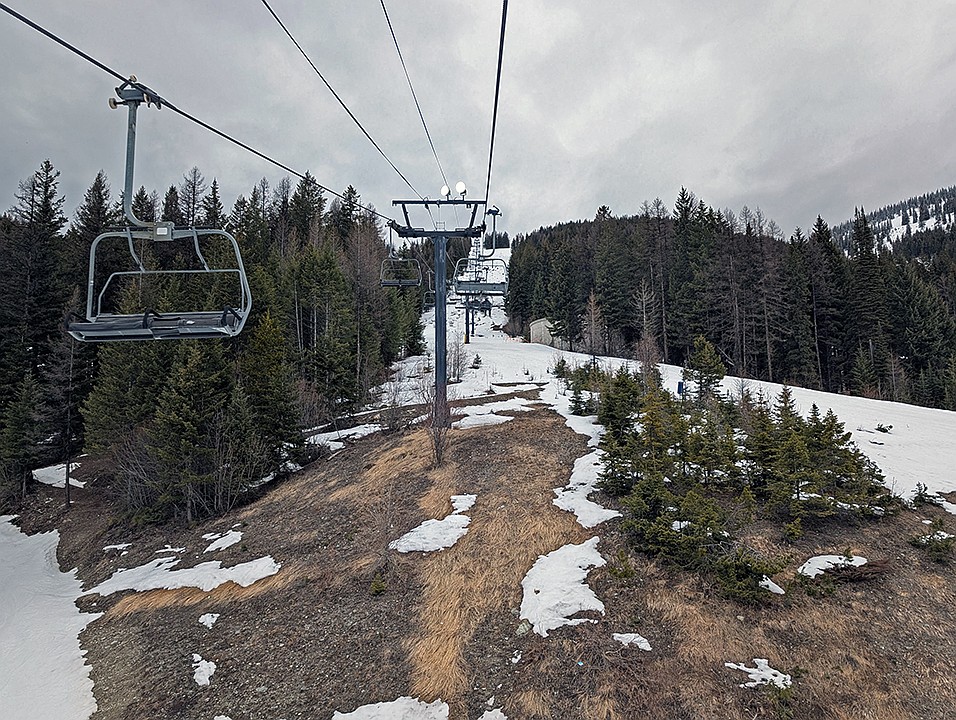
Below Chair 2 at Whitefish Mountain Resort on Friday, March 6. (Kelsey Evans/Whitefish Pilot)
As of early April, when snowpack-monitoring stations in Montana are typically peaking, one-third of the longer-standing sites are posting record-low totals.
That’s according to the April Water Supply Outlook the Natural Resources Conservation Service released on Tuesday, which highlighted that some low-elevation snowpack monitoring sites had completely melted out by April 1, when they’re normally hitting their peak for the water year. (The “water year,” as hydrologists call it, begins on October 1. Water supply forecasters use it to understand the relationship between wintertime snow accumulation and anticipated spring runoff.)
The upshot of the bleak state of Montana’s snowpack is that Montana’s rivers and reservoirs are currently facing a dismal summer. The link between water supply and this summer’s fire-season forecast is more difficult to predict: Experts say the fate of the Treasure State rides on precipitation over the next few months.
In an April 8 conversation with Montana Free Press, NRCS water supply specialist Eric Larson emphasized how little snow many basins are holding, despite decent precipitation in March. Above-average temperatures in the state, and across the West more generally, are largely to blame for suboptimal snowpack conditions.
If temperatures don’t reach that critical 32-degree F threshold, precipitation falls as rain, which doesn’t sustain rivers and reservoirs the same way gradually melting snow does. Snowpack loss is accelerated if temperatures stay above freezing through the night, which has happened multiple times this winter, even at high elevations.
According to the NRCS report, 84 of the 250 monitoring stations that have at least 20 years of data are sitting at record-low levels. Another 22 are reporting their second-lowest year on record. Basins in particularly poor shape include the Jefferson, Gallatin, Bighorn, Powder and Tongue River.
The red dots indicate snowpack monitoring sites that were reporting record-low levels of snow-water equivalent for late March. The orange dots indicate sites with the second-lowest snow-water equivalent for the period of record. Credit: NRCS
Larson said warm temperatures, combined with precipitation inconsistency and variations in snowpack based on elevation, have made for a “unique year.” The widespread warm temperatures help explain why it’s felt like such a dry winter, he says, even as many regions received more precipitation through the winter than they typically do.
“At my local ski hill, Bridger Bowl, it was raining at the top of the ridge throughout parts of the winter when it should have been snowing,” Larson said, adding that many basins vacillated between adding snowpack when storms came through only to lose much of it when a warm spell arrived.
This winter’s warm temperatures were widespread and record-setting. Virtually the whole state experienced above-average temperatures, according to Nick Vertz, warning coordination meteorologist with the National Weather Service. Over the past 120-day period, most locations were between 6 and 11 degrees warmer than average, he said.
Temperatures were well above normal this winter across Montana and the West more generally. Credit: Courtesy High Plains Regional Climate Center
Livingston, for example, is experiencing its warmest-ever year to date with records dating back to 1948. Billings, which has a database stretching back to 1934, is looking at its second-warmest period during the same timeframe, from Jan. 1 to April 9.
Monitoring sites that are relatively close to one another as the crow flies are reporting vastly different snowpack totals. The highest-elevation sites still have snow while the lower ones have none. Between precipitation falling as rain and warmer temperatures melting the snow that did accumulate, there is little or no snow remaining at many mid- and lower-elevation snowpack-monitoring sites.
In the Boulder drainage of south-central Montana, for example, one site at 8,700 feet was sitting squarely at its typical April 1 snowpack while another one at 6,700 feet was at just 7%.
Nearly all of the state’s snowpack-monitoring sites have likely hit their peak for the year, according to Larson. That’s true even for some of the highest-elevation sites that normally continue to accumulate snow into early May.
“Everything peaked several weeks to a month early this year,” he said. “That doesn’t mean that we’re not going to have additional accumulation, which will help [but] most basins have peaked. Typically that’s occurring more in mid-April.”
Vertz says having so little snow across the valleys and mid-elevations means that soils are warmer and thirstier. Montanans should expect vegetation to mature earlier, he said. “My grass here in Billings is fully green and lush already. I’m debating if I have to mow this weekend.”
Springtime precipitation will play an important role in the type of wildfire season we’re faced with this summer, Vertz added. “Even just a normal precipitation period over the next couple of months can alleviate so much of that concern going into the summer — or even just having a wet summer can help that a ton. So while it’s not looking great, a lot can still happen to prevent a huge wildfire year.”
Larson echoed that point. “There have been years in the past — similarly low-snow years — in which spring and summer precipitation did balance things out a little bit,” he said. That’s particularly true east of the Continental Divide, which tends to receive a decent amount of precipitation in April, May and June.
For streamflows, however, the forecast is bleak. Even with a wet spring, basins that don’t have high-elevation snow to sustain them will almost certainly face meager streamflows. “It just depends on how far below average it’s going to be in the later part of the summer,” Larson said.
Dam managers are bracing for difficult conditions ahead. In an April 8 press release, NorthWestern Energy said it’s preparing for a “challenging year” for Hebgen Reservoir, which flows into the Madison River and plays an important role in its Missouri-Madison Hydroelectric Project.
“Our focus remains on operating responsibly to conserve water in the early season so we are able to provide river flows and reduce stress on fish during periods when water temperatures are highest,” said Andy Welch, who helps NorthWestern stay in compliance with its federally-administered license.
Vertz noted that we are expected to “fully enter” an El Niño pattern in June, with a potential “Super El Niño” developing later this year.
We typically consider El Niño and La Niña patterns through the lens of wintertime temperature and precipitation trends, but these larger, global patterns can shape summer conditions, too.
“For Montana summers, if we have an El Niño ongoing through the summer, there actually is a slight correlation to have it be a wetter and cooler summer,” Vertz said. “It’s a [sliver] of hope. A small one, but we’ll take what we can get right now.”