
Poor snowpack could impact 'every Idahoan'
BILL BULEY | Hagadone News Network | UPDATED 9 hours, 9 minutes AGO
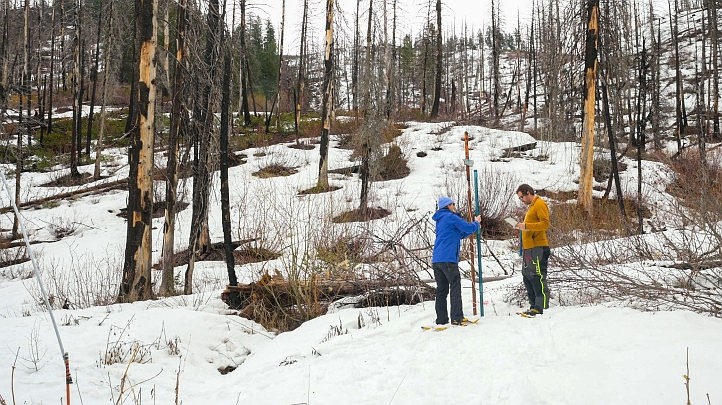
Hydrologists Erin Whorton and Dave Eiriksson measuring a record low snowpack on March 31 at Mores Creek Summit with exposed vegetation and bare ground visible on all surrounding hillsides.
Photo courtesy of Kirsten Strough
Bill Buley covers the city of Coeur d'Alene for the Coeur d’Alene Press. He has worked here since January 2020, after spending seven years on Kauai as editor-in-chief of The Garden Island newspaper. He enjoys running. | April 11, 2026 1:07 AM
The summer outlook for Idaho’s water supply isn’t good.
According to the Natural Resources Conservation Service’s April report, Idaho’s snowpack peaked nearly three weeks early on March 17 at 68% of normal. It said this year’s snowpack is one of the lowest on record since snowpack measurements began in the 1930s.
The snowpack is rapidly melting even at the highest elevations, 10,000 feet, due to the record-setting heat wave in mid-March. By April 1, 25% of the snowpack had already melted away statewide.
“This spring and summer, every Idahoan will likely feel the impacts of this year’s historically poor snowpack,” the report said. “The consequences of a below normal snowpack, early melt onset, and rapid melt out will be most apparent to anyone who spends time in our state’s many creeks, rivers, lakes and reservoirs.”
All of Idaho is considered to be either abnormally dry or in some level of drought as of April 1, according to the U.S. Drought Monitor.
If warm spring conditions continue, many rivers will likely peak and then recede much earlier than normal, according to the report. Without an ample, high-elevation snowpack to sustain streamflow in the spring and early summer, low streamflow conditions will be observed across Idaho and the Western U.S.
Record lows
The report said new records were set this year at sites throughout Idaho for lowest April 1 snowpack conditions: how early the snowpack peaked; how much melt occurred in the second half of March and how early some sites melted out completely.
“Early peak streamflow and a quicker drop off of natural flow will pose significant water supply challenges for irrigators unless ample spring precipitation boosts streamflow,” the report said. “Unfortunately, that’s unlikely to occur since drier and warmer than normal spring conditions are predicted this year.”
According to the NRCS, “The winter that never arrived" will likely be talked about for years to come. Record low (or tied for lowest) snowpack conditions April 1 were measured at 64% of the 1,570 snow measurement sites across the Western United States.
Snow drought, defined as conditions below the 20th percentile, was recorded at 80% of the sites. It’s “very likely” that this is the lowest recorded snowpack on April 1 since NRCS began measurements in the early 1930s.
Why are snowpack conditions across the West so bleak?
Simply put, it was too warm to snow or keep the snow that fell. This may have been the warmest winter since 1895 (1934 held the previous record). All five of the snowpack building months (November to March) were significantly warmer than normal.
Warm weather between snowstorms melted off the snow that fell in the lower and mid-elevation mountains (7,500 feet). This kept the snowpack from growing thick enough to withstand periods of warm weather without melting. Thinner snowpacks are easier to melt than thicker snowpacks because they heat up more quickly.
A record-breaking, mid-March heat wave sent temperatures soaring above 80 degrees in Idaho. This 11-day heat dome warmed the thin snowpack up enough that even the snowpack at high elevation SNOTEL stations began to melt.
After the heat wave, not enough snow fell to counter the widespread melting that occurred during that period and in the second heat wave at the end of March.
"These very warm conditions during March led the snowpack to peaking several weeks earlier than normal in Idaho and across the West,” the report said.
There were positive signs
The Pend Oreille-Kootenai Basin received 100% of normal precipitation in March and thanks to a mid-March storm, the Coeur d’Alene-St. Joe Basin received 145% of normal precipitation.
This mid-March storm was cold enough to bring mostly snow to the Coeur d’Alene-St. Joe Basin and provided a boost to this year’s snowpack, but it was not enough to overcome the deficit.
As of April 1, the snowpack in the Pend Oreille-Kootenai Basin was 56% of normal and only 66% of normal in the Coeur d’Alene-St. Joe Basin.
"Although this was an improvement, the low-elevation snowpack across the region is still well below normal and ranges between 25 to 50% below 4,500 feet," the report said.
As of April 1, the Panhandle basins only reached 70% of their typical median peak snowpack and it’s unlikely that any more significant snow accumulation will occur with the warm, wet spring weather.
“Notably, unlike basins elsewhere in the state, the Panhandle basins haven’t yet seen significant melt this season due to cooler temperatures up north,” the report said.
Reservoir storage in the Panhandle lakes is near to above normal: Coeur d’Alene is 151% of normal (97% full), Pend Oreille is 114% of normal (55% full), and Priest Lake is 156% of normal (84% full).
El Niño in the forecast
Currently, National Oceanic and Atmospheric Administration predicts that El Niño conditions will develop sometime in late summer and persist through the end of December.
In the Pacific Northwest, El Niño periods are often warmer and potentially drier than normal.
“In other words, another warm winter could be in our future," the report said.
ARTICLES BY BILL BULEY
Poor snowpack could impact 'every Idahoan'
Levels of creeks, rivers, lakes and reservoirs expected to be lower
Streamflow forecasts for April through July are 48 to 91% of normal at the 50% exceedance level in the Panhandle basins.

Of all Hawaii's creatures, chickens left a lasting impression
Such is the dislike, bills have been considered in the Hawaii Legislature to allow residents to kill feral chickens. Some do kill them.

George and Katie Sayler have subscribed to The Press for more than 50 years
George and Katie Sayler have subscribed to The Press for more than 50 years
The retired government teacher and former legislator has long been involved in civic and public issues and strongly believes that each citizen is responsible for being informed.