
State biologists seek answers to rut in South Fork elk numbers
HAILEY SMALLEY | Hagadone News Network | UPDATED 6 months AGO
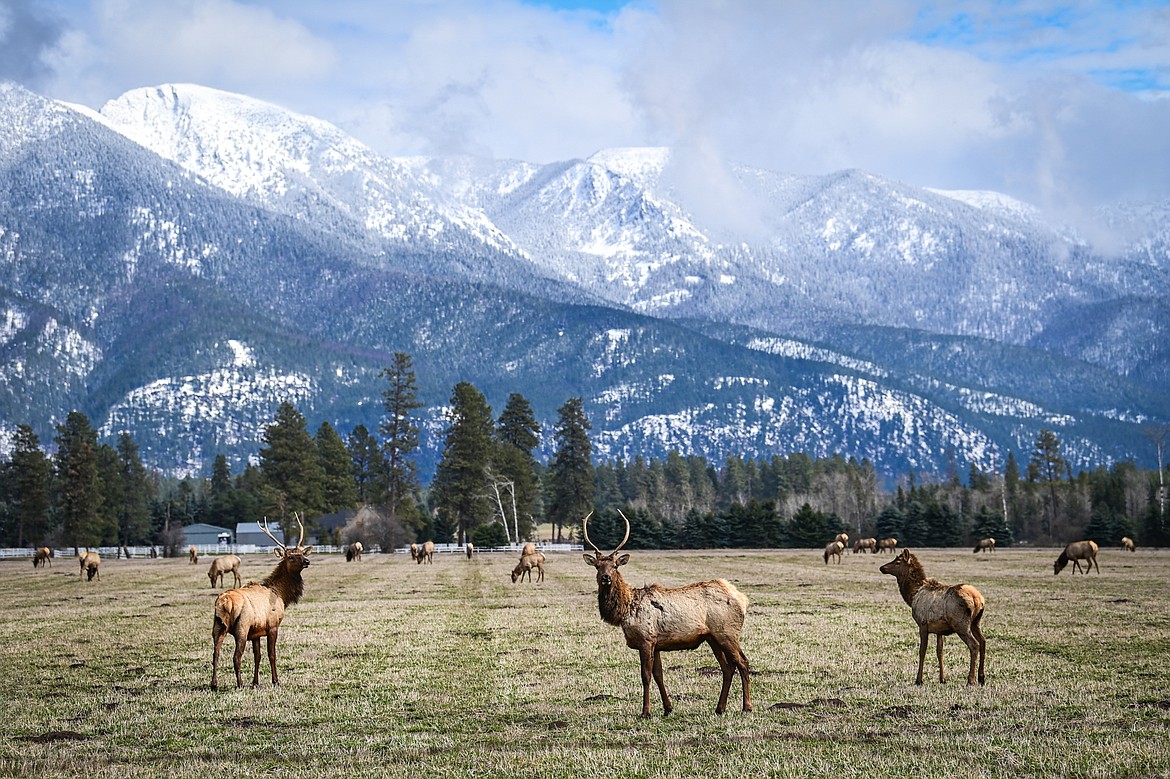
Elk graze in a field along Middle Road on Thursday, April 3. (Casey Kreider/Daily Inter Lake)
Casey Kreider
When Franz Ingelfinger took over as the Kalispell area biologist for Montana Fish, Wildlife and Parks four years ago, he kept hearing the same suggestion from hunters and outfitters: Check out what’s happening in the South Fork Flathead River drainage.
“They took an interest in my schooling and what was going on up there,” Ingelfinger said. “They had lots of concerns about declines in game populations within the South Fork, particularly elk, where our harvest and our game counts were at over a 100-year low."
In 2024, Ingelfinger spearheaded a study to uncover the reasons behind the mysterious decline. His team has trapped and collared 25 elk so far and collected upwards of 60,000 data points on the animals’ movements. While the study is far from over, Ingelfinger shared some of the preliminary insights he has gleaned from the project at the April 14 Wilderness Speaker Series, hosted by the Bob Marshall Wilderness Foundation, Wild Montana, Northwest Montana Lookout Association and Flathead Valley Community College.
Elk populations in the South Fork Flathead River drainage peaked around 1937, when an estimated 3,700 ungulates roamed the valley bottoms. By the 1950s, the population dipped to about 2,200 elk, which researchers have since considered the maximum sustainable capacity. Aerial surveys in recent years have found closer to 300 animals.
Changes in how Montana Fish, Wildlife and Parks conducts elk surveys and estimates populations likely account for some of the difference in elk numbers, but Ingelfinger said environmental shifts are also at play. One major change has come in the way of wildfires; about 30% of the South Fork Flathead River drainage has burned in the past 25 years.
Fires benefit elk by encouraging the growth of grasses and forbs the ungulates munch on, but large burns can also raze the tree cover that elk overwintering in the mountains rely on for shelter.
“Winters are long, snow is deep and one of the biggest characteristics of their time in winter is kind of a subsistence diet and a dependence on canopy cover, tree cover to provide what we call thermal cover and snow intercept,” said Ingelfinger. “Basically, it’s a warmer blanket under the trees, and the snow is not as deep.”
Another major change comes in the way of predator populations, which experienced a boom in the latter part of the 20th century following nationwide policy changes.
“I’m going to share a secret with you. Wolves kill stuff. Lions kill stuff. Bears kill stuff, and we kill stuff,” said Ingelfinger. “As a biologist, I don’t care about the individual. What I’m most interested in is what’s the population effect.”
Not all prey animals are equal, he said. If a wolf kills an old sick elk, for example, there is little effect on the overall population because the animal would have likely died soon anyways.
Not all predators are equal either. Early data from a similar study in the Noxon area suggests that mountain lions are to blame for most elk deaths in the region.
There isn’t enough data about predation in the South Fork Flathead River to know whether the same patterns apply, though Ingelfinger did conclude that one of the 25 elk he collared was killed by a mountain lion. Another collared elk died in April last year, but researchers were unable to determine the cause.
That puts the survival rate of Ingelfinger’s study population at 92%, on par with statewide averages. Pregnancy rates have also matched statewide averages, with 22 of the 23 surviving collared cows testing pregnant. More good news came during an aerial survey Ingelfinger conducted a few weeks ago, when he estimated there were about 27 calves for every 100 cows. Most researchers consider 25:100 the minimum calf-cow ratio for a sustainable elk herd.
Going forward, Ingelfinger said he hopes to collar another five to 10 elk. All the radio collars are programmed to continue sending data points every four hours for 2-3 more years. At that point, the collars will automatically unlatch and fall from the animal’s neck.
Even with all that data, Ingelfinger said a definitive cause for the decline in elk populations would be difficult to pinpoint.
“It’s not going to necessarily get us the answer,” he said. “What it is going to give us is the ability to have an informed discussion as well as informed management.”
Reporter Hailey Smalley can be reached at 406-758-4433 or [email protected]. If you value local journalism, pledge your support at dailyinterlake.com/support.
ARTICLES BY HAILEY SMALLEY

Trump stumps for Flint in Kalispell as Election Day nears
President Donald Trump, wearing a dark suit, red tie and red USA cap, ambled into the Majestic Valley Arena to the raucous roar of a crowd.

Flathead National Forest greenlights Swan Valley timber project
A 2,307-acre timber project is now under way in the Swan Valley.
Flathead National Forest greenlights Swan Valley timber project
A 2,307-acre timber project is now under way in the Swan Valley.