
Biologist reels in 36-year career with tribal fisheries program
HAILEY SMALLEY | Hagadone News Network | UPDATED 6 months AGO
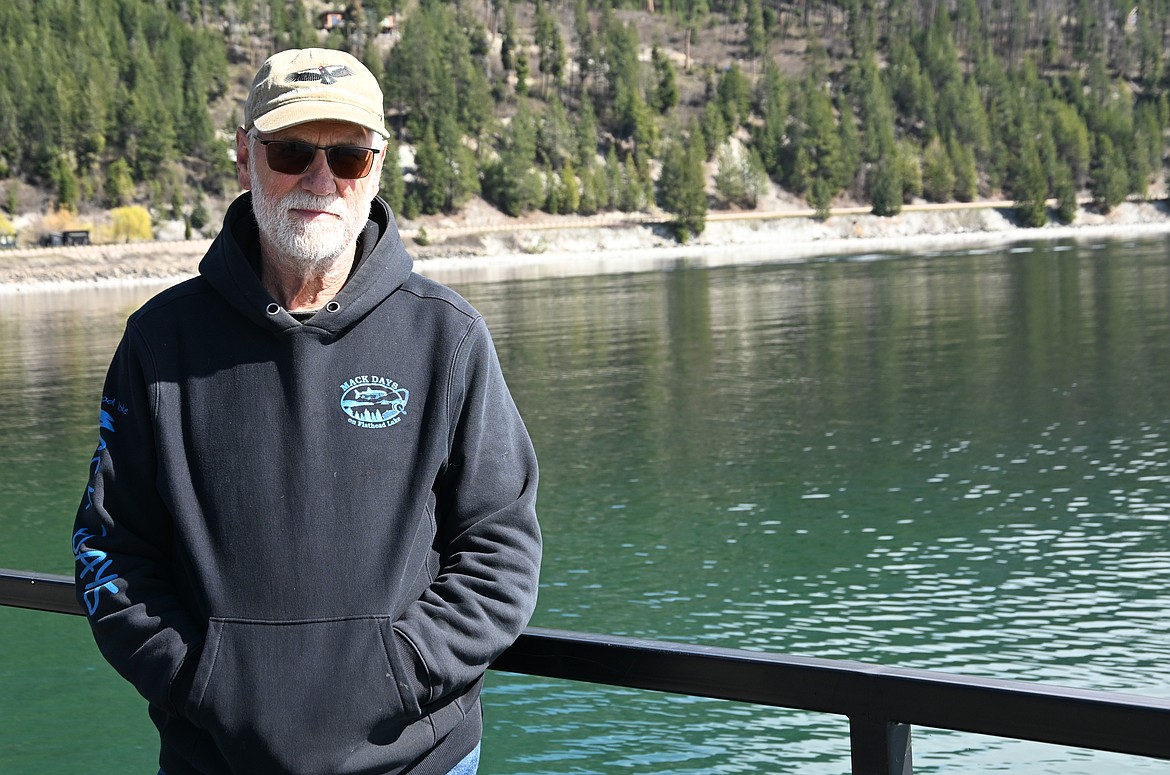
Fisheries biologist Barry Hansen will retire from the Confederated Salish and Kootenai Tribes fisheries program after 36 years. (Hailey Smalley/ Daily Inter Lake)
One hack, and the fish’s head flopped to the side. In the same fluid motion, a gloved hand fed the fish’s silvery body through the mouth of the processing machine. Two perfectly symmetrical fillets fell out the other end.
Fisheries biologist Barry Hansen, 74, watched from a few feet away, arms crossed. He’s seen this same process unfold hundreds of thousands of times, but he can’t keep the pride from his voice as he holds up the finished product a few moments later.
The vacuum-sealed package, emblazoned with a Native Fish Keepers sticker, is more than a choice dinner option. The fillets also represent the Confederated Salish and Kootenai Tribes’ decades-long effort to save Flathead Lake’s native bull trout and westslope cutthroat trout populations in the face of invasive species. Hansen has dedicated most of his career — 36 years — to the cause.
"Many said it’s too big. You can’t do it,” he said, recalling the fisheries program’s early days. “And we said, no, we can do it.”
Hansen is one of three long-time tribal fisheries employees to retire this year. Both he and Cindy Benson, who has overseen Mack Days for more than two decades, are set to retire next month. Les Evarts, the fisheries program manager, retired earlier this year.
Back in 1970, when Hansen first started studying ecology at Tulane University, he had no idea what a bull trout was. He was hardly interested in fish at all, instead turning his sights on the fabled megafauna of eastern Africa.
He spent the intervals between biology classes cruising the docks in New Orleans, in search of a captain who would let him stowaway on a journey across the Atlantic. Nobody took him up on the offer.
“Turns out you haven’t been able to do that sort of thing since the 1800s,” said Hansen, a hint of a smile briefly overturning his usual stoic expression.
He turned instead to the Peace Corps, a government-sponsored volunteer program in which members commit to a 27-month service period in a foreign country. His dreams were once again dashed when the agency assigned him to a rural health clinic in Liberia, on the western coast of Africa, but Hansen quickly overcame his disappointment.
Organizing campaigns to combat common maternal health issues and teaching health classes at a local school proved both interesting and rewarding, and the community was warm and inviting.
Plus, once his service concluded, Hansen was able to use his Peace Corps stipend to travel to the African savannas he had dreamed of for so long. He watched the wildebeest migrate across Serengeti National Park in Tanzania and spent six days scaling Mount Kilimanjaro, the tallest free-standing mountain in the world. Then, it was time to return home.
Back in the United States, Hansen struggled through culture shock as he wavered on what to do, now that his lifelong dream had been accomplished.
A trail crew job took him to Northwest Montana, where he stayed for the next 10 years, working habitat restoration projects with the U.S. Forest Service and Montana Fish, Wildlife and Parks during the summer. When the weather turned cold, he migrated south to Missoula to take classes in the University of Montana’s environmental studies graduate program. His focus gradually sharpened toward fisheries.
“I like the holistic nature of it,” he said. “You have to look at a watershed, and you have to look at all the factors that influence the watershed. It all interacts.”
When Hansen graduated in 1990, he took a job with the Confederated Salish and Kootenai Tribes’ fisheries program. He wasn’t a tribal member, but Hansen said he resonated with the tribes’ valuation of natural resources and native species and their willingness to take on big projects, including what Hansen described as “a lot of environmental upheaval in Flathead Lake.”
Native populations of bull trout and westslope cutthroat trout had all but disappeared from Flathead Lake by the 1980s, while numbers of non-native lake trout boomed. Researchers, including Hansen, eventually tracked the shift to the introduction of mysis shrimp to the watershed a few decades prior. Young lake trout feasted on the shrimp, then grew into adults that directly competed with the native fish.
Hansen said he didn’t see a real choice in the issue; if Flathead Lake’s native fish populations were going to survive, the lake trout population needed to be seriously reduced. He also knew that many sport fishermen enjoyed the chance to land a large lake trout and opposed the complete elimination of the species.
“We set a goal to reduce lake trout, to not eliminate the opportunity, but make room for the native fish,” said Hansen.
The first step was Mack Days, an annual angling competition that incentivizes local fishermen to help cull the lake trout population. To date, participants have removed more than 900,000 lake trout from Flathead Lake. Those efforts were supplemented in 2014 with a gill netting program that Hansen oversaw.
Employees donated their catch of lake trout and whitefish to local food banks before the tribes’ nonprofit corporation, Native Fish Keepers, was established in 2017. Fish processed through the company are now sold to local grocery stores and distributors, helping offset the costs of the gill netting program.
Hansen estimated that sales only cover about a quarter of the total program costs, but the corporation is about more than turning a profit. About 300,000 lake trout have been removed from Flathead Lake through gill netting, and the processing center in Blue Bay employs around a half-dozen people.
And, while native fish populations haven’t exactly rebounded since the efforts began, Hansen said the numbers aren’t dropping either.
“I’m beginning to see that as success, that we’re holding the line,” said Hansen. "So many of these problems are never fixed. They never go away. That’s the reality. If we stop, we lose what we’ve gained and what’s so important: the native species and the health of the ecosystem.”
Reporter Hailey Smalley can be reached at 406-758-4433 or [email protected]. If you value local journalism, pledge your support at dailyinterlake.com/support.
ARTICLES BY HAILEY SMALLEY

Trump stumps for Flint in Kalispell as Election Day nears
President Donald Trump, wearing a dark suit, red tie and red USA cap, ambled into the Majestic Valley Arena to the raucous roar of a crowd.

Flathead National Forest greenlights Swan Valley timber project
A 2,307-acre timber project is now under way in the Swan Valley.
Flathead National Forest greenlights Swan Valley timber project
A 2,307-acre timber project is now under way in the Swan Valley.