
Four candidates for Western District congressman face off in Pablo
KRISTI NIEMEYER | Hagadone News Network | UPDATED 6 months AGO
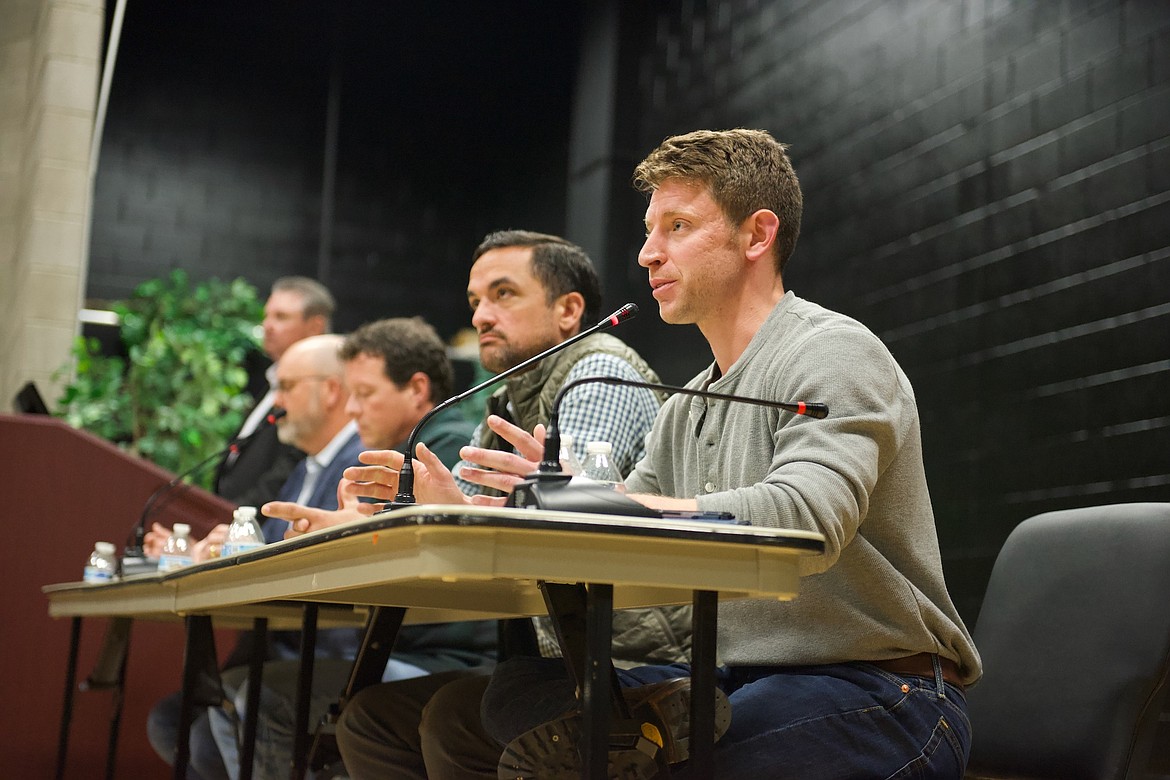
Sam Forstag takes his turn at the microphone during a forum last Thursday in Pablo that also included Democratic candidates for the U.S. House Russ Cleveland, Matt Rains and Ryan Busse. (Kristi Niemeyer/Leader)
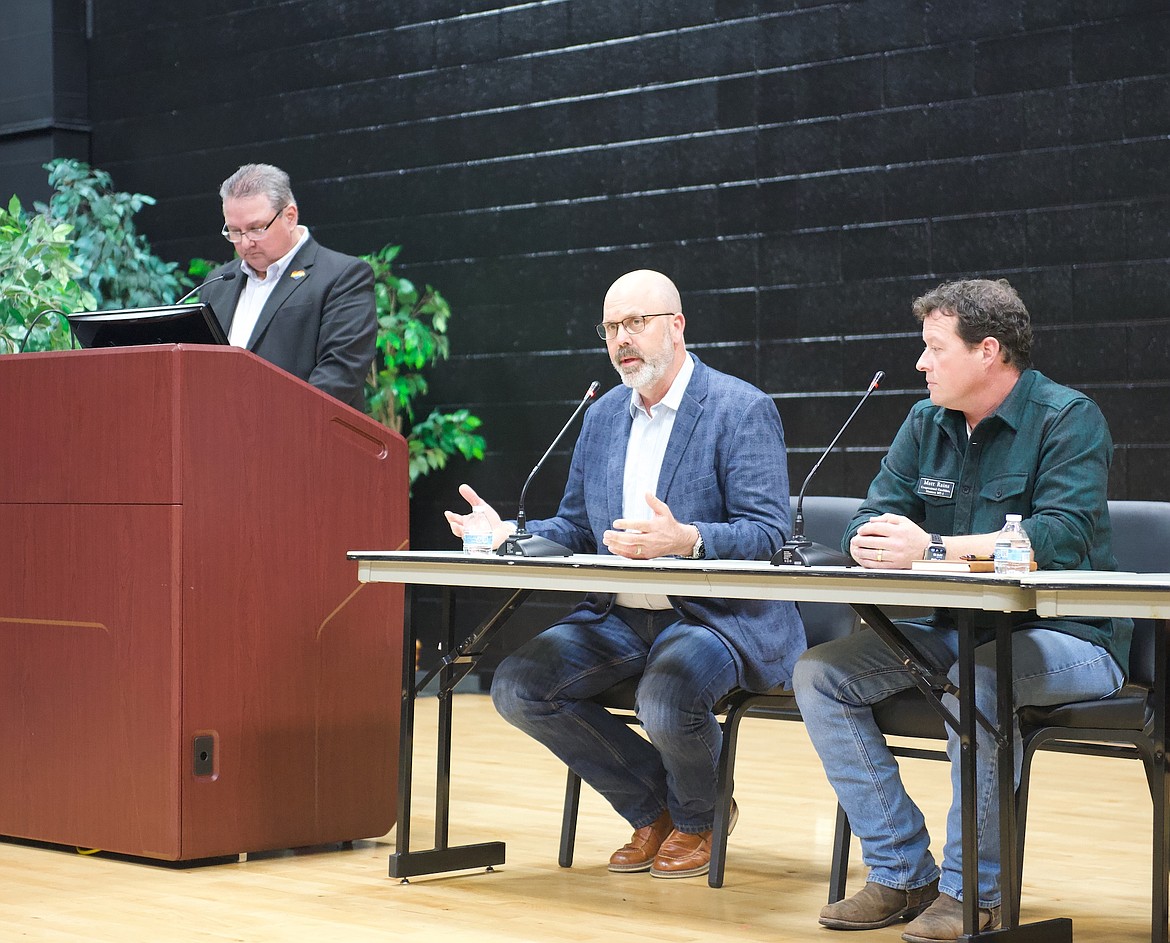
Moderator James Steele Jr. (left) and Matt Rains (right) listen while Ryan Busse answers a question during the candidates forum at Salish Kootenai College last Thursday. All four Democratic candidates for the seat currently held by Rep. Ryan Zinke attended. (Kristi Niemeyer/Leader)
Kristi Niemeyer learned her newspaper licks at weekly newspapers, beginning at the Mission Valley News in 1981, then at the helm of the Ronan Pioneer and, eventually, as co-editor of the Lake County Leader until 1993. She launched and co-published Lively Times, a statewide arts and entertainment monthly, before returning to the Leader in 2022, and serving as its editor until July 2026. Reach her at [email protected] | April 23, 2026 12:00 AM
Four men, each hoping to cinch the Democratic nomination for the Western District congressional seat, faced off at Salish Kootenai College last Thursday evening.
Each tried to convince the crowd of about 130 prospective voters at the Johnny Arlee-Victor Charlo Theatre that their experience and perspectives made them the best person to turn a Republican seat blue – a shade it hasn’t been since Pat Williams retired from office in 1997.
It’s a seat currently held by Ryan Zinke, who announced in March he was retiring from an office he’s held for four terms – most recently winning elections in 2022 and 2024. Zinke, and the Republicans who dominate politics in Montana and nationally, were frequent targets of candidates Ryan Busse, Russ Cleveland, Sam Forstag and Matt Rains.
The forum, hosted by the Lake County Democrats, was moderated by Confederated Salish and Kootenai Tribal Councilman James Steele Jr.
Each candidate sought to differentiate himself from his peers. Busse, having run for governor against Greg Gianforte two years ago, cited his experience running a statewide campaign and name recognition; he also touted his efforts to protect the Badger-Two Medicine from oil and gas drilling, and work with national conservation organizations.
“I'm here tonight because Montana made me a better person,” he said. “I feel like I owe this state something.”
Rains, who lives on a ranch near Simms that’s been in his family for generations, is a West Point graduate and former Black Hawk pilot, power-plant engineer and, most recently, chief of staff at the Montana Farmers Union, also ran for the House in 2020.
"I've got generations and branches of generations of roots deep, deep in this state,” he said. “That really matters for what we send to Congress and what they do there.”
Frostag, the youngest candidate, is a Forest Service smokejumper and union organizer from Missoula – the son of a nurse and a schoolteacher. He believes his age (31) and his experience as the local leader of the National Federation of Federal Employees can help him galvanize young voters who have increasingly deserted the Democratic party, or been disengaged from the political process.
“I am running to finally get us some representation in Washington that knows what it is like to be on the wrong end of all of those broken systems,” he said.
Cleveland, a Navy veteran, grew up on a small farm in the Bitterroot Valley, and now lives on ranch in St. Regis where he raises “cattle and six kids.” He’s the former owner of Rocky Mountain Kids, Colorado’s largest private childcare provider.
Cleveland and his wife lost their eldest daughter to leukemia in 2020, when she was 13. When the Trump administration cut pediatric cancer research from the National Institutes of Health a year ago, “that was my catalyst for deciding to run. We deserve better, all of us.”
They fielded questions on a wide range of issues, from federal-tribal relationships to funding and support for agriculture, proposed data centers in Montana, affordable housing and federal cuts to healthcare. For the most part, there were no major schisms between their policy positions; just subtle differences in how to solve the complex issues facing the nation.
Steele first asked candidates how they would work with the CSKT and Blackfeet Nation on common issues, such as healthcare, housing and economic development. Each candidate was supportive of tribal sovereignty and expressed an eagerness to work with local tribes.
“We are unique. or close to unique in this district. We have not just 16 counties, we have two sovereigns nations,” said Forstag. “So that means not just representing folks who are on the Flathead Reservation or Blackfeet Reservation, but it also means partnering with tribal governments on a government-to-government basis.”
He also spoke about providing resources to counter the Missing and Murdered Indigenous People crisis
and addressing jurisdictional issues that occur “when the federal government fails to follow up on needs,” including housing and access to healthcare.
For Cleveland, “the answer is simple, show up,” he said and asked the audience how many had heard from Rep. Ryan Zinke or Sen. Steve Daines. The crowd chuckled, to which Cleveland replied, “Me either.”
Asked whether the candidates supported abolishing Immigration and Customs Enforcement, or reforming the force, three out of four favored abolishing it, while also acknowledging immigration needs reform that should include a path to citizenship.
“We have to start from top to bottom, by removing the dangers of this mass police force while simultaneously fixing the system that has created it,” Cleveland said.
“ICE is a domestic terror organization,” said Busse. “Responsible law enforcement does not wear a mask, … march into a community and zip tie kids in schools, murder American citizens in their cars or on the street.”
Rains told the crowd he was “on the reform side,” accusing the Trump administration of using ICE “basically as their private military force.” He cited his own military experience, saying ICE officers “need to be properly trained and their numbers “reduced to what it was pre-Trump and let them do their job.”
Food insecurity was another topic, based on the Trump administration’s decision to eliminate the USDA Local Food Procurement Program, which had provided locally sourced food to Montana food banks, tribal communities, and food -insecure families.
Busse said local producers feeding local families “is best for the planet, it's the best for you, it's the least processed food. So why aren't we encouraging that as a government?” He blames agribusiness, corporate farms and meat processors, and politicians on both sides of the aisle for “rigging the system.”
Rains touted his experience with Montana Farmers Union, where he helped set up the the nation's first USDA-approved processing plant owned by local ranchers and farmers.
“We need 50 of these facilities," he said. "This is a real-world solution helping actual Montanans.”
Forstag spoke about how important Food Stamp benefits had been to his family, and decried decision makers “that do not know what it is like to rely on these programs.”
All four roundly criticized the impact on agriculture of Trump-imposed tariffs and the rising costs of fuel and fertilizer spiked by the war in Iran. Cleveland said unless Congress keeps Trump’s power in check “we will become a permanent corporatocracy, where corporations control everything and the people control nothing.”
All four supported major healthcare reform, beginning with repealing legislation that made Medicaid less accessible by imposing work requirements, and adding back the Affordable Care Act subsidies that were reduced or eliminated last year.
For Cleveland, who lost one daughter to cancer and has another struggling with pulmonary capillaritis – an illness requiring medication that costs $10,000 a dose – healthcare is personal. “It’s why I’m in this race.”
“If the U.S. can afford $280 billion for ICE and $1.5 trillion for the Department of War budget, we can pass universal healthcare.”
“It's not a health care system. It's a health insurance profit system,” added Busse.
Forstag advocates “filling up the holes” in Medicare by including vision, dental, hearing and home care, and offering it to all Americans, regardless of age or income.
In response to a question about the lack of affordable housing in Montana, Forstag said it was “what everybody's talking about,” on the campaign trail. He pointed out that the housing crisis that followed World War II was addressed with a significant investment of federal dollars and suggested the same should be happening now.
Instead, he said programs like Community Development Block Grants, community land trusts, and rural self-help loan programs “are being zeroed out” of the federal budget.
Cleveland noted that he and his wife built a seven-plex in St. Regis after discovering that teachers couldn’t afford to live there. His remedies for the housing shortage include paying higher wages, creating incentives for builders to construct affordable housing and banning corporate ownership of residential housing stock.
According to Busse, Montana has become “the most expensive housing state in the country” because legislators “haven't been holding town hall meetings, they haven't been listening, they haven't been representing.”
The four also agreed on the damage of so-called dark money in Montana’s elections and encouraged voters to sign the Montana Plan, a citizen initiative that aims to bypass the impact of the Supreme Court’s decision that defined corporations as persons, and has lead to the cascade of money into elections.
Until the rules change, however, Rains said – unlike his fellow candidates – he is not opposed to accepting corporate dollars. “We need to get dark money out. We need to get corporate money out. We need to stop the insider stock trading,” he said. “We need to do all that stuff. But we have to get elected first.”
Forstag calls data centers, like the 11 that have been proposed for Montana, and the Artificial Intelligence the centers are designed to propagate, “the single biggest existential threat to economies, to entire industries, and genuinely, potentially, to humanity itself.”
Busse said the one proposed near Billings would occupy 5,100 acres, consume up to five million gallons of water per day and use more energy than all the residential users in Montana combined.
“They want to take your power, your water, your intelligence, package it up, sell it back to you, and then take your jobs with it. That sounds to me like something we ought to be regulating.”
Cleveland advocates “a full moratorium … AI is moving quickly. It is the new modern-day arms race.”
Rains, who used to inspect power plants as an engineer, took a different stance. He suggested that regulations need to be imposed to make sure these centers “are a boost for Montana, not a drain on us.”
At the conclusion of the 90-minute forum, one audience member said she’d vote for any of the four, while several said they attended the forum planning to vote for a particular candidate in the primary, and left with a new favorite in mind.
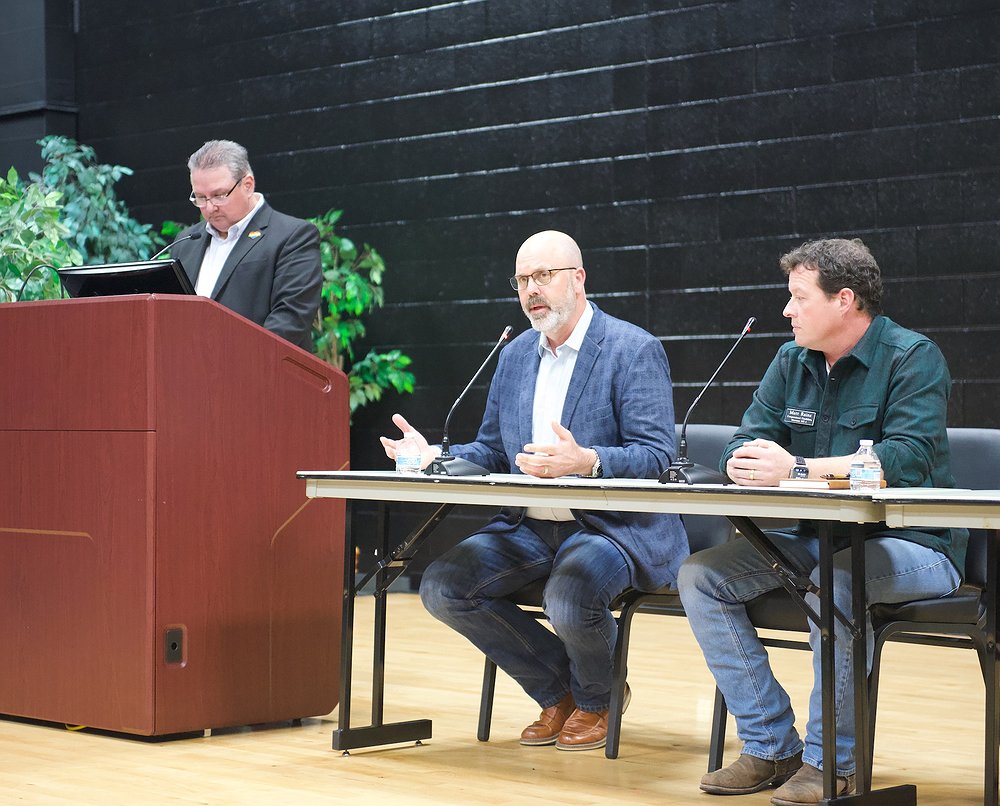 Moderator James Steele Jr. (left) and Matt Rains (right) listen while Ryan Busse answers a question during the candidates forum at Salish Kootenai College last Thursday. All four Democratic candidates for the seat currently held by Rep. Ryan Zinke attended. (Kristi Niemeyer/Leader)
ARTICLES BY KRISTI NIEMEYER

Polson Farmers Market takes break after productive season
“My body’s ready for a break, but it’s been a good year,” said Eric Gedenk between sales at the Ploughshare Farm stand. The organic farm in Moiese is a regular vendor at the Polson Farmers Market, which wrapped up for the season last Friday morning.

The Ripple Effect: Poolside party raises more than $20,000 for aquatic center
The Ripple Effect, a fundraiser for Mission Valley Aquatics and Fitness in Polson, drew nearly 200 supporters to the poolside Saturday night for games, drinks, appetizers and auctions.

Incumbent Shelly Fyant faces Republican Charles Headley in HD 91 race
Incumbent Democrat Shelly Fyant is running for a second term in the House of Representatives against Charles Headley.