
MAY NIBJ: Planning for the next generation: Sandpoint tackles downtown quandary
JACK FREEMAN | Hagadone News Network | UPDATED 4 months, 3 weeks AGO
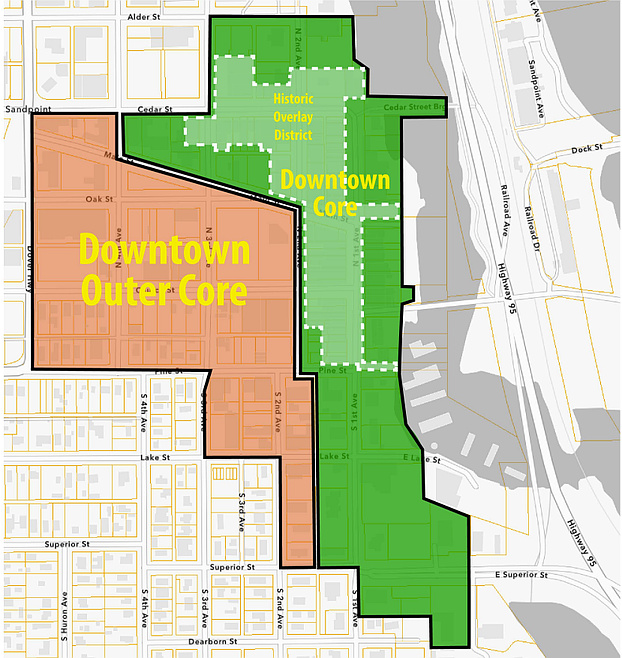
The proposed downtown zoning map presented to the City Council.
Photo Courtesy CITY OF SANDPOINT
When Bill Dean was hired as Sandpoint’s next city planner, he was shocked to see how massive the city’s commercial A zone was.
Over 200 acres of the city, stretching from the southern entrance to the downtown to nearly the eastern exit, were zoned with the same regulations, which presented challenges for the city’s historic downtown. Dean said the zoning was spread out and left the downtown corridor feeling less of a special place that residents dream of it being.
“If everything is labeled downtown, well then, you really don't have a downtown,” Dean said. “When we walk downtown, there's almost an emotional feel that you get when you get to a certain point, and I want to understand where that line was. Where do people feel like they're downtown, versus what the zoning map that may have been printed 20 or 30 years ago says.”
That difficult challenge fell to Dean, who began walking and talking to residents and businesses in the downtown area, learning what people love about the space and what could be reworked. What he heard from downtown business owners is that they loved the look and of the historic buildings on First Avenue, but that they were concerned about storefronts becoming vacant.
Prior to coming to Sandpoint, Dean had experience working in city planning and downtown. He described the problem with downtowns with a donut analogy, saying that downtown areas either have a great inner core, or donut hole, or a fantastic outer region, the donut.
Dean’s proposed solution was bringing that donut to life as two new downtown zones, downtown core and downtown outer core, each complete with their own set of regulations and different design standards.
“[Cities] have a great donut hole, these wonderful buildings and this great fabric in this area or it's the opposite,” Dean said. “Everything right around it is fantastic, but the inside core has got this problem. And I would say here we've got a great donut hole. We need to work on the donut.”
The most significant change Dean is proposing would be allowing ground-floor residential development in the downtown outer core. Dean said people and their ability to access downtown are crucial to building a thriving commercial zone and that the current restrictions are making development too difficult.
“What we're planning for is not a solution that's oriented toward trying to attract just a hotel or just a new condo,” Dean said. “Those things can be good for your downtown. So, make no mistake, but this is a much more difficult exercise by trying to create multiple avenues for downtown to be a larger choice in everybody's weekly activities.”
Dean said that writing the code is a difficult technical exercise where he tries to balance what residents want to see while allowing property owners to have creativity in developing the land. That’s why he’s focused on finding things that the public finds objectionable, whether it be building heights or land uses.
Currently, much of the discussion around land uses in Sandpoint’s downtown has been surrounding offices. Originally, the proposal included limiting any office space in the downtown core area to the second floor and above, in order to attract businesses that generate more activity after normal work hours.
“Nothing wrong with the offices. It's just that when you're talking about vibrancy and having a population downtown, that's after 5 or 6 p.m.,” Dean said. "Then I think you'll start to see demand for more restaurants and places to frequent more that's going to have a higher periodicity of interaction with people."
Many of Dean’s proposals have been given a broad-stroke approval from the Planning and Zoning Commission and City Council, but the city is determined to slow roll the initiative. Dean said that they are going in-depth to ensure that the rules they set are going to be beneficial in the long run and address the concerns of today’s residents and business owners.
"This is intended to be a plan that enables Sandpoint to continue to choose downtown as a place for everyone,” Dean said. "It'll unfold and then, 10 or 20 years from now, you'll have another set of problems to solve for, right? There'll be other issues that are that are the focus.”
ARTICLES BY JACK FREEMAN

PREP SOCCER ROUNDUP: Sandpoint girls control their destiny with win over Moscow
After falling to the reigning 5A state champion Moscow Bears 4-1 early in the season, the Sandpoint Bulldogs had one chance to get back in the league race as they played host to the Bears at the Field of Dreams on Thursday night.

PREP FOOTBALL PREVIEWS: Sandpoint faces toughest test yet, Priest River returns to action
From Priest River to Bonners Ferry, every football team in the two northern counties returns to action this Friday.

PREP GOLF: Sandpoint battles with Lewiston courses
Nearly all Sandpoint golfers made the trip to Lewiston for two revealing meets against quality 6A/5A competition on Wednesday afternoon.