
Civil Air Patrol cadets spread their wings at Desert Eagle Flight Academy
JOEL MARTIN | Hagadone News Network | UPDATED 2 months, 2 weeks AGO
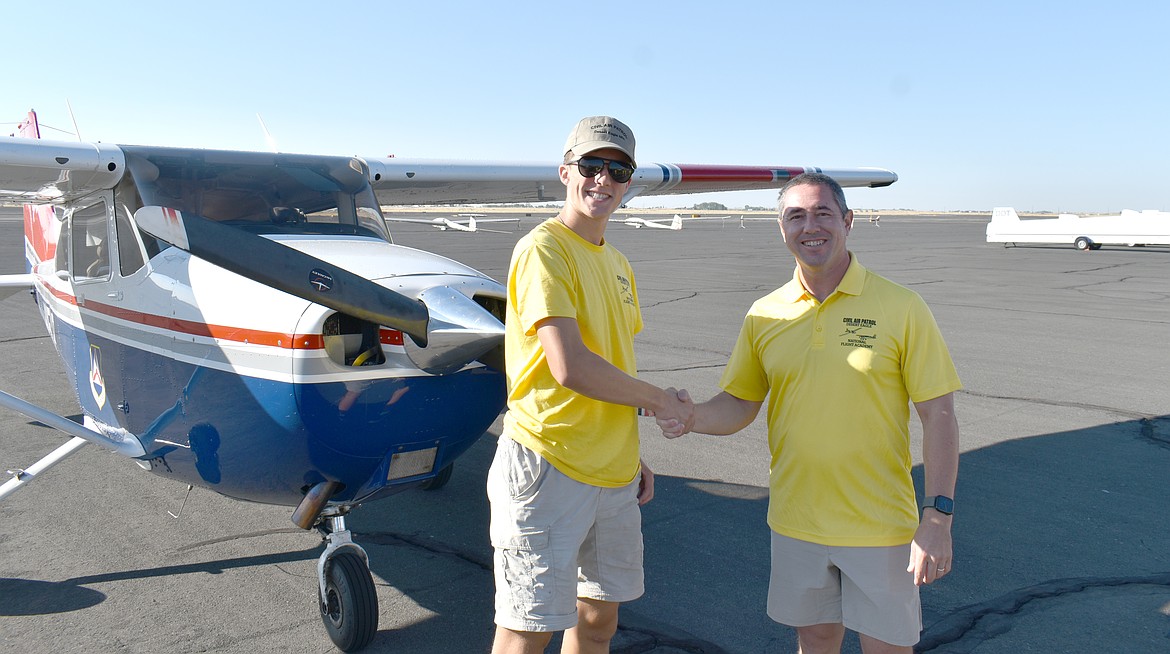
Civil Air Patrol Cadet Ethan Birkhead, fresh from his first solo flight, shakes hands with his instructor, Maj. James Davis, Thursday morning at the Civil Air Patrol’s Desert Eagle Flight Academy in Ephrata.
JOEL MARTIN/COLUMBIA BASIN HERALD
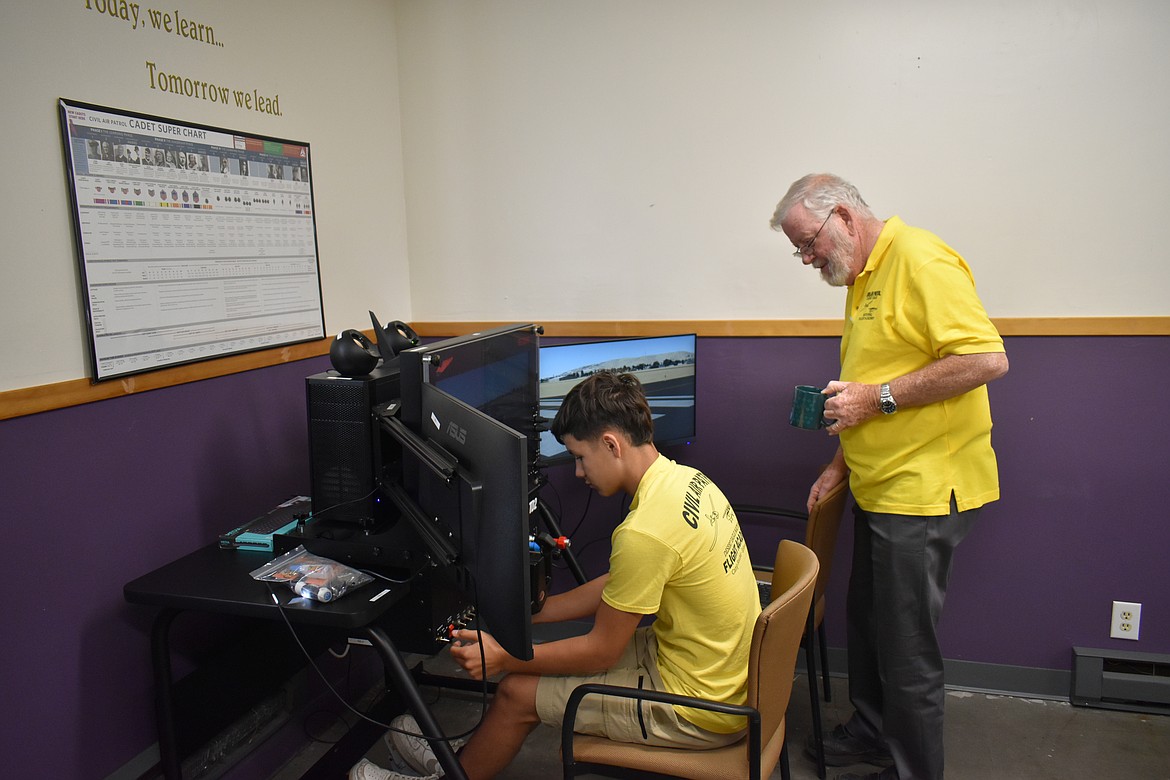
Civil Air Patrol Cadet Austyn Miller goes through his preflight checks on a Redbird flight simulator as instructor Dave Widrig supervises. Miller, who comes from Othello, is one of 20 cadets at the Desert Eagle Flight Academy in Ephrata this year.
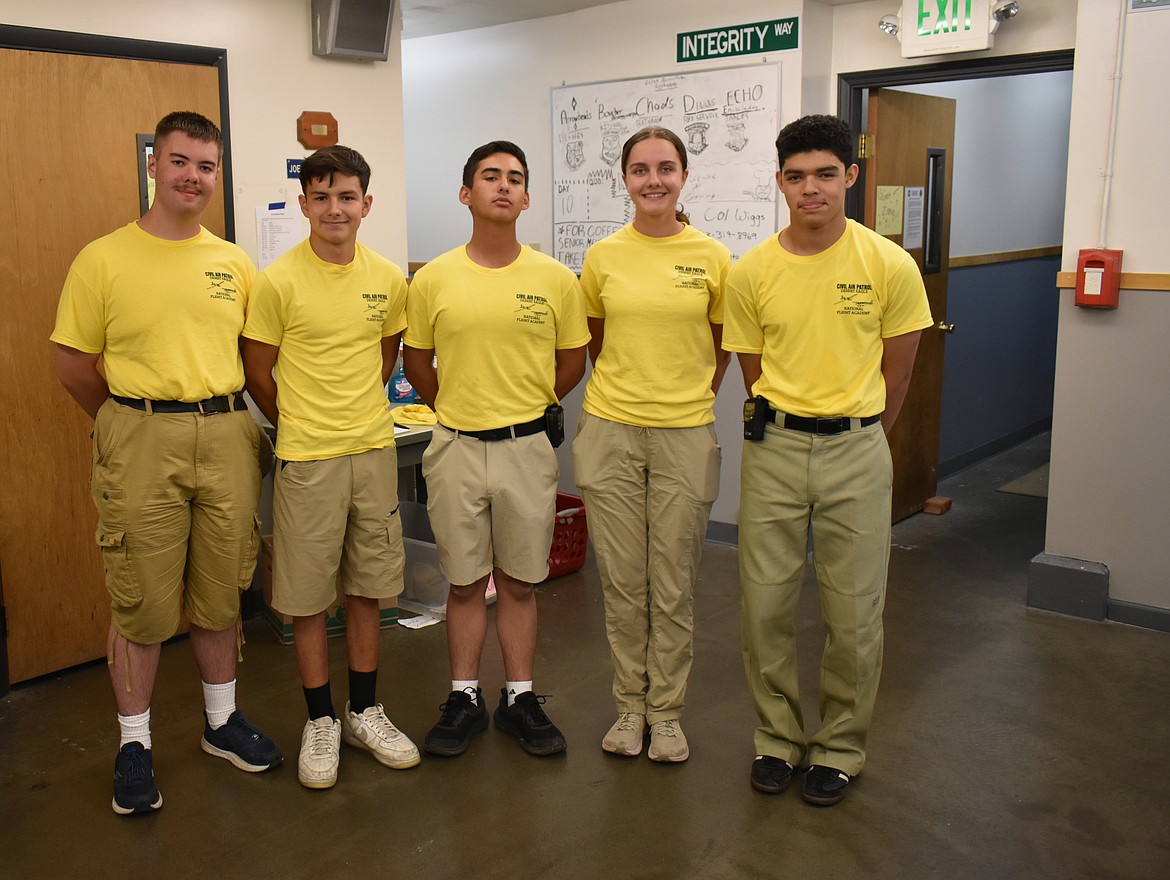
Civil Air Patrol Cadets (from left): Marc Gourley, Austyn Miller, Travis Rawlings II, Sophia Taylor and Rossell Duran all took part in the 50th Desert Eagle Flight Academy at Camp Boucher in Ephrata last week.
Joel Martin has been with the Columbia Basin Herald for more than 25 years in a variety of roles and is the most-tenured employee in the building. Martin is a married father of eight and enjoys spending time with his children and his wife, Christina. He is passionate about the paper’s mission of informing the people of the Columbia Basin because he knows it is important to record the history of the communities the publication serves. | August 3, 2026 3:20 AM
EPHRATA — Getting that first driver’s license is kind of a rite of passage for a teenager. But some aren’t content to drive around on the ground.
“You'd be surprised at how safe the airplanes are,” said Cadet Lt. Col. Sophia Taylor. “When you drive, you just turn on the engine. But with the airplane, there is this huge checklist just to make sure that you really don't miss anything, and we always follow that checklist in everything that we do. If you're following all components of the checklist and you're abiding by all regulations, then it's really safe.”
Taylor, 17, is the cadet commander for this year’s Desert Eagle Flight Academy, an intensive 10 day training course at Civil Air Patrol Camp Robert Boucher at the Ephrata Airport. There are 20 cadets this year, coming from nine states, according to Lt. Col. Kathy Maxwell, the Columbia Basin Composite Squadron’s director of cadet programs. Of those, six had made their first solo flight by Thursday morning, and two more were expected to on Friday. Everyone who wanted to solo would get the chance, even if they had to fly again on Saturday, Maxwell said. Those who didn’t would still have the necessary preparation, she said.
“Some people just can’t do it this fast,” Maxwell said. “They’ll still have their hours, so they’ll have the opportunity to (solo) later. They can fly with a new instructor and go from there.”
There are only a dozen academies like Desert Eagle in the country, Maxwell said, which is why Desert Eagle attracts cadets from all over.
The weather is a factor, said Taylor, who’s from Seattle.
“I haven’t seen any clouds this whole entire time,” she said. “The visibility conditions and the cloud clearance are two things that we have to worry about. Those have been amazing here, practically perfect.”
Cadet Marc Gourley came from Ames, Iowa to Ephrata because most of the Civil Air Patrol academies take place in June, he said, and his 16th birthday came too late for him to qualify for those.
“There was this academy, and then there was one in Syracuse, New York. I had read a lot better things about this one; it was longer, had more aircraft and a better facility, so I put all the weight of my application into this one and got accepted.”
Gourley did his first solo on Wednesday, he said.
“It's a unique feeling when you know you've spent a week training with an instructor who's always right there next to you, and then when you're taxiing, there's still kind of the feeling that if I need to, I can just turn around. But once you take off, then the realization hits you that you're up in the plane, the instructor's not there and you are now the pilot in command, and you have to safely return the aircraft. You never forget it.”
Cadet Ethan Birkhead, of Manhattan, Kansas, soloed Thursday morning and felt pretty good about the accomplishment, he said.
“I didn’t crash it,” Birkhead said. “That’s the goal.”
Most of the cadets’ flying is done in the mornings, said Col. David Lehman, because the air currents become stronger as the day heats up, and the wind tends to pick up in the afternoon.
“The bumps are safe, but the cadets aren’t used to it, and it’s hard for them to learn if they’re getting bounced around,” he said.
The time not actually spent in the sky is spent either in book study or cultivating muscle memory on a flight simulator. Camp Boucher recently acquired a new state-of-the-art Redbird simulator, said Dave Widrig, an instructor who came up from Oregon for the purpose. The simulator has an additional display on each side of the operator, to give a closer approximation of what the pilot would be seeing in an actual cockpit. The monitors displayed the view of Ephrata and the Beezley Hills that would be visible from the tarmac outside.
“It doesn’t move, but if you’re paying attention to it, you can get where to go,” Widrig said. “It has all the buttons they would have to push in the plane when they’re getting ready, and they can practice the radio calls where it happens in the pattern, so they're getting through all of the things they'd have to do without the distraction of actually flying a real airplane and burning gas.”
The view outside and some of the controls are the same, but the simulator isn’t a perfect reproduction of the real thing, said Cadet Austyn Miller of Othello, who was slated to solo Thursday.
“It’s not very accurate to the plane,” he said. “In my experience the controls are very loose compared to the plane.”
Like all teenagers, the cadets work up an appetite, and the kitchen serves four meals a day, said Cadet Chief Rossell Duran, of Los Angeles. There’s a cold breakfast between 4:30 and 5 a.m., then a hot breakfast at 9, lunch at noon and dinner at 5:30 p.m. Duran doesn’t fly, but he came to the academy to volunteer behind the scenes.
“Mainly I help out in the kitchen, making sure that my senior member in charge is able to get meals out on time,” Duran said. “If I’m not doing that, or between meals, I clean. I think it's pretty fun to be able to support any sort of event at all, no matter what I'm doing. I also think it's cool that they're flying because we're able to provide support for them.”
This is the 50th time Camp Boucher has hosted the Desert Eagle Academy, Maxwell. The first was held in 1975, but the COVID-19 pandemic forced the CAP to skip a year. The camp looked very different 51 years ago, Lehman said.
“There wasn’t any air conditioning; we had a swamp cooler,” he said. “There were no showers. There was an Army National Guard post, and we’d walk up there to take showers. It was pretty rustic in 1975.”
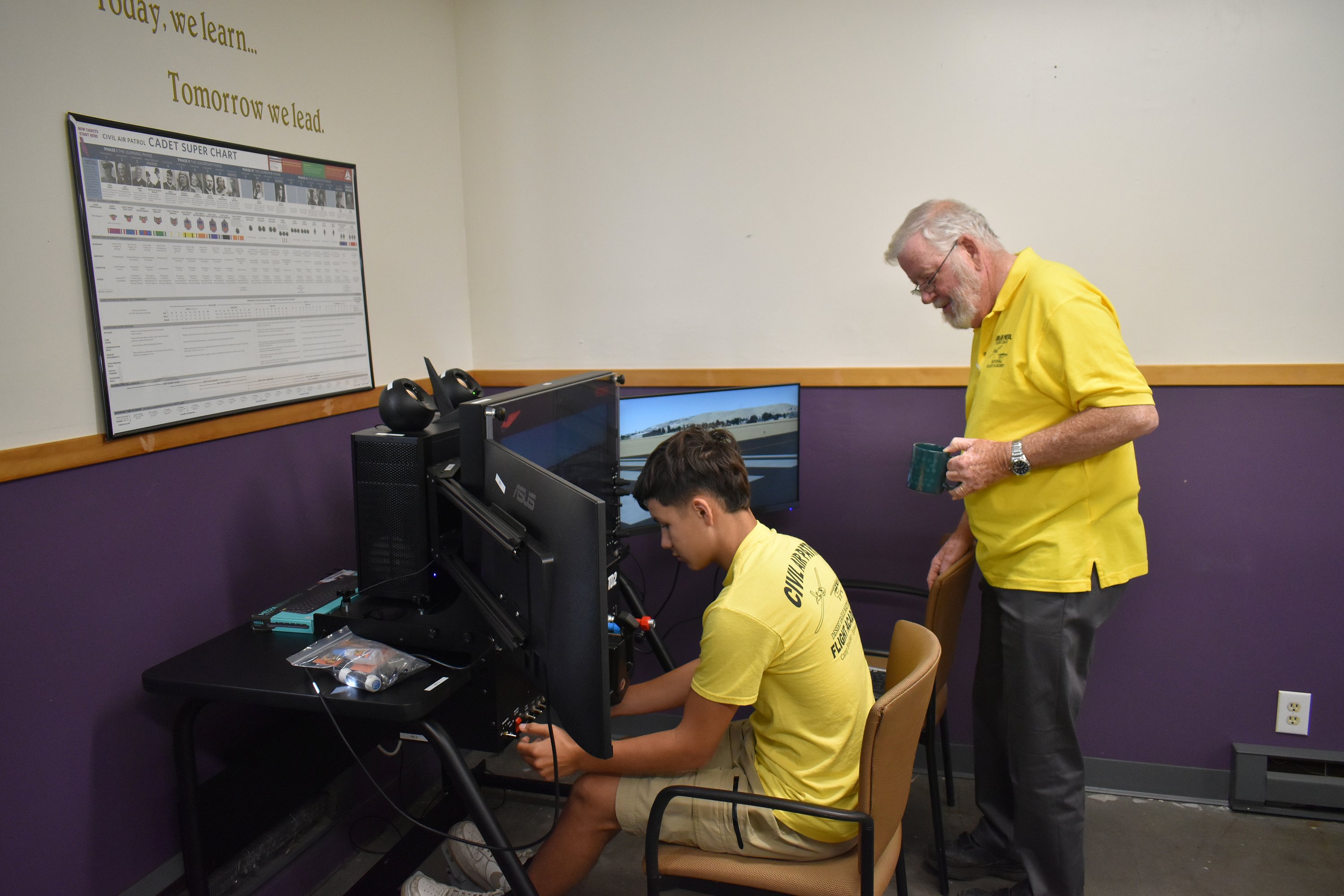 Civil Air Patrol Cadet Austyn Miller goes through his preflight checks on a Redbird flight simulator as instructor Dave Widrig supervises. Miller, who comes from Othello, is one of 20 cadets at the Desert Eagle Flight Academy in Ephrata this year.
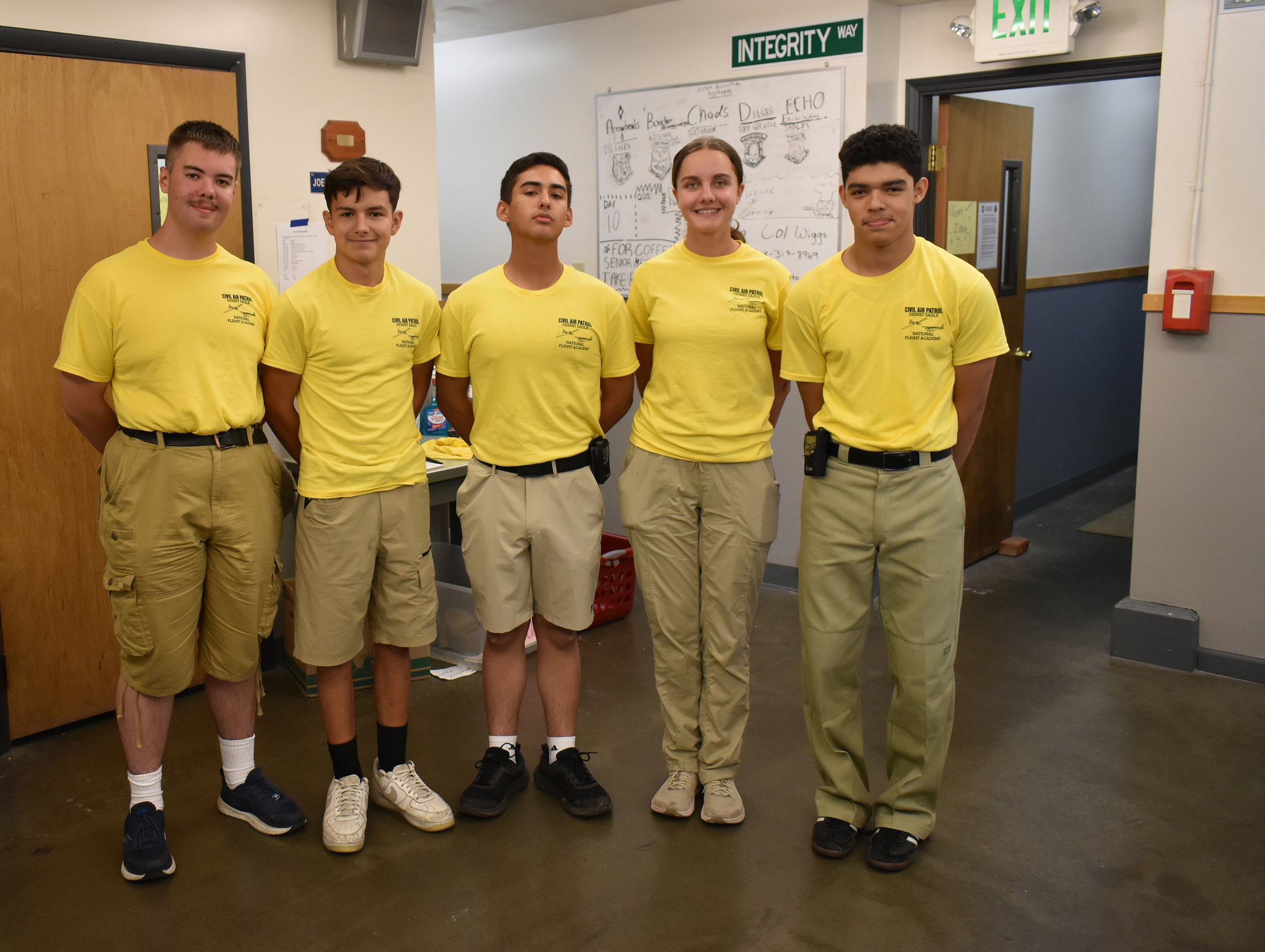 Civil Air Patrol Cadets (from left): Marc Gourley, Austyn Miller, Travis Rawlings II, Sophia Taylor and Rossell Duran all took part in the 50th Desert Eagle Flight Academy at Camp Boucher in Ephrata last week.
ARTICLES BY JOEL MARTIN

Endless battle
Noxious Weed Control Board works to keep invasive plants under control
MOSES LAKE — Some of the nastiest plants in Grant County were the topic of a class led by Jay Johnson, a consultant with the Grant County Noxious Weed Control Board, Tuesday. The Noxious Weed Control Board, as its name would suggest, is tasked with keeping weeds under control in Grant County. That’s not a small job; the board’s website lists 129 species of noxious weeds that are found around Grant County. A noxious weed is defined as an invasive, non-native plant that threatens agricultural crops, local ecosystems or fish and wildlife habitat, according to the Noxious Weed Control Board. Washington state law requires that these weeds be identified and their spread kept to a minimum, if not completely eradicated. “We’re one of those agencies a lot of people don’t really understand,” Johnson said. “We’re a county office and … our funding is tax-based assessment. When you get your tax bill and you look down at all the expenses that you pay for, there we are.”

BASIN EVENTS: Oct. 16-24
COLUMBIA BASIN — Whether you feel like shopping, crafting, learning or seeing a show, there’s something happening for you this week in the Basin. Oct. 16 ‘My Family (Mi Familia)’ screening Spanning three generations, “My Family (Mi Familia)” is a heartfelt drama that follows the Sánchez family as they build their lives in East Los Angeles. Through love, hardship, triumph, and sacrifice, the film explores the immigrant experience, the strength of family bonds, and the traditions that connect one generation to the next. Lowrider show and taco truck before the screening. Sponsored by Columbia Basin Allied Arts, EDUBS C/S and the Moses Lake Creative District. $12 per person. Doors open at 6 p.m., film begins at 7 p.m. at the Moses Lake Civic Center Auditorium, 401 S. Balsam St. Tickets and info: www.cba-arts.org.

Moses Lake author encourages women to look beyond church culture norms
MOSES LAKE — A Moses Lake author’s book, “A Christian Woman Striving to Live Her Faith in a Man-Controlled World,” takes aim at the role to which many churches relegate the female half of their congregations. “It’s to encourage women in the faith,” Linda Curran said. “A lot of churches say, ‘Teach Sunday school, do this, do that, but don’t (evangelize.)’" In her book, Curran recounts a time when she moved to a new community and joined a church there. She was surprised to learn that, as a new female member, she had been automatically assigned church cleaning duties. When she questioned it, she wrote, she was met with condescension and her objections were brushed aside. In other churches, she said, women who were capable of teaching were relegated to “women’s ministry.”