
Best Night Sky Events for August
JOHN TAYLOR/Contributing Writer | Coeur d'Alene Press | UPDATED 1 week, 2 days AGO
Get ready for everyone’s favorite observing month because the nights are getting longer, are still warm, plus there is arguably the best meteor shower of the year. The August night sky brings the famous Perseid Meteor Shower, followed by the Full Sturgeon Moon. Plus, a very close approach between the Moon and M45, another close approach between Venus and the Moon and few more fun events to observe. Below is everything worth watching this month.
August 5 – Third Quarter Moon
The third (or last) quarter phase shows the moon appearing half-illuminated on its western, or left side. It rises before midnight local time and then remains visible until it sets in the western daytime sky in the early afternoon. The dark, moonless evening skies that follow this phase gives you an opportunity for observing deep sky targets, like the Andromeda galaxy!
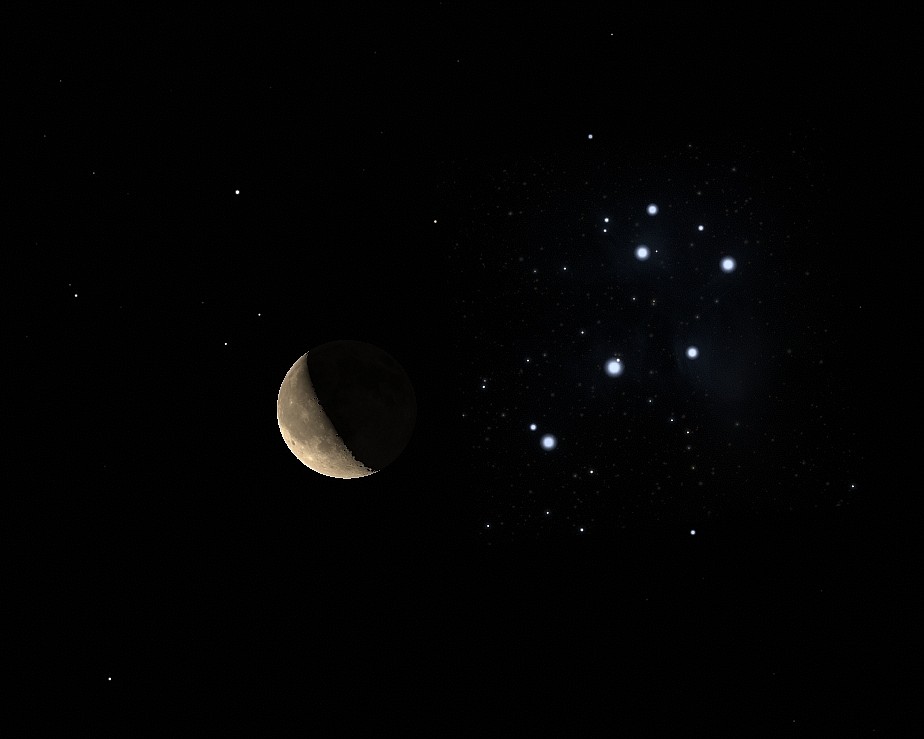
August 7 – Moon and the Star Cluster, The Pleaides (M45), Are Very Close
Just after midnight (12:30 a.m.) on the 7th look to the East to see the newly risen Moon nearly immersed within the Pleaides star cluster. They’ll be just over one degree apart.
August 12 – New Moon
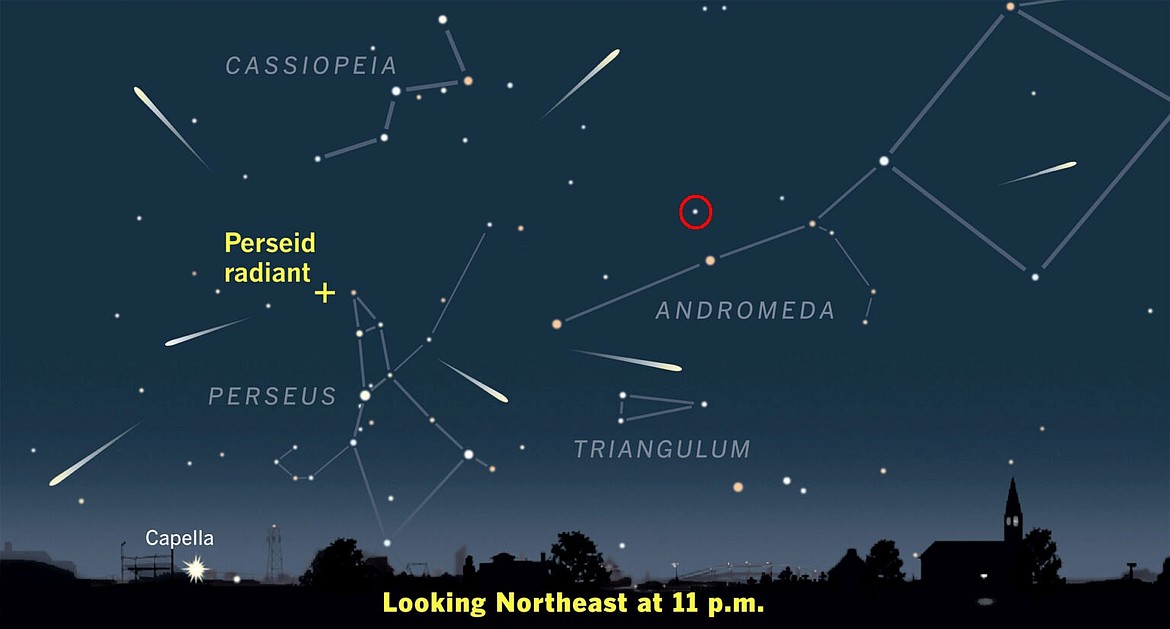
On Friday, Aug 22 at 10:37 a.m., the moon will officially reach its new moon phase. The moon is now between Earth and the sun, and the side of the moon facing toward us receives no direct sunlight making it hidden from view from anywhere on Earth for about a day or two. This is a mid-week new Moon, but it is still your best opportunity to get away from city lights putting you out under very dark skies to see some amazing stuff. One of these amazing sights is the most distant object you can see with your unaided eye – The Andromeda Galaxy. It is only a mere 2.5 million light years away! This means the light you are seeing left that galaxy 2.5 million years ago! Refer to the Perseid chart below. Find the star circled in red look just above it to see this wonderous sight. Binoculars on a tripod would really enhance the view.
August 12 – 13 – Perseids Meteor Shower
The Perseids is one of the best meteor showers to observe, producing up to 90 meteors per hour at its peak. It is produced by the comet, Swift-Tuttle, which was discovered in 1862. The Perseids are famous for producing a large number of bright meteors. The shower runs annually from July 17 to August 24. It peaks this year on the night of August 12 and the morning of August 13. The new moon will not interfere at all with year’s Perseid meteor show. Remember that the best viewing will still be from a dark location after midnight. Meteors will radiate from the constellation Perseus but can appear anywhere in the sky. These meteors are colorful and they frequently leave persistent trails called trains. All of these factors make the Perseid meteor shower perhaps the best and most spectacular meteor shower for the Northern Hemisphere.
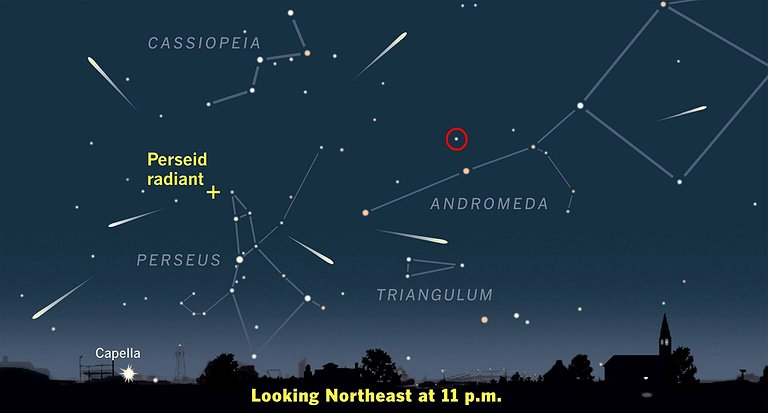 Image courtesy of Sky and Telescope Magazine
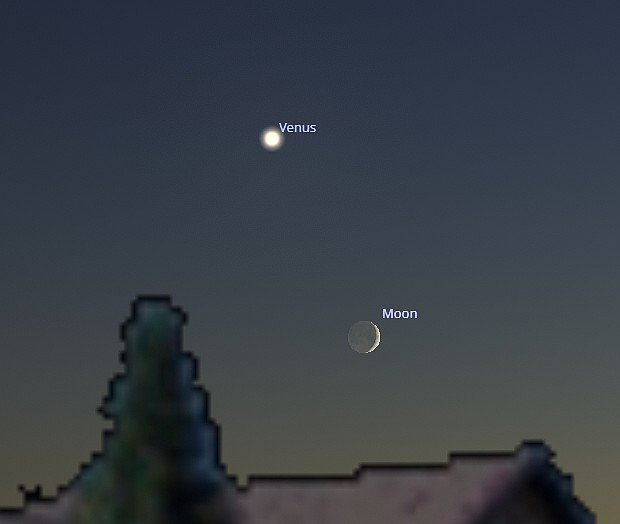
August 15 – Close Approach of the Moon and Venus
Look to the West just after sunset (8:30pm) to see Venus just a fist’s width (at arm’s length) away from a 4-day old crescent Moon. These two celestial bodies should be easy to spot as they are the second and third brightest objects in the sky.
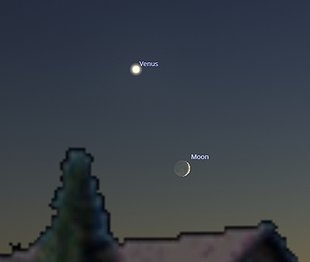 Image courtesy of John Taylor and Stellarium
August 19 – First Quarter Moon
When the moon completes the first quarter of its journey around Earth this evening at 7:46 p.m., Its 90-degree angle between us and the sun will cause us to see the moon half-illuminated — on its eastern side, the right side.
At first quarter, the moon always rises around mid-day and sets around midnight, so it is also visible in the afternoon daytime sky. The evenings surrounding first quarter are the best evenings to use a telescope or even a pair of binoculars for seeing the lunar terrain which will be dramatically lit by low-angled sunlight, especially along the terminator, the pole-to-pole boundary that separates the light and dark hemispheres.
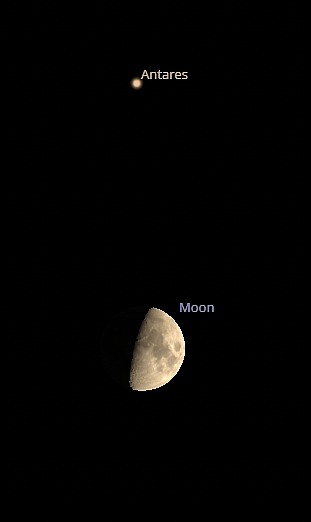
August 20 – The Moon and Antares, a Close Approach
On this night the Moon will pass a mere 1 ½ degrees from the brightest star in the constellation of Scorpio, Antares. One of the great features of this event is that Antares is one of the reddest stars in the night sky. Also, both will be set against the backdrop of the brightest part of the Milky Way. If you have binoculars, now would be a great time to use them. Look to the South at 9:00pm to see this spectacle.
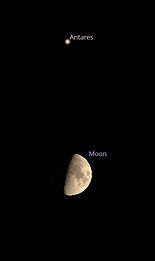 Image courtesy of John Taylor and Stellarium
The Moon will be located on the opposite side of the Earth as the Sun and its face will be fully illuminated. This phase occurs at 9:18 p.m. This full moon was known by some early Native American tribes as the Sturgeon Moon because the large sturgeon fish of the Great Lakes and other major lakes were more easily caught at this time of year. This moon has also been known as the Green Corn Moon and the Grain Moon.
Lastly, whether you’re choosing your first telescope, setting up gear, tracking down night sky objects, or diving into astrophotography, just ask at:
ncmrrimrockobservatory.space/contact
• • •
John Taylor is an amateur astronomer who lives in Hayden.