
Guest opinion: Bigfork Bay meets Public Trust Doctrine criteria
Jim Goetz | Daily Inter-Lake | UPDATED 1 week, 2 days AGO
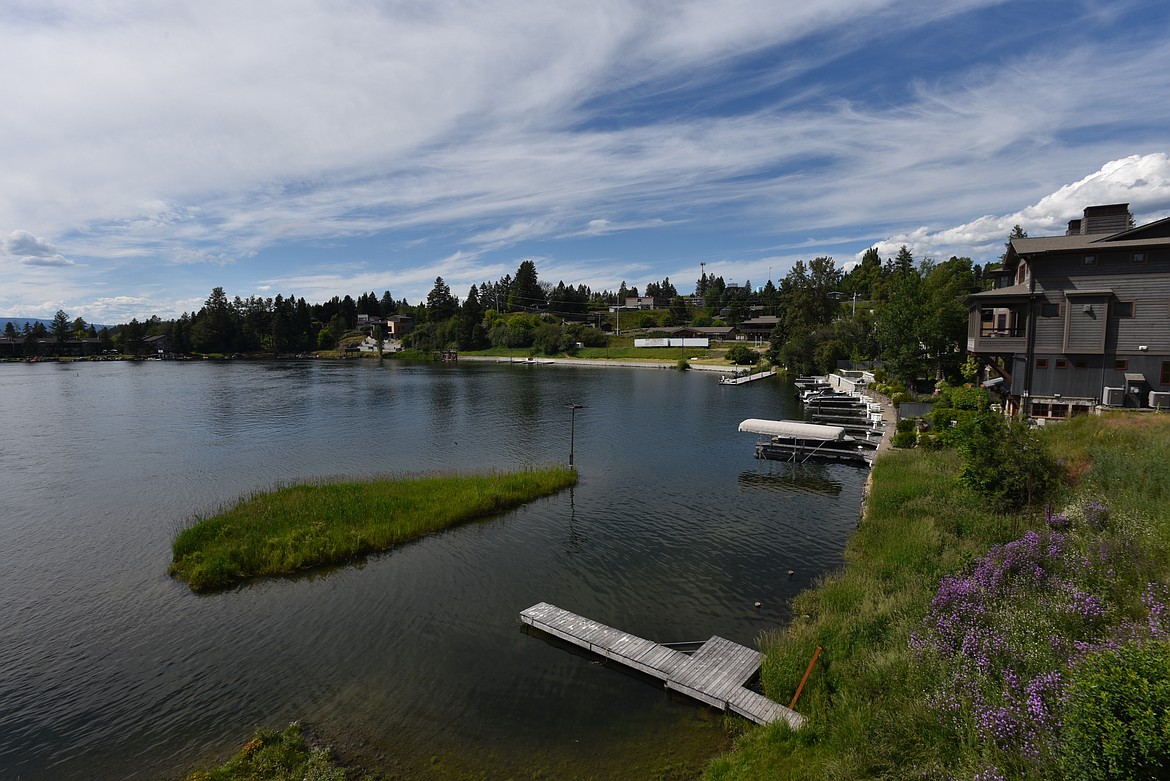
A view of Bigfork Bay and the site of the proposed marina project as seen from the Inn on Bigfork Bay on June 24. (Elsa Ericksen/Bigfork Eagle)
My wife and I own property on Flathead Lake near Bigfork, and have been seasonal residents of Flathead County for over 30 years. We share with our neighbors the unmatched beauty of Bigfork Bay — one of Northwest Montana’s great treasures.
Unfortunately, Bigfork Bay is now threatened with a proposal by an entity called Cougar Ridge LLC, which is requesting a 310 Permit from the Flathead County Conservation District to install about 97 floating docks, which will clutter and obstruct a good part of the bay. We oppose this project, which will defile an otherwise unspoiled Montana jewel.
It appears Cougar Ridge takes the position that it owns the submerged lands between a high and low water mark, and it, therefore, is free to do what it wants. Although I am now retired, I spent many years as a practicing attorney and have extensive experience litigating on water issues. In the 1980s, I successfully handled the seminal stream access cases, Curran v. Montana Stream Access Coalition (Dearborn River) and Hildreth v. Montana Stream Access Coalition (Beaverhead River). These cases firmly establish the right of Montana recreationists to float and otherwise use Montana’s rivers, streams and lakes.
In those cases, the landowners made the same argument — that the streambed owner could control recreational use on the surface. The Montana Supreme Court roundly rejected this argument. As part of its rationale, the court applied the Public Trust Doctrine. The Public Trust Doctrine is based on the provision of the Montana Constitution that provides that all waters of the state are owned by the state, held in trust for the use of Montana’s population.
In rejecting the streambed ownership argument, the Montana Supreme Court said in the Dearborn River case:
In essence, the question is whether the waters owned by the state under the constitution are susceptible to recreational use by the public. The capability of use of the waters for recreational purposes determines their availability for recreational use by the public.
Streambed ownership by a private party is irrelevant. If the waters are owned by the state and held in trust for the people by the state, no private party may bar the use of those waters by the people.
The constitution and the public trust doctrine do not permit a private party to interfere with the public’s right to recreational use of the surface of the state’s waters.
Emphasis added.
This holding was reiterated in the Beaverhead River case. The court said: “We held in Curran, supra, that the question of title to the underlying streambed is immaterial in determining navigability for recreational use of state-owned waters. The holding applies equally to the case now before us.”
Shortly after these cases, the Montana Legislature passed the Stream Access Act. Among other things, that act states, “all surface waters that are capable of recreational use may be so used by the public without regard to the ownership of the land of underlying waters.”
Cougar Ridge’s 310 application asserts that the water in the bay is not “navigable.”
Nonsense. Over the years, undoubtably thousands of boat users have navigated throughout Bigfork Bay, including the northeastern part of it, which is now subject to the Cougar Ridge proposal. The assertion of non-navigability is, in any event, a red herring. The court, in the Dearborn River case rejected any over-restrictive definition of “navigability,” finding that the “capability of the use of the waters for recreational purposes [alone] determines their availability for recreational use by the public.”
In addition to the stream access cases, I was one of the originating attorneys in PPL Montana, LLC, v. Montana, a case seeking to collect rent for use of state-owned streambeds under navigable waterways. The importance of that case is that the US Supreme Court reinforced the Public Trust Doctrine holding:
The Public Trust Doctrine is of ancient origin. Its roots trace to Roman civil law and its principles can be found in the English common law on public navigation and fishing rights over tidal lands and in the state laws of this country.
Importantly, that court held that the “Public Trust Doctrine” remains a matter of state law,” stating, “the states retain residual power to determine the scope of the public trust over waters within their borders, while federal law determines riverbed title under the Equal-Footing Doctrine.”
To determine whether the Public Trust Doctrine precludes development here, application of a three-part test is necessary. First, are the waters important to the public, and have the public historically and traditionally used these waters for aesthetic, commercial or recreational purposes?
Second, will the proposed permit destroy or seriously impair the public’s historical use?
Third, is the public interest so paramount that it overrides any countervailing interest of the proposed developer?
Bigfork Bay clearly meets these criteria. Accordingly, the bay’s waters are held in trust for us, the public. We, members of the public, have long enjoyed them, and will, hopefully, for years into the future.
A regular 310 Permit hearing before the Flathead County Conservation District is scheduled for Aug. 10. That, however, is subject to change because the board is awaiting more information from the applicant. Whenever that hearing takes place, persons should attend and voice their opposition.
Jim Goetz is a retired Bozeman attorney. He and his wife, Jill Davenport, spend summers in Bigfork.