
Mass funeral held in Gaza and other developments from across the Mideast
Coeur d'Alene Press | UPDATED 4 hours, 54 minutes AGO
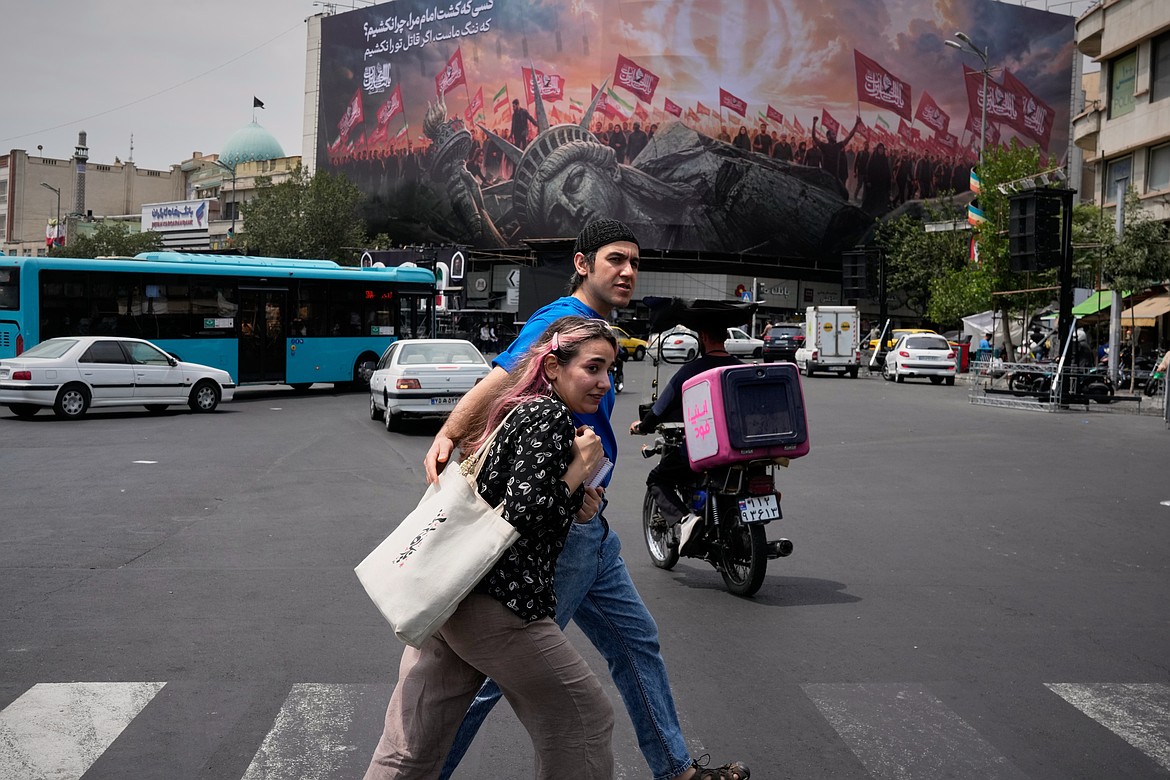
Pedestrians cross a street in front of a billboard depicting a fallen Statue of Liberty and crowds carrying Iranian and Shiite flags at Revolution Square in Tehran, Iran, Monday, Aug. 3, 2026. (AP Photo/Vahid Salemi)
CAIRO (AP) — A mass funeral was held in Gaza City on Tuesday for 112 Palestinians whose bodies were recovered nearly three years after Israeli warplanes flattened a residential block.
Hundreds of people gathered as the bodies wrapped in Palestinian flags were laid in rows near the destroyed buildings before being carried on stretchers through a narrow street for burial in a nearby cemetery.
Elsewhere, a projectile reportedly struck a cargo ship in the disputed Strait of Hormuz, Qatar said it was mediating peace talks between the United States and Iran, a memorial service was held in Beirut for victims of a 2020 port explosion and Yemen’s Houthis claimed they fired at a Saudi Arabian airport.
Here is a look at the most important developments in the Middle East on Tuesday.
Gaza residents killed in 2023 airstrike laid to rest
The 112 victims were among more than 300 killed during an attack on Nov. 22, 2023, on Gaza City’s Sabra neighborhood.
First responders recovered the bodies over the weekend after digging through the rubble for 136 hours, according to the Civil Defense, a rescue agency operated under Gaza’s Hamas-run Interior Ministry.
The bodies included 40 children, 30 women and seven people with disabilities, the agency said in a statement, adding that another 157 people remained missing under the rubble.
The Gaza war began on Oct. 7, 2023, when Hamas-led militants attacked southern Israel, killing around 1,200 people and taking 251 hostage.
Israel’s military offensive in Gaza has since killed 73,375 people, including civilians and combatants, according to Gaza’s Health Ministry.
Around 7,400 people are still missing and presumed buried under the rubble from the war, according to Zaher al-Waheidi, head of the Gaza Health Ministry’s records department.
Cargo ship reports strike in Strait of Hormuz
A cargo ship reported being “hit by an unknown projectile” at 2 a.m. local time in the Strait of Hormuz while it was 37 kilometers (23 miles) northeast of Al Khasab in Oman, the United Kingdom Maritime Trade Operations Center said, without providing further information on the ship, including what flag it was sailing under or whether it was carrying cargo.
The ship suffered damage, according to British maritime security firm Ambrey, which did not elaborate.
The town of Al Khasab sits on the tip of the Arabian Peninsula that juts into the Strait of Hormuz, the crucial waterway at the mouth of the Persian Gulf through which a fifth of the world’s oil and natural gas passed before the war.
The strait has been effectively shut by Iran’s attacks on shipping since the start of the war in February, while the U.S. also has imposed a blockade on Iranian ports in the waterway.
Qatar mediating talks between US and Iran
Despite conflicting claims, mediation efforts were underway between the U.S. and Iran to wind down the war, Qatari Foreign Ministry spokesman Majed al-Ansari said Tuesday.
“We’re looking into a diplomatic solution,” he said during a briefing, without elaborating.
U.S. President Donald Trump had threatened to unleash massive strikes on Iran before calling them off at the urging of Gulf allies Qatar, Saudi Arabia and the United Arab Emirates.
On Monday, the president said the two sides were resuming talks, but Iran insisted it was only talking with Oman about establishing a route through the Strait of Hormuz, drawing Trump’s ire.
Senior U.S. officials struck an optimistic tone on Tuesday, suggesting a deal to reopen the strait could be reached soon.
Secretary of State Marco Rubio told reporters there has been progress made in talks between Iran and Oman, “but not finality yet.”
Treasury Secretary Scott Bessent told CNBC that "there is a chance we may have a deal today or tomorrow to open the strait and move towards a more normalized position in this conflict.”
Yemen’s Houthis fire at airport in Saudi Arabia
In Yemen, Brig. Gen. Yahya Saree, a military spokesman for the Iranian-backed Houthi rebels, said a drone hit a “sensitive target” at the airport in the southwestern city of Najran, without providing evidence. He said the attack was in response to what he described as Saudi breaching of Yemen’s airspace over the provinces of Saada and Hajjah. There was no immediate comment from Saudi Arabia.
The Houthis recently announced a blockade on Saudi-linked shipping passing through the Bab el-Mandeb Strait that leads to the Red Sea.
Saudi Arabia led an international coalition and imposed an air and sea blockade against the rebels after they seized the capital, Sanaa, and much of northern Yemen in a civil war that began in 2014. Major fighting ended in a truce in 2022.
Memorial marks Beirut port explosion anniversary
Families of the more than 200 people killed in the massive explosion at the port in Beirut in 2020 gathered at the blast site to mark six years since tons of improperly stored ammonium nitrate exploded, devastating large parts of the Lebanese capital.
No one has been convicted in a long-stalled judicial investigation into the incident, but some families expressed renewed hope after government officials promised indictments would be issued by the end of the year.
The tragedy has been overshadowed by recent events, including two wars between Israel and the Hezbollah militant group and an Israeli military occupation of much of the country’s south.
Israel discusses withdrawal from Lebanon
Israeli and Lebanese officials met in Rome on Tuesday to continue talks on implementing a U.S.-mediated deal in which the Israeli military would gradually withdraw from southern Lebanon while the Iran-backed Hezbollah militant group would be disarmed.
Implementation of the June 26 agreement began last month with an initial “pilot zone” in an area that wasn't occupied by Israeli forces but had previously sustained Israeli fire.
U.S. Ambassador to Lebanon Michel Issa suggested ahead of the three-day talks that no new pilot zones would be immediately implemented, saying that “moving too quickly risks jeopardizing the very civilians this process is meant to protect.”