
Sunny yellow canola offers another tool for Mission Valley farmers
KRISTI NIEMEYER | Hagadone News Network | UPDATED 2 months, 2 weeks AGO
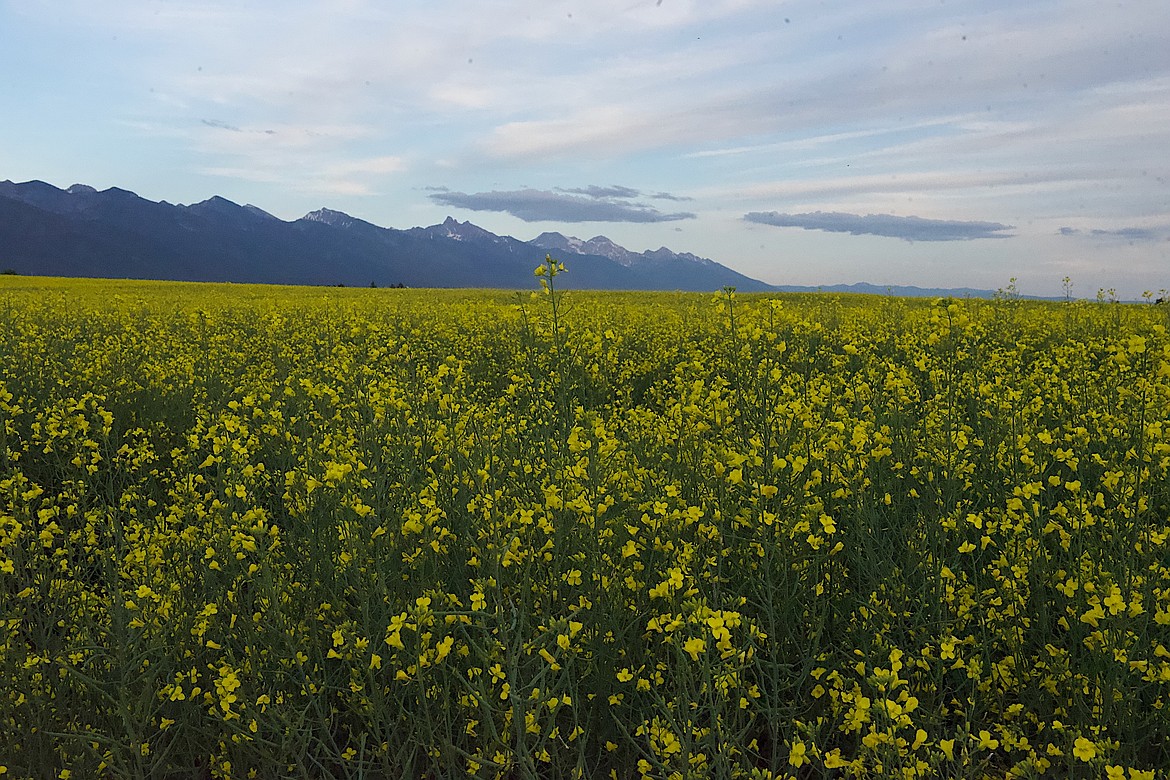
Lake Seed's canola field, south of Polson, was radiant at with yellow blossoms a few weeks ago. The crop turns pale green as the seed pods ripen, signaling harvest time for the heart-healthy oil seed. (Kristi Niemeyer/Leader)
Kristi Niemeyer learned her newspaper licks at weekly newspapers, beginning at the Mission Valley News in 1981, then at the helm of the Ronan Pioneer and, eventually, as co-editor of the Lake County Leader until 1993. She launched and co-published Lively Times, a statewide arts and entertainment monthly, before returning to the Leader in 2022, and serving as its editor until July 2026. Reach her at [email protected] | August 6, 2026 12:00 AM
The tiny sun-hued flowers that turned fields across the Mission Valley a brilliant shade of yellow in early July are now shifting to pale green, signaling the ripening of canola seed pods and an ensuing harvest.
Tim Lake, one of the four brothers who own Lake Seed Inc., said the family-owned business is growing around 600 acres of canola this year. They planted the oil-seed crop as part of a four-year rotation that also includes two years of wheat and one year of certified seed potatoes – the crop that Lakes are perhaps best known for producing and selling to commercial spud growers in Idaho, Washington and Oregon.
According to Lake, they first tried growing canola about two decades ago for a company based in Dutton called Intermountain Canola. “We raised seed,” he said. “The varieties were real tall and they didn’t yield real great.”
Canola-growing fell by the wayside until a few years ago when they tried interspersing the crop between wheat rotations, but again, it wasn’t very successful. The challenge they were trying to combat was declining wheat yields in the third year, and an incursion of wild oats.
Last year, however, they planted about 600 acres of canola and liked what they saw. “It seemed to work, and the market is good,” he said. “So it just fits right into our rotation.”
The current plan, he said, is to plant seed potatoes, follow that with a year of wheat, a year of canola and another year of wheat before returning the field to seed potatoes.
Canola seeds are tiny – about the size of a mustard seed. The crop goes in the ground after the danger of frost subsides and is planted about three-quarters of an inch deep. Plants grow up to six or seven feet tall, “and put out that beautiful yellow bloom,” before setting seed pods that are about three inches long.
The Lake canola crop is setting seed pods now, and in a few weeks, “we’ll start swathing it, and we’ll put it in a windrow to dry.”
Next, the combines will roll through the fields, threshing the seeds from the pods. The seeds, in turn, get shipped to Kalispell and from there to a canola crushing plant. The closest, in Warden, Wash., processes about 386,000 tons of seed a year, which is then sold as food-grade oil and, once the oil is extracted, as animal feed.
Canola was developed by Canadian scientists in the 1970s as a healthier alternative to rapeseed (https://www.northerncanola.com/). A decade later, it was approved by the U.S. Food and Drug Administration and has since gained traction with consumers for its “heart-healthy” properties. It’s considered the least saturated fat of all common culinary oils.
According to the U.S. Canola Association, farmers are growing about 2.7 million acres of these tiny seeds, with about 200,000 acres planted in Montana last year.
Lake estimated that more than 1,000 acres of farmland in the Mission Valley sported the flashy canola flowers this year. The Flathead Valley grows closer to 10,000 acres annually.
“The Mission Valley is well suited to canola,” Lake said. “We don't get real hot, and canola doesn't like heat … This year was especially nice because we really didn't get above 90 as it was flowering.”
Extreme heat during the flower phase can cause the plant to “abort” flowers, causing gaps in the production of seed pods.
“We're seeing plants that are pretty well loaded with pods,” Lake said. “Although until we get it in the bin, we don't really know.”
That process begins in a few weeks when swathers cut the plants about 18-24 inches from the ground, or just below the pods, and perch the windrows across the stalks. The pods dry there, with air circulating above and below the windrow.
At that point, the pods are quite stable, Lake said. “Actually, a rain on it will increase the quality. It'll swell a little bit better.”
Before harvesting the crop, Lake said crews fortify the combines and trucks that collect the canola so the seeds can’t escape. “We have to really tape up all the little tiny holes because the seeds are so small,” he said.
Although canola, which is traded on the global market, yields considerably less per acre than wheat, it’s currently worth more. Besides, when used in rotation with other crops, it’s helping them control weeds in their fields.
“It just gives you another tool in your toolbox,” Lake said, even as it gives Mission Valley fields the summery hue of sunshine.
ARTICLES BY KRISTI NIEMEYER
Polson Farmers Market takes break after productive season
“My body’s ready for a break, but it’s been a good year,” said Eric Gedenk between sales at the Ploughshare Farm stand. The organic farm in Moiese is a regular vendor at the Polson Farmers Market, which wrapped up for the season last Friday morning.

The Ripple Effect: Poolside party raises more than $20,000 for aquatic center
The Ripple Effect, a fundraiser for Mission Valley Aquatics and Fitness in Polson, drew nearly 200 supporters to the poolside Saturday night for games, drinks, appetizers and auctions.

Incumbent Shelly Fyant faces Republican Charles Headley in HD 91 race
Incumbent Democrat Shelly Fyant is running for a second term in the House of Representatives against Charles Headley.