
Victory Village: Moses Lake’s wartime housing legacy
Dollie Boyd | Columbia Basin Herald | UPDATED 5 hours, 34 minutes AGO
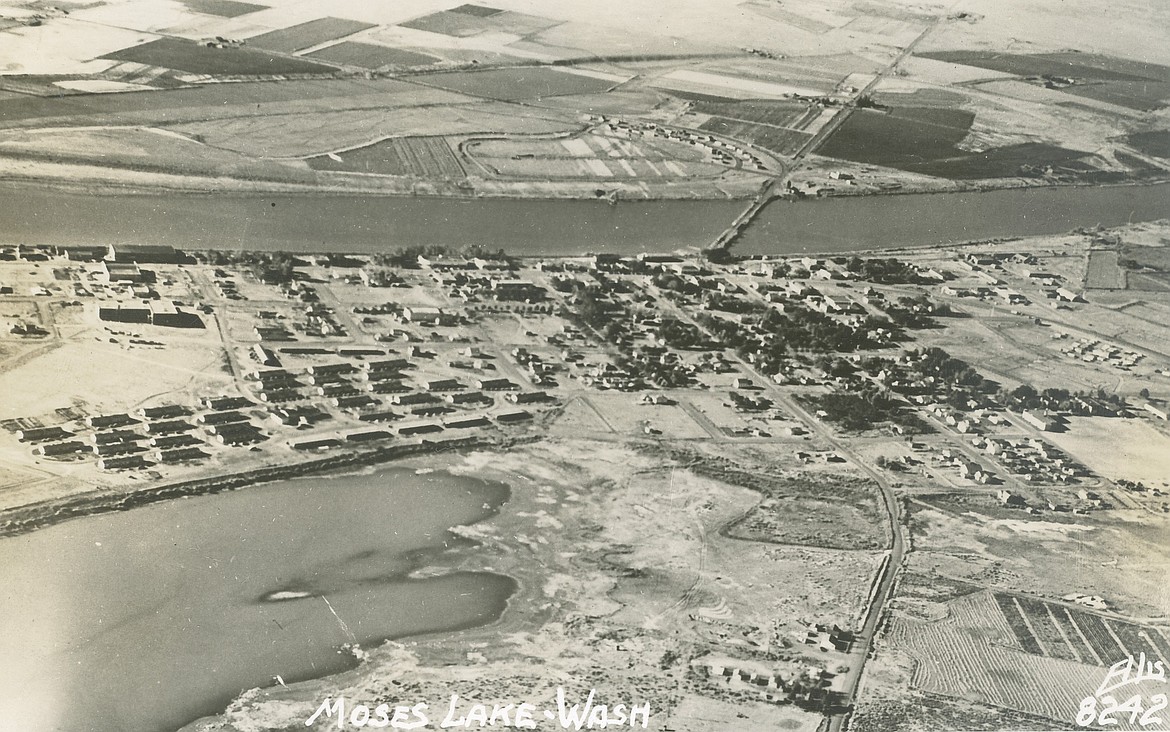
An aerial view of Moses Lake in the late 1940s or early ’50s. Victory Village is in the center left of the photo, where McCosh Park is now, and the first homes of Knolls Vista can be seen at the top across the lake.
COURTESY PHOTO/MOSES LAKE MUSEUM & ART CENTER
If you lived there, you called it The Housing. For nearly 19 years Victory Village was home to hundreds of new Moses Lake residents. The first inhabitants were drawn here when World War II thrust Moses Lake onto the national stage. The town, then a modest farm service community of a few hundred people, was transformed almost overnight. The establishment of the Moses Lake Army Air Base brought a surge of workers and military personnel, straining local housing and prompting a federal response that would shape the city for decades.
In 1941, the First War Powers Act empowered President Roosevelt to direct funds toward wartime housing. Moses Lake, remote and under-resourced, was quickly identified as a prime candidate. One of the first housing efforts began in early 1943 when construction began on a regulated trailer camp, offering 200 units with amenities. The camp expanded to 300 units, accommodating 1,000 new residents.
Soon after, the Defense Housing Administration launched a dormitory-style project with 100 family units, later expanded to 130 apartments. These units ranged from studios to three-bedroom apartments, each equipped with basic facilities. Rents were modest, reflecting the urgency and limited resources of wartime construction.
Despite rapid construction and budget constraints, planners recognized the importance of community. A central hall became the heart of Victory Village, hosting clubs, celebrations, childcare, and volunteer efforts. Residents formed a volunteer fire department, children celebrated birthdays, and women contributed to the Red Cross. The “V-V Club” emerged as a philanthropic force, and in 1944 the name “Victory Village” appeared for the first time in the pages of the Herald.
The project faced persistent challenges. Poor electrical wiring led to later restrictions on appliance use, frustrating residents who felt their rent should cover upgrades. The issue lingered until 1950, when a contract was finally awarded to rewire the units.
The end of World War II did not diminish Moses Lake’s housing needs. The Columbia Basin Project attracted thousands, and returning veterans industriously contributing to the baby boom sought new beginnings. Demand for Victory Village units remained high, prompting further expansion. However, local veterans’ groups protested the slow pace and substandard conditions, citing bureaucratic delays and inadequate facilities.
Turnover was high, with most residents viewing the housing as temporary. By 1947, Victory Village averaged nearly eight moveouts per month, but units filled quickly. The community hall became a fixture for civic events, and the project’s role in Moses Lake life deepened.
As the years passed, eligibility rules shifted. Initially open to a wide range of workers, by 1946 only veterans’ families qualified. Later, income limits were proposed to prioritize lower-income families. By 1954, pressure mounted for long-term residents and high earners to vacate, with tenancy reserved for Larson Air Base personnel.
In July 1954, the Federal Housing Administration ordered the project’s closure, sparking local outcry. Many units housed military personnel, and the community feared losing affordable housing. Despite official timelines, Victory Village persisted, with the city eventually negotiating to acquire the property.
Sen. Warren Magnuson and Rep. Hal Holmes worked to transfer ownership to Moses Lake, but bureaucratic delays pushed the process into late 1956. The city pledged to operate the project until demand waned, and plans for a public park began to take shape. Rental rules evolved, opening units to low-income families and those on welfare.
Gradual demolition began, but housing needs kept Victory Village alive longer than expected. The administration building remained a community hub, hosting meetings including those of the local NAACP branch. By 1962, only the administration building stood, and the site was finally cleared for a new municipal pool and eventually, McCosh Park, named after the mayor who championed the transformation.
Victory Village’s story is emblematic of wartime America: rapid mobilization, community resilience, and evolving social norms. While public housing nationwide was often segregated, Moses Lake’s project showed signs of inclusivity, hosting families of diverse backgrounds and community organizations.
Though living conditions were imperfect, many residents recall their time in The Housing with fondness. The sense of community, shared purpose, and formative experiences left lasting memories. Mary Jane Honegger remembers, “With its dirt roads, scraggly grass, and few trees, Victory Village was a hot and dusty place to live. But during those halcyon years following the war, we all thought it was the best place in the world … and fighting the tumbleweeds made us strong.”
Today, McCosh Park stands as a testament to Moses Lake’s adaptability and spirit, offering lush grounds and gathering spaces where temporary housing once stood. Victory Village far outlasted its original wartime purpose, and its legacy endures in the stories, photographs, and collective memory of those who called it home.
Dollie Boyd is the Cultural Services Superintendent for the City of Moses Lake. She has an MA in Public History from Middle Tennessee State University and specializes in researching local history’s little-known stories.
“Back in the Day” will appear bi-weekly and will look at the rich and sometimes little-known history of the Columbia Basin.