
Bio Station hosts successful and informative open house
Vivianne Ostheimer | Bigfork Eagle | UPDATED 1 hour, 34 minutes AGO
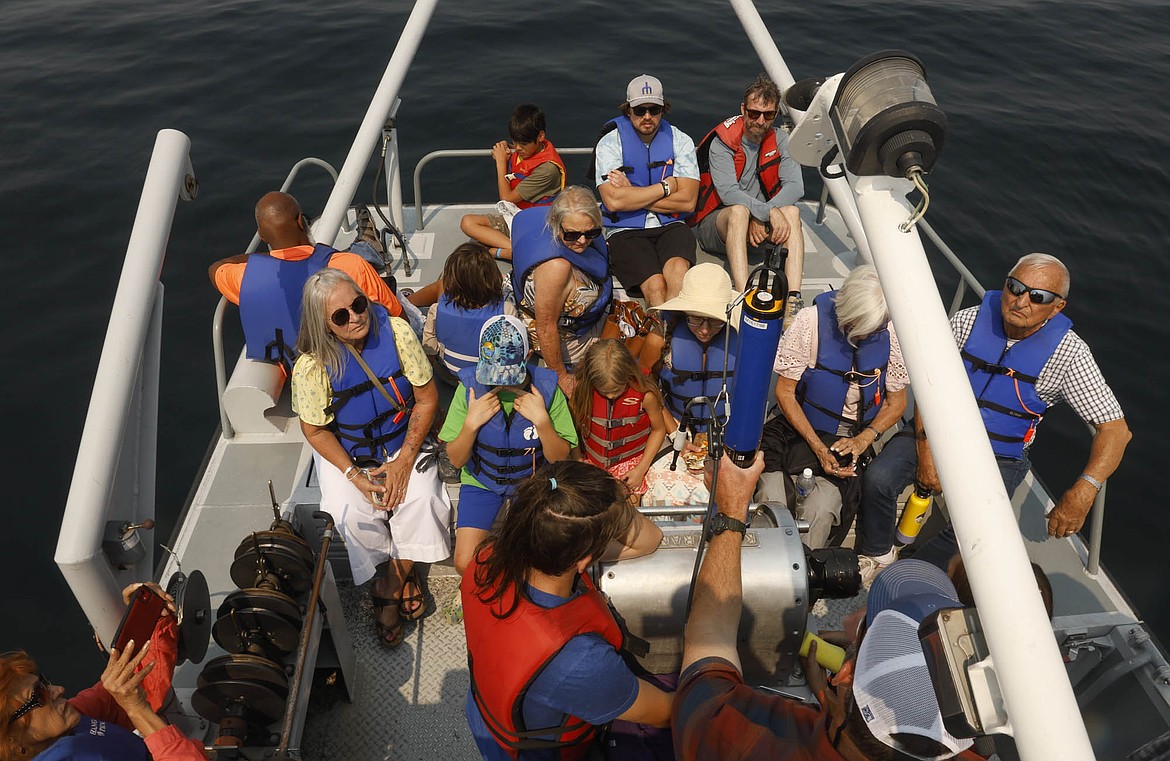
Open house attendees take a ride on the station's research boat to learn about current research and sampling methods. (Vivianne Ostheimer photo)
Nearly 300 people braved the heat and smoky air to visit the Flathead Lake Biological Station for its annual open house on Friday, Aug. 7.
The event displays the breadth and diversity of the station’s work to the public.
A table piled with boxes of cherries welcomed guests of all ages to the event. Visitors could listen to researchers speak, ride the station’s research boat (the Jesse B), watch mussel-sniffing dogs in action, listen to live music, play games and have lunch.
More than 10 stations, staffed by bio station scientists and interns, showcased research and projects ranging from the impacts of Canadian mining on the watershed to invasive bullfrog management and children's programs.
Ernie Wiggin and his grandchildren wandered from exhibit to exhibit, stopping at an interactive table — one so large it had to be transported by forklift. The exhibit featured a water-filled replica of the lake showing how actions on land, such as pesticide use, can affect water quality and the overall ecosystem.
Wiggin said he’s been in Polson for “forever” — more than 60 years — but hasn’t been back to the bio station since a middle school field trip.
He often sees the Jesse B out on the lake and wonders what it’s doing.
“I was always intrigued by the giant crane on the back,” he said. “Were they pulling up wrecks, or what?”
At the open house, Wiggin and his grandchildren put on life jackets and climbed aboard the research boat for a ride to the deepest part of the lake.
“I got to ask the gentleman driving it, and he said the crane is to pull a huge net to bring up mysis shrimp,” Wiggin said.
The bio station samples mysis shrimp because they are a favorite food of lake trout, a nonnative species that has disrupted the lake’s ecosystem.
“ It's a lot of really good research these guys do,” Wiggin said. “And it's good to get the public knowledgeable about it.”
For Ian Withrow, the bio station’s marketing and communications manager, that kind of interaction is exactly what the open house is designed to create.
Withrow ran the welcome table and organized the event. From finding historical documents and curating exhibits to advertising and managing vendors, Withrow had a busy week. He started setting up tables at 1 a.m. on Friday to beat the heat. Withrow said the annual open house helps humanize science and the research happening at the station.
“It makes it less mysterious,” he said. “I mean, you hear ‘Flathead Lake Biological Station,’ and that’s almost an ominous title. But we’re a part of the community, and they're a part of the work we’re doing.”
Withrow estimated that between 250 and 300 people attended this year’s open house, an event he sees as exemplary of director Jim Elser’s legacy at the station: community outreach and involvement. Elser and his wife, bio station education liaison Monica Elser, are both retiring at the end of the year.
“Jim was very invested in community outreach from the very beginning,” Withrow said. “From the minute he got here, it was about transparency. It was about opening the doors. It was about making everything accessible to people as much as possible.”
This year’s open house gave Elser a chance to reflect on his time at the station and the work ahead. In his 2026 State of the Lake talk, he said Flathead Lake remains chilly, low phosphorus, and mussel—free — signs of a healthy ecosystem — but faces emerging threats from pesticides, microplastics, pharmaceuticals and personal care products, PFAS and increasing development around the lake. 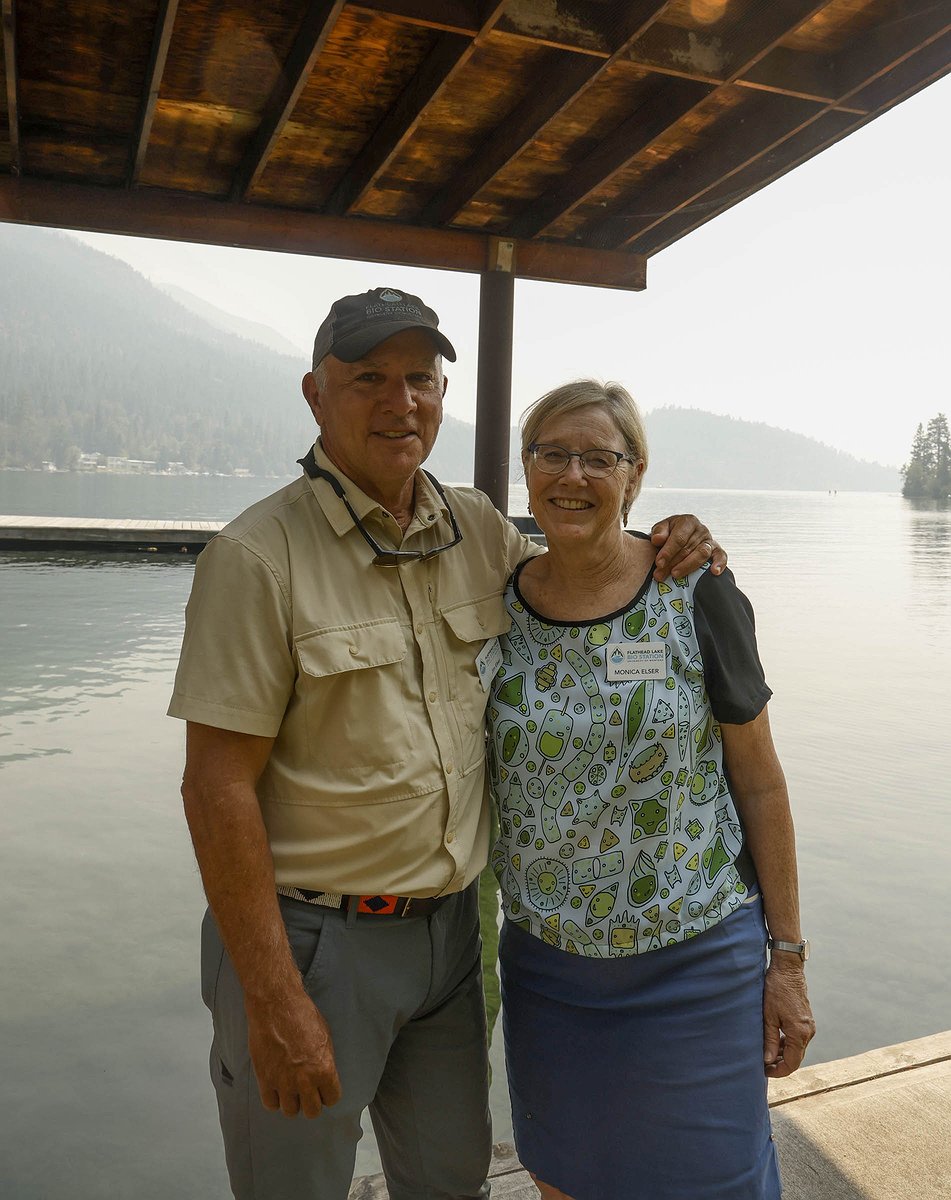 Jim and Monica Elser pose by the bio station's dock on Flathead Lake. The couple is retiring from the station after this year and moving to California. (Vivianne Ostheimer photo)
Collecting data is how scientists listen to the lake, Elser said. Continuous research and monitoring are needed to understand and address emerging issues.
“It’s our responsibility to speak of what we’ve learned and heard,” he said to the crowd. “That’s what we do here at the station: we listen, very carefully, and we try to understand the message and communicate it. I hope that, with your support going forward, the station will continue to prosper and the data will continue to be produced.”
Elser said the station’s next director is expected to be announced in late fall, probably no earlier than October.
“But I’m here to say that I’m not dead yet!” Elser joked.
In retirement, he plans to continue working on a phosphorus sustainability project at Arizona State University and teach for a year at the University of Granada in Spain.
Elser closed his remarks with “The Fifth Day” by Jane Hirshfield, a poem about the 2017 removal of scientific information from federal agency websites.
“‘On the fifth day, the scientists who studied the rivers were forbidden to speak or to study the rivers…’” he read.
“We’re at a challenging time in science right now,” he said, “but the bio station will not be silent as it speaks for the rivers and the lake.”
The crowd gave Elser a standing ovation.