
Huckleberry crop key to a bear's reproduction
Shane Lisowski | Bigfork Eagle | UPDATED 1 hour, 34 minutes AGO
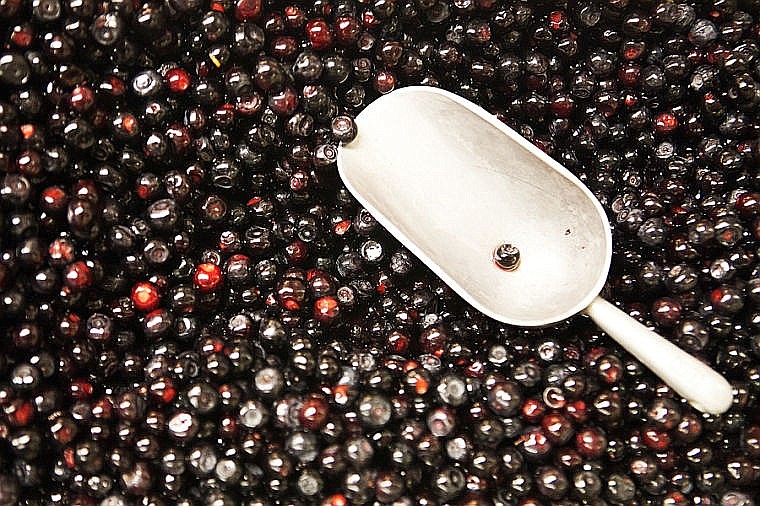
A scoop sits in a bin of huckleberries at the Huckleberry Patch in Hungry Horse in this July 24, 2014, file photo. (Patrick Cote/Daily Inter Lake)
This year seems to be the year of the cub. There are a lot of cubs, both black and grizzly bear, out running with moms throughout the Swan watershed. This is a great indicator of last fall’s huckleberry crop.
Other indicators are younger ages of first-time moms, and the many pictures I receive from my own and many other game cameras scattered to the four winds. Nearly all the bears this spring looked as if they were ready to go to bed for a long sleep, not that they had just awoken.
Age of first reproduction is directly related to a bear's ability to secure quality foods, huckleberries, as we all, hopefully, have experienced are a pretty quality food. Putting on that fall fat, doing the old “Special K pinch an inch test” to assess our fat levels, thus our fitness. Not the fitness they talk about in the gym commercials, but the ability to grow, birth and rear offspring.
Reproduction is an expensive endeavor, energetically speaking. While bears don’t usually incur the first car, or college tuition costs, they do have security and food costs, lots and lots of food costs.
So, to offset these costs they bank those huckleberries as inches of fat and make withdrawals every time they nurse. The more fat in those accounts the more cubs they can support and for a longer time.
Another indicator of last year’s berry crop is the large number of grizzly bears dispersing their young as yearlings rather than carrying them until they are 2-year-olds.
The Rocky Mountain front on the east side of the divide regularly experiences female bears kicking off their yearlings, while in the Swan it is a rare event. This year, in the Swan, three of the four radio-collared females with yearlings did so, resulting in five yearlings dispersing and only one staying with mom.
As we don’t have but a small proportion of the females radioed, and not all females will have yearlings, it is still a sizable number of potentially dispersing yearlings. This likely means that females came out of their den in such good shape, their bodies said they could try to have kids in quicker succession. Meaning, disperse last year's cubs and breed in May and June and go to bed in the coming fall. Do the pinch an inch and see how things are looking and maybe implant and officially become pregnant, starting the cycle anew.
Remember, bears have delayed implantation. They breed in the spring but the fertilized egg(s) free floats in the uterus with cell division stopping after it has become a several hundred cell blastocyst. This only implants after the bear’s body assesses its condition or fitness. If the bear's body, the pinch an inch test, gives the green light, with hormonal changes the uterine walls become engorged and the blastocyst implants, now the bear is pregnant, usually around first part of November. Then after an eight-week gestation period cub(s) are born the first two weeks of January, weighing less than a pound (12-14 ounces).
Speaking of huckleberries, hopefully everyone still has some from last year. While it is still too early to be sure, this year’s crop does not appear overly promising. Certainly not to last year’s level, where even the lodgepole pines seemed to have huckleberries. There are several theories as to why it may be a lower to poor yield, mostly weather driven, although it was suggested that the bushes are simply tired from last season’s effort.
But the more likely is the cold and the timing of the rain we had this spring. While the bushes seem to flower in abundance, many were impacted by the late hard frosts. Some flowers were knocked off by the rain.
But the real impact may have been on the pollinators. The colder temperatures kept them in, rather than out flying flower to flower collecting and spreading the pollen, a critical step in the beginnings of a berry.
But fear not. Bears have the ability to find good hucks even on bad years, plus there are lots of alternate natural foods for them, but few as good as a thumbnail sized purple berry of deliciousness. So, when out picking, be gentle on the plant, carry bear spray, have fun and leave some for the bears.
As always, enjoy our great outdoors, keep bear attractants locked up, and report conflicts to Fish, Wildlife and Parks when they occur. The sooner we know of an issue, the more options we have available and the higher success in addressing the problem and for the bear.
Shane Lisowski is bear conflict prevention coordinator with Swan Valley Connections.