
Superior native serves as a member of Navy’s submarine force
JAMES GREEN Navy Office of Community Outreach | Valley Press-Mineral Independent | UPDATED 1 day, 17 hours AGO
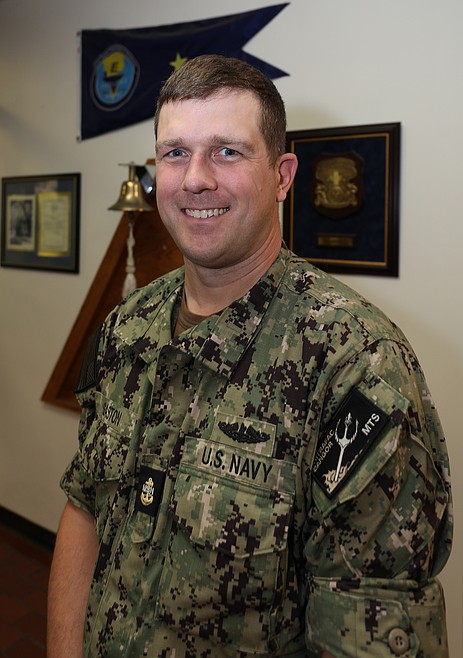
Chief Petty Officer Jeffrey Gaston. (Diamond Kyles photo)
Chief Petty Officer Jeffrey Gaston, a native of Superior serves in the U.S. Navy assigned to Trident Training Facility Bangor at Naval Base Kitsap-Bangor, Washington, where sailors receive the training needed to serve aboard and support the submarine force.
Gaston graduated from Superior High School in 2006.
The skills and values needed to succeed in the Navy are similar to those found in Superior.
“Growing up in a small town, I learned the importance of everyone working together,” Gaston said. “Submarines are a small community, and taking care of each other is paramount in this field.”
Gaston joined the Navy 15 years ago and now serves as an electrician’s mate (nuclear power).
“I joined the Navy to honor a family tradition of military service,” Gaston said. “My grandfather served in the Coast Guard, and my dad served in the Air Force, and I wanted to be part of something similar to that.”
TTFB trains officers and enlisted sailors to operate and maintain their submarines. TTFB provides replacement, conversion, off-crew and team training for submarine crews and submarine support personnel.
Through modernized training, TTFB remains ready to meet today’s challenges while building highly skilled and technically proficient warfighters. TTFB provides hands-on learning technologies that use a variety of submarine applications, all of which provide sailors opportunities to create training environments that continually refine their learning experiences.
Known as America’s “Apex Predators,” the Navy’s submarine force operates a large fleet of technologically advanced vessels. These submarines are capable of conducting rapid defensive and offensive operations around the world to deter aggression and defend the U.S. homeland. A major component of that maritime security is homeported at Naval Base Kitsap-Bangor.
There are three basic types of submarines: fast-attack submarines, ballistic-missile submarines and guided-missile submarines.
Fast-attack submarines are designed to hunt down and destroy enemy submarines and surface ships; strike targets ashore with cruise missiles; support special operations missions; conduct intelligence, surveillance, and reconnaissance missions; and engage in mine warfare. The Virginia-class fast-attack submarine is the most advanced submarine in the world today. It combines stealth and payload capability to meet combatant commanders’ demands in this era of strategic competition.
The Navy’s ballistic-missile submarines, often referred to as “boomers,” serve as a strategic deterrent by providing an undetectable platform for submarine-launched ballistic missiles. SSBNs are designed specifically for stealth, extended patrols and the precise delivery of missiles. The Columbia-class ballistic-missile submarine will be the largest, most capable and most advanced submarine produced by the U.S. – replacing the current Ohio-class ballistic-missile submarines to ensure continuous sea-based strategic deterrence into the 2080s.
Guided-missile submarines provide the Navy with unprecedented strike and special operation mission capabilities from a stealthy, clandestine platform. Each guided-missile submarine is capable of carrying 154 Tomahawk cruise missiles, plus a complement of heavyweight torpedoes to be fired through four torpedo tubes.
Strategic deterrence is the nation’s ultimate insurance program, according to Navy officials. As a member of the submarine force, Gaston is part of a rich 126-year history of the U.S. Navy’s most versatile weapons platform, capable of taking the fight to the enemy in the defense of America and its allies.
The Pacific Submarine Force provides strategic deterrence, anti-submarine warfare, anti-surface warfare, precision land strike, intelligence, surveillance, reconnaissance, early warning, and special warfare capabilities around the globe.
With 90% of global commerce traveling by sea and access to the internet relying on the security of undersea fiber-optic cables, Navy officials continue to emphasize that the prosperity of the United States is directly linked to recruiting and retaining talented people from across the rich fabric of America.
Gaston has had many opportunities to achieve accomplishments during military service.
“I am most proud of being Submarine Force, U.S. Pacific Fleet Sailor of the Year in 2023,” Gaston said. “I took care of my sailors when we had an unexpected chief loss, and as a result, I was meritoriously promoted to chief.”
Gaston serves a Navy that operates far forward, around the world and around the clock, promoting the nation’s prosperity and security.
“Serving in the Navy is who I am,” Gaston said. “I love my job, and it is important to me to be able to continue to serve and defend my country and loved ones. Being a submariner in the Navy made me a better person. It has given me a greater purpose in life.”
Gaston is grateful to others for helping make a Navy career possible.
“I would like to thank my wife, Andrea, and my kids for their support,” Gaston said. “Without them, I wouldn’t be doing what I do. I also want to thank my parents, Steve and Diane, and my in-laws, Danny and Romina, for always being there and supporting our family when I am on mission.”