
Good Grief: Flathead Lake summer camp offers healing for grieving children
ELSA ERICKSEN | Hagadone News Network | UPDATED 1 month, 3 weeks AGO
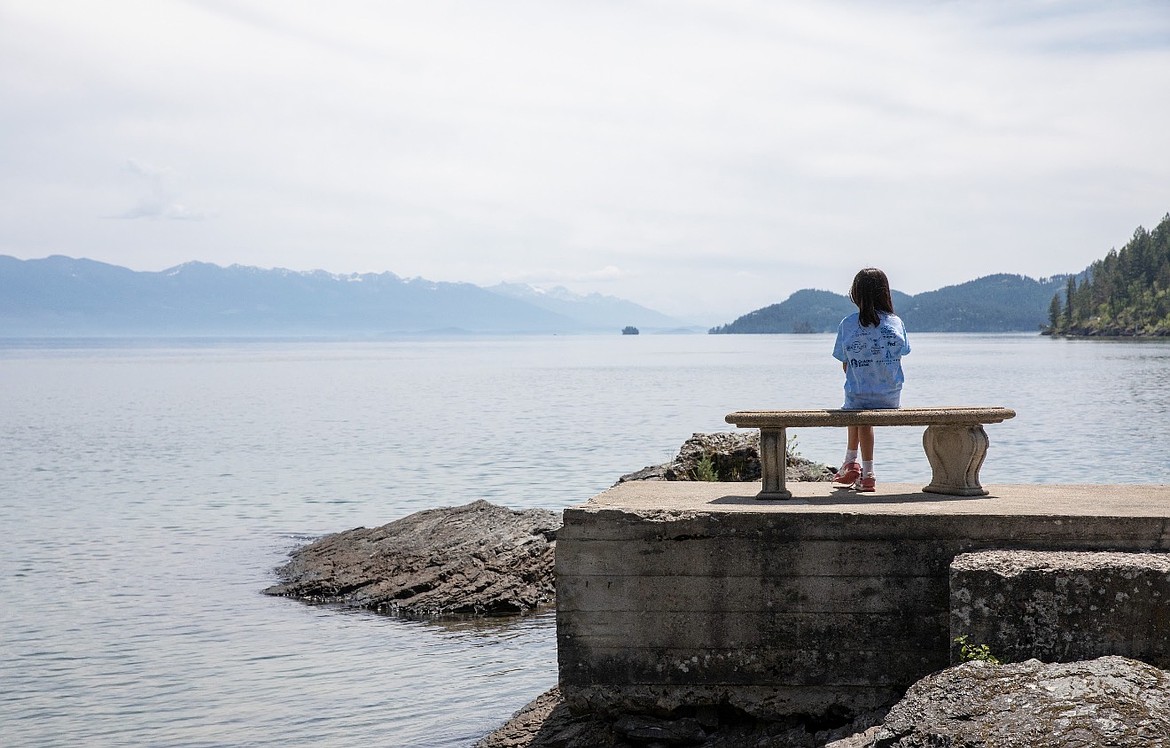
A Good Grief Camp camper sits on a bench at Flathead Lake. (Courtesy Good Grief Group)
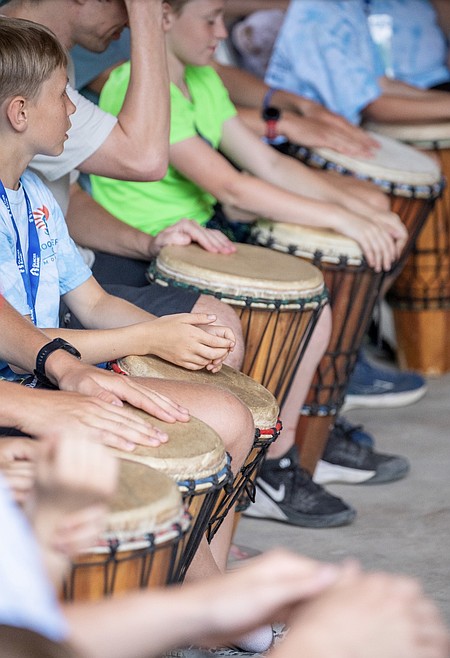
Campers take part in an African drumming circle led by the Drum Brothers of Arlee at Good Grief Camp. (Courtesy Good Grief Group)
A Good Grief banner hangs at Flathead Lutheran Bible Camp during Good Grief Camp. (Courtesy Good Grief Group)

A camper jumps off a diving board into Flathead Lake at Good Grief Camp. (Courtesy Good Grief Camp)
On June 14, a bus arrived from Kalispell to Flathead Lake Bible Camp to drop off a group of about 30 children between the ages of 6 and 12 at the forested camp along the lake's west shore. As the kids disembarked, there was the normal nervous summer camp chatter: some had been coming to Good Grief Camp for years and had friends and knew what to expect, while others only had the 30-minute drive from Kalispell to wonder what the next four days had in store.
Among the campers was 8-year-old Jeremiah Humphrey. Back for his third year, Jeremiah joined the other kids as they found their assigned cabins, dropping duffel bags and sleeping bags on bunk beds, and looked forward to the coming days in which he would hike on the nearby trails, swim in the lake and tackle an obstacle course.
In the evening on the first night, Jeremiah sat in a circle with the other campers, holding an African hand drum. The Drum Brothers, from Arlee, showed the children how to find a rhythm, and Jeremiah tapped his drum along with the other campers until the noise reached a rumbling crescendo.
As the noise died down, the energy still hummed in the air, giving a weight to the moment. In the quiet, the Drum Brothers asked the campers to name who they were there for.
In quiet voices, the campers named a mother or an uncle. When it came time for Jeremiah to share, he said the name of his father, Joshua Humphrey, who had died three years earlier. As he did so, he lit a candle and placed it in a pan of water.
When every loved one had been named, the campers gathered around the candles, and the Drum Brothers led them in an African chant. For some, the emotions that surfaced were too much to bear. They sank to the floor; eyes flooded with tears.
While Good Grief Camp in many ways resembles an ordinary summer camp on Flathead Lake, these are the moments that, despite the discomfort they bring, mean the most to the young campers.
"I think that the biggest impact that it's had on Jeremiah is that he felt less alone, and he made some really good friends at camp who we have been able to stay connected with who also lost their dad. It can be very isolating, especially for a child," Jeremiah's mother, Chelcee Humphrey, said before tearing up. "As a parent, going through the loss of my husband and the worst moment of our lives, it's hard to know how to support your child who has lost their parent, and I'm very grateful."
"We're the camp that nobody wants their kids to come to," Good Grief's founder Jo Ann Graves-Gill said with a wry smile. "But thank goodness they have a camp to come to."
This year is the 13th year Graves-Gill has run Good Grief since she started the organization in 2014. The nonprofit's mission is to cultivate a safe space for young campers to “feel, heal and grow” following the death of a significant family member and break the sense of isolation that children often feel while grieving a loved one.
Good Grief runs three camps per year. The camp in June is for children ages 6 to 12, a tween camp in October is for ages 13 to 15 and a day camp for both age groups takes place between Christmas and New Year's Day to help families get through the holidays. Each year has a theme, an animal meant to represent each cohort, and this year's was the bald eagle.
Over the course of their time at camp (four days for kids and three days for tweens), campers take part in a mix of fun and ceremonial activities meant to foster friendships, honor their loved ones and equip them to process their emotions when they return home.
In Montana, one out of 10 children experience the death of a parent or sibling by age 18, according to research from Judi's House, a nonprofit devoted to supporting grieving children and their families. Accidental deaths and suicides led to 45% of those deaths.
"Studies show that if kids aren't given an opportunity to deal with that grief, there are typically school problems, mental health problems, behavioral problems," Graves-Gill said.
Developmentally, children are still learning to comprehend death, making it harder for them to understand and process what has happened. Chelcee's youngest son, Brooks, was just 1 when his father died, but Jeremiah was 6 and extremely close to Joshua, she said. When Jeremiah returned to school, he felt very alone. His classmates didn't understand what it was like to have lost the person who provided a sense of security and guidance and was supposed to be a constant at the milestone events of life.
Graves-Gill has experienced firsthand how important it is for people who are grieving to understand they're not alone. Her own brother died by suicide just six days before her 21st birthday, which she said knocked her legs out from under her. A decade later, as Graves-Gill was beginning a career as a therapist, her sister died unexpectedly of an unknown heart condition. Graves-Gill traveled to the Grief Recovery Institute in California where, taking part in group sessions, she realized how powerful it was to know that she was not alone in her grief.
Graves-Gill knew she had found her heart's work. She switched her focus from alcohol and drug counseling to grief therapy, opening up a private practice that she operated for 24 years before her retirement in 2022.
In the mid 2000s, she started volunteering with Camp Francis, a grief camp for children outside of Great Falls. Graves-Gill couldn't imagine what it was like for these children to navigate such a shattering loss at such an early age, thinking back to some of the destructive choices she had made in the wake of her brother's death.
At the first Good Grief Camp, Graves-Gill hosted nine campers, and the volunteers were mostly students in a grief class she taught at Flathead Valley Community College. Today, more than 30 kids come to camp, with many returning year after year and then staying on as volunteers after they age out.
Good Grief Camp is entirely free for campers, made possible by donors who support the camp's mission.
"Last year, 82% of our campers came from families below the poverty line," Graves-Gill said. "I'm actually very proud of that because these are kiddos who wouldn't get four days on Flathead Lake otherwise."
Prospective volunteers often wonder how a grief camp for kids will be "fun," Graves-Gill said. While fun isn't necessarily the right word, Good Grief Camp does feature the activities kids expect during any normal summer camp experience. Campers take hikes with Franz Inglefinger, a wildlife biologist who teaches them how to use a compass and is known to hide chocolate bars along the trail. There's an obstacle course and arts and crafts and water activities at the lake. The time spent outside in nature is healing in its own way, as well as an opportunity for the campers to bond with one another.
But dispersed throughout the camp's schedule are what Graves-Gill call "sacred ceremonies" that are drawn from traditions used by cultures around the world to honor the dead.
"We don't know how to do grief and loss in this country," Graves-Gill said. "We as a society get uncomfortable with that: 'Hurry along, time's up, let's move on.' It's about our own discomfort, and I think there are other cultures that do it better than we do."
"People are weird about grief," Chelcee echoed. "We don't talk about it, and it's so much worse when people just pretend like nothing happened. So this is a very significant thing for Jeremiah, to have a space where he can just freely talk about what happened and honor his dad."
In African villages, Graves-Gill told the campers on the second night, when someone dies, the tribal members line up and tell the family members, "I'm sorry for your loss. Tell me your story."
One by one, the campers and volunteers told the stories of their family members, of the grandfather who was supposed to be there for the hunter safety course or the dad who had never missed a football game. They placed a handful of colorful sand in a vase and rang a Tibetan singing bowl, meant to honor the hard work of the storytelling.
This night is the most challenging for the volunteers, Graves-Gill said. But it's also the most important for the campers, as they realize they're not alone in their grief and their pain.
"We had one camper who became a volunteer and wrote in one of his cards, 'Typically I don't like to cry, but I cried a lot here, and I cried with my new friends and I feel a lot better.' It's statements like that that make us realize that this is what we're here for," Graves-Gill said.
On the last night of Good Grief Camp, the adults in the campers' lives are invited to camp for lunch and one final ceremony. Chelcee joined Jeremiah, and together they placed a rose in a flower wreath in honor of Joshua.
When the rose wreath was complete, the campers looked on as volunteers gently placed it on the calm waters of Flathead Lake. Together, the family members remembered their loved ones and, as the soft words of Whitney Houston's "I Will Always Love You" whispered through the trees, a juvenile bald eagle soared through the blue sky above them.
For more information about Good Grief Camp, visit goodgriefcamp.org/. As a nonprofit, Good Grief Camp is entirely reliant on community donations to make its camp a reality each year and is participating in this year's Great Fish Community Challenge.
Reporter Elsa Ericksen can be reached at 406-758-4459 or [email protected]. If you value local journalism, pledge your support at dailyinterlake.com/support.
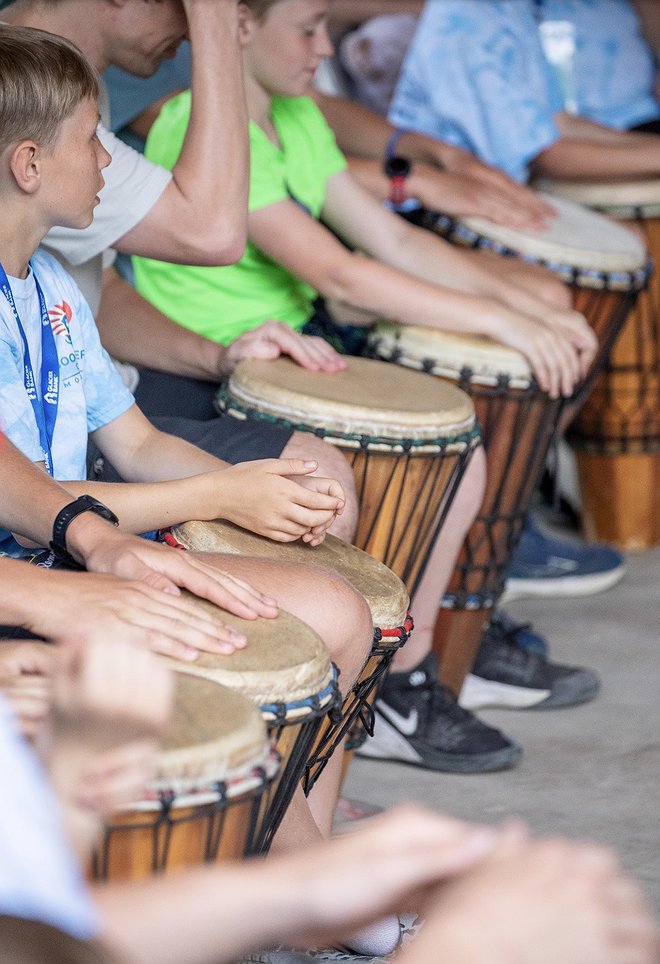 Campers take part in an African drumming circle led by the Drum Brothers of Arlee at Good Grief Camp. (Courtesy Good Grief Group)
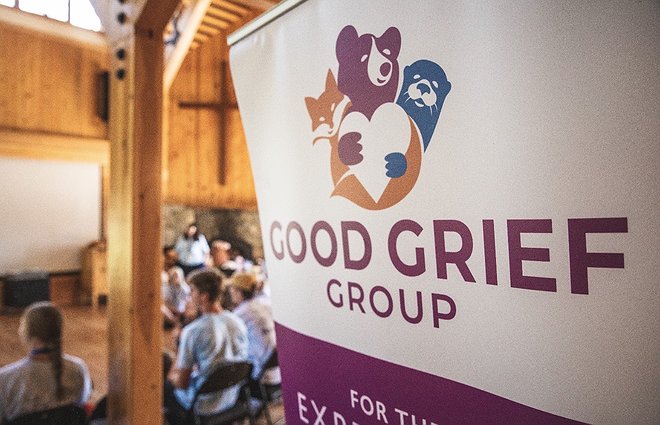 A Good Grief banner hangs at Flathead Lutheran Bible Camp during Good Grief Camp. (Courtesy Good Grief Group)
 A camper jumps off a diving board into Flathead Lake at Good Grief Camp. (Courtesy Good Grief Camp)
ARTICLES BY ELSA ERICKSEN
The century club: Montana's centenarians reflect on 100 years of life
Completing those hundred laps around the sun is no easy feat. There are an estimated 108,000 centenarians in the United States.
Lakeside residents turn to citizen-initiated zoning to protect neighborhood
For the last three years, Fetveit has spearheaded a neighbor-led effort to create a new zoning district in Lakeside that would protect this area along the lakeshore from overdevelopment.
Effort to rebuild iconic Bigfork cross is underway
When completed, the new cross will stand 100 feet tall with a crossbeam that spans 53 feet. The metal roof trusses that will be used to construct the cross will be 5 feet wide.