
Idaho leaders weigh in on grizzly plan
KAYE THORNBRUGH | Hagadone News Network | UPDATED 1 month, 3 weeks AGO
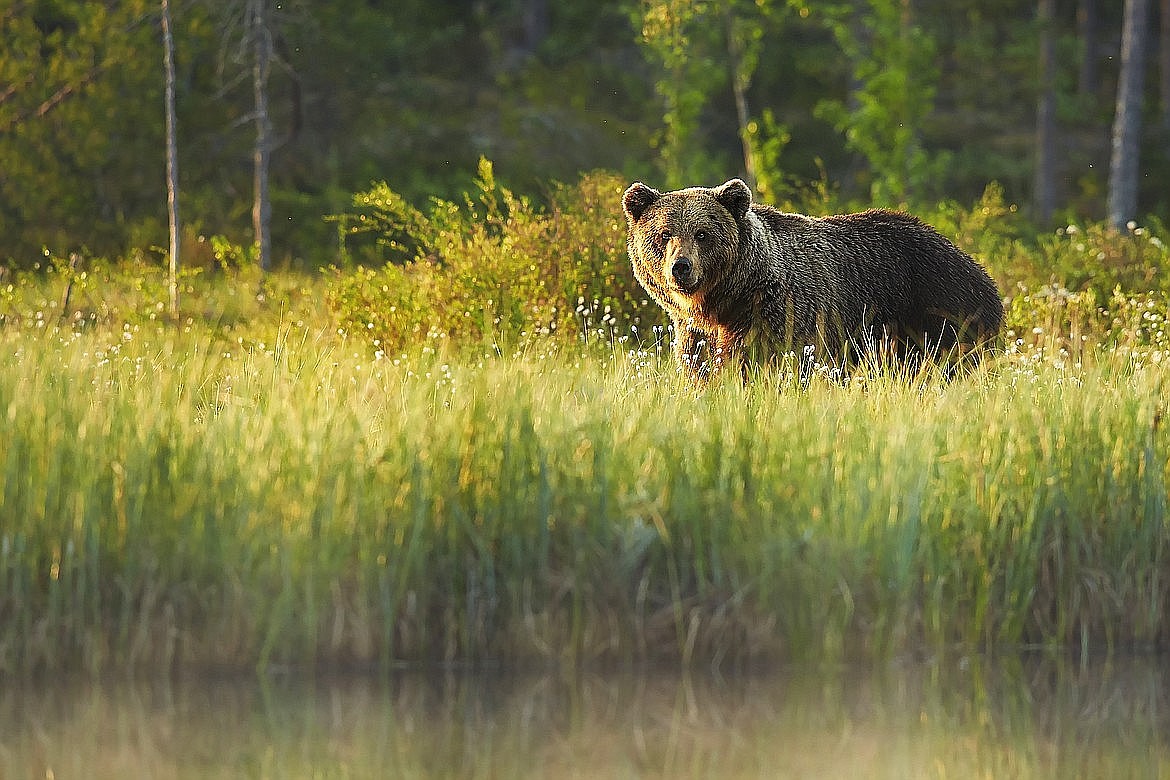
A grizzly bear looks up from a field in Idaho.
Photo courtesy of Idaho Department of Fish and Game
Kaye Thornbrugh is a second-generation Kootenai County resident who has been with the Coeur d’Alene Press for six years. She primarily covers Kootenai County’s government, as well as law enforcement, the legal system and North Idaho College. | August 20, 2026 1:06 AM
Idaho officials and conservationists are weighing in this week, taking opposite stances on the federal government's plan to shift management responsibility for grizzly bear recovery to the state level, giving greater control to Idaho, Montana and Wyoming.
Announced in July, the proposed rule from the U.S. Fish and Wildlife Service doesn't remove the grizzly bear from the Endangered Species list or change geographic boundaries of the management plan.
The proposal would revise the Endangered Species Act's "4(d) rule," allowing the U.S. Fish and Wildlife Service to create specific rules for a species with a "threatened" designation.
Under the current rule, harming or killing grizzlies is illegal unless federal authorities specifically permit it. The proposed rule would potentially expand the allowable killing of grizzly bears.
Idaho leaders, including Gov. Brad Little and U.S. Sens. Jim Risch and Mike Crapo, have all praised the proposal.
"Increasing state authority to manage grizzly bears ensures our own local wildlife agencies, who understand Idaho’s environment best, can follow the science and make common sense conservation decisions without bureaucratic inefficiencies," Risch said in July.
Attorney General Raúl Labrador announced Wednesday that he submitted formal comments on the proposal to the U.S. Fish and Wildlife Service this week and supports the change.
"For the past five decades, Idaho has grown the grizzly bear population back to health through real investment and sacrifice from our state agencies and local communities," Labrador said in a news release. "Now it's time the federal government admitted that success instead of rewarding armchair critics and taxpayer-funded activist lawyers who want to run our state from a courtroom."
Many environmental groups have criticized the proposal, arguing that it could jeopardize grizzly bear recovery.
"This rule appears designed to allow potentially unlimited mortality of grizzly bears outside of those core recovery areas," said Jenny Harbine, managing attorney for the Northern Rockies regional office of Earthjustice, a nonprofit environmental law organization. "That would set grizzly bear progress that we've achieved over the past decades back to an era where we were really concerned about the grizzly bear's very survival."
In comments submitted to the U.S. Fish and Wildlife Service this week, Earthjustice said the revised proposed management rule "would unacceptably weaken federal protections for grizzly bears just as the federal government has taken separate actions that jeopardize grizzly bear habitat."
The change would turn authority for grizzly bear management "over to states whose political branches have proven hostile to continued protection," setting back recovery progress, according to Earthjustice.
"The Northern Rockies states of Idaho, Wyoming and Montana have demonstrated, particularly when it comes to management of the states' native wildlife, that politics have a tendency to carry the day more than science," said Jenny Harbine, managing attorney for the Northern Rockies regional office of Earthjustice, a nonprofit environmental law organization. "That's true when state legislators and other state elected officials get involved."
Harbine said the proposal lacks assurances that state oversight of grizzly bear management won't jeopardize recovery, nor does it allow for the U.S. Fish and Wildlife Service to take over grizzly bear management if state management puts the animals in harm's way.
Grizzly bears across the contiguous United States were listed under the Endangered Species Act in 1975. At that time, an estimated 300 to 400 grizzlies were left in the wild.
According to Earthjustice, although grizzly bears in the lower 48 states have grown in numbers, some recovery areas remain unoccupied and most other subpopulations, especially small and isolated populations, experience insufficient population sizes and/or genetic exchange to maintain long-term viability.
In his comments, Labrador called on the federal government to delist grizzly bears from the Endangered Species Act.
"The science and the law both say these bears should be delisted," he said. "Until that happens, Idaho needs a rule that protects our hunters, trappers and rural communities from being sued into submission by radical environmentalist groups."
Harbine said true grizzly bear recovery is within reach if state and federal partners work together to make it a reality.
"Grizzly bears are part of our natural landscape and heritage in the west," she said. "One of the things that make living in states like Montana, Idaho and Wyoming special is we still have intact wilderness that is home to natural wildlife. When we protect grizzly bears, we protect a host of wildlife species that occupy that same land."
She said states should double down on their commitment to grizzly bear protection now instead of backing off.
"We need grizzly bear protection now more than ever," Harbine said. "It's not the time to weaken on it."
ARTICLES BY KAYE THORNBRUGH

Stateline shooter pleads guilty to manslaughter
A DoorDash driver who fatally shot a pedestrian during a road rage incident near Stateline Speedway has pleaded guilty to voluntary manslaughter, though whether a judge will accept the pretrial settlement offer in the case remains to be seen.
Stateline shooter pleads guilty to manslaughter
Prosecutors originally charged Edsel Johnson with first-degree murder
A DoorDash driver who fatally shot a pedestrian during a road rage incident near Stateline Speedway has pleaded guilty to voluntary manslaughter, though whether a judge will accept the pretrial settlement offer in the case remains to be seen.

Kootenai County history revealed
Community members get close-up look at time capsule contents
Liz Boutin is no stranger to historical artifacts. A museum professional and fine artist, Boutin said she's handled Egyptian and Greek items that date back to antiquity. But she had a new experience this summer, after local historical preservationists retrieved a 100-year time capsule from inside the outer wall of the old Kootenai County courthouse.