
Montana Supreme Court denies Knudsen’s bid to block legislators from November ballot
VICTORIA EAVIS Montana Free Press | Daily Inter-Lake | UPDATED 3 weeks, 2 days AGO
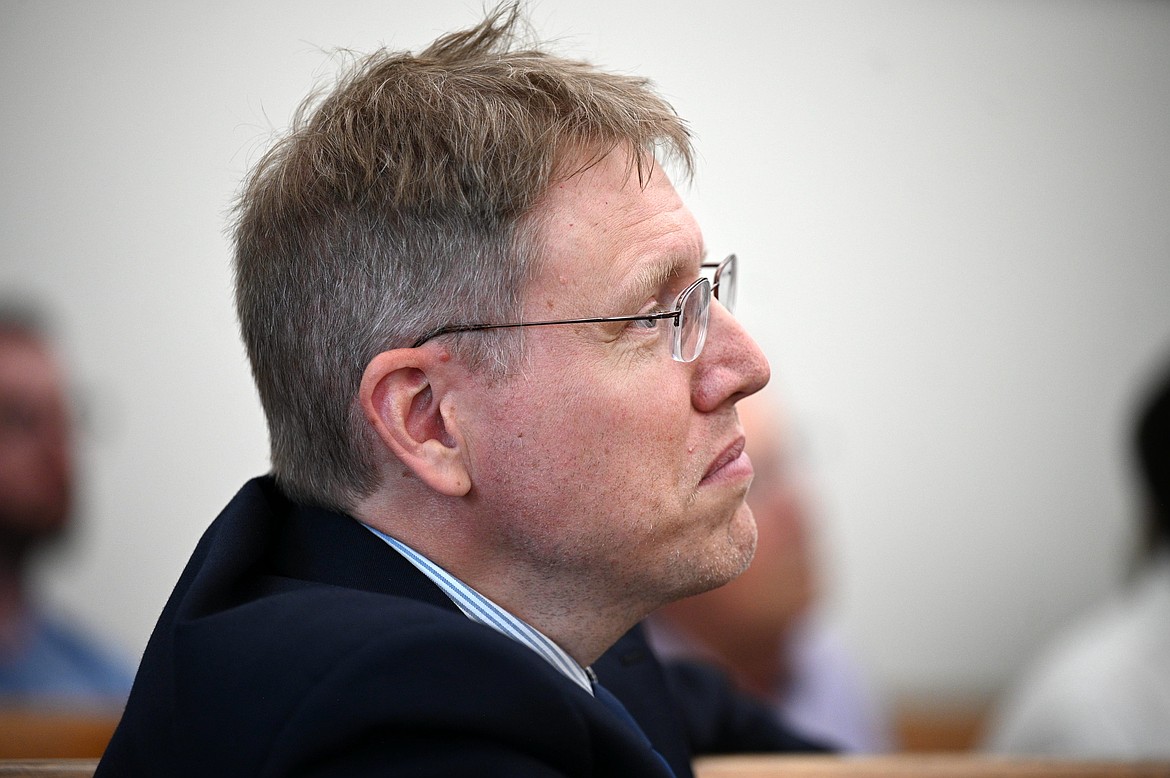
Rep. Steve Fitzpatrick, R-Great Falls, listens to arguments regarding Montana Republican Attorney General Austin Knudsen’s legal opinion on the state’s term limit law, which could block Fitzpatrick from being eligible to run for the state House in the 2026 election cycle, on Aug. 18, 2026, in Helena. (Lauren Miller/ Montana Free Press/CatchLight Local/Report for America)
In yet another development this week in the legal dispute between Republican legislators and the Republican attorney general, the Montana Supreme Court Wednesday evening denied a request to intervene in the case.
On Wednesday morning, Lewis and Clark County District Court Judge Christopher Abbott blocked a recent attorney general opinion that would have kept two Republican candidates for the Legislature off the general election ballot. A few hours later, Attorney General Austin Knudsen appealed that decision to the Montana Supreme Court and asked the high court to immediately intervene and block Abbott’s ruling.
A five-justice panel of the Montana Supreme Court unanimously denied the request in less than two hours from the time the original petition was filed to when the decision was released.
Rep. Llew Jones, R-Conrad, and Rep. Steve Fitzpatrick, R-Great Falls, two highly influential legislators, sued Knudsen last week following his new legal opinion on term-limit laws, as Knudsen’s opinion would have made them ineligible to seek reelection.
It is now likely that both Jones and Fitzpatrick will be eligible for the November ballot in Senate District 9 and House District 24, respectively.
Attorney General Communications Director Amanda Braynack said in an emailed statement Wednesday evening that Knudsen’s office has not yet determined what it will do in response to the ruling.
“We’ll continue to defend the constitution and the term limits overwhelmingly supported by Montanans,” she said in an email. “We are reviewing the ruling to determine next steps.”
For nearly 15 years, Montana has allowed a legislator to serve the statutory maximum of eight years in the state House, then serve eight years in the Senate, and then immediately return to the House. Switching from one chamber of the Legislature to the other (as both Jones and Fitzpatrick have done) to work around Montana’s term limits has become an accepted strategy employed by legislators of both parties. Knudsen’s opinion disagrees with the interpretation and calls the practice unconstitutional.
The Montana secretary of state has a statutory deadline of Thursday to certify ballots, so all parties were racing against the clock, particularly because Knudsen’s opinion was released less than two weeks before the certification deadline. In the petition to the state Supreme Court, Knudsen and his attorneys argued that the only remedy was for the high court to block Abbott’s decision and issue what’s called a “writ of supervisory control” over his court.
“Unless this Court intervenes immediately, ineligible candidates will be certificated for the November 2026 ballot tomorrow in violation of Article IV, Section 8 of the Montana Constitution,” the attorney general’s petition read.
The five-justice panel acknowledged the time crunch but placed the blame on Knudsen.
“…The urgency was created because of a matter that could have been raised much sooner,” the Supreme Court’s ruling read. “We have previously ruled that a party cannot manufacture urgency or emergency to fulfill the necessary criteria to justify a writ of supervisory control.”
Kalispell Republican and Senate President Matt Regier, who is one of Jones’ frequent adversaries, requested in July that Knudsen evaluate whether Jones is eligible for the ballot under the state’s laws on term limits.
In Abbott’s ruling, he wrote that Regier was acting outside the scope of his authority as Senate president when he requested the attorney general’s opinion, and that the attorney general does not have “unfettered authority” to issue binding opinions.
“We note that in this case, which raises novel legal and Constitutional issues which require careful consideration by the Court, there is no reasonable prospect of a ruling on the merits at literally the last possible hour for such a decision to go into effect,” the Supreme Court ruling read.