
Public outcry prompts Kalispell Council to pull license plate reader funding from budget
JACK UNDERHILL | Hagadone News Network | UPDATED 2 months AGO
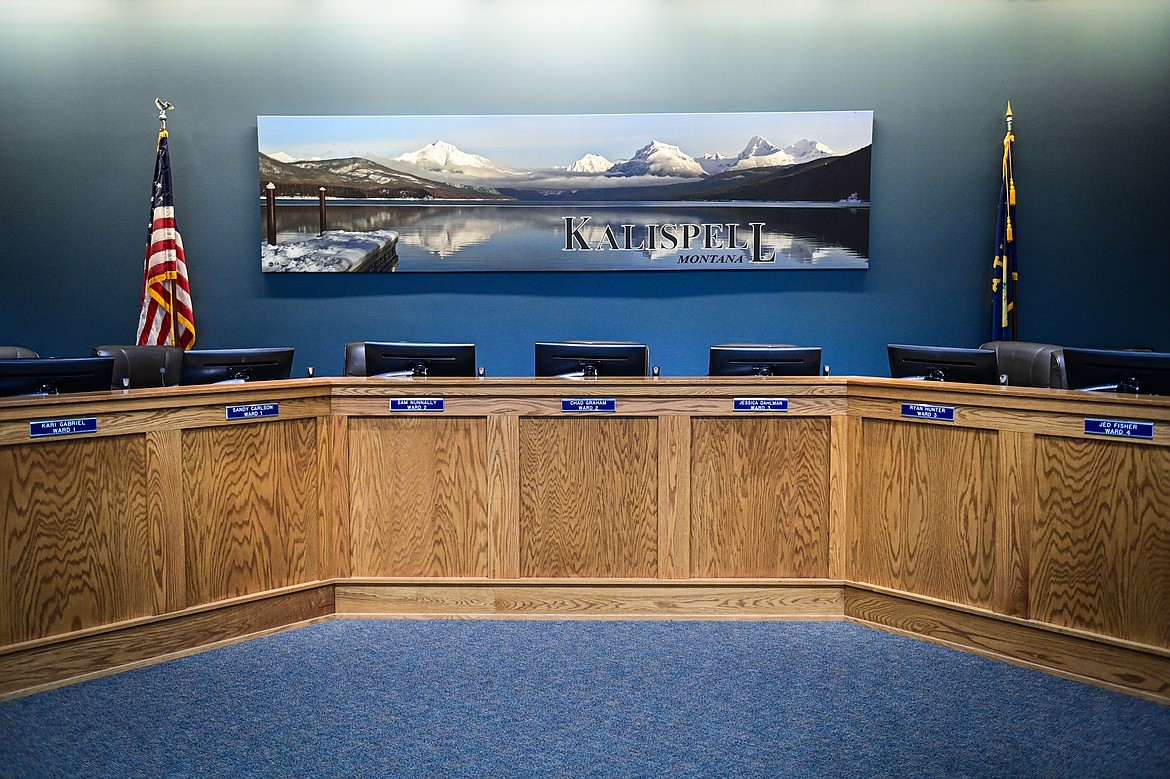
Kalispell City Council chambers in City Hall on Wednesday, April 3. (Casey Kreider/Daily Inter Lake)
Casey Kreider
KALISPELL GOVERNMENT, HOUSING AND TRANSPORTATION REPORTER Jack Underhill covers Kalispell city government, housing and transportation for the Daily Inter Lake. His reporting focuses on how local policy decisions affect residents and the rapidly growing Flathead Valley. Underhill has reported on housing challenges, infrastructure issues and regional service providers across Montana. His work also includes accountability reporting on complex community issues and public institutions. Originally from Massachusetts, Underhill graduated from the University of Massachusetts, Amherst with a degree in Journalism before joining the Inter Lake. In his free time, Underhill enjoys mountain biking around the valley, skiing up on Big Mountain or exploring Glacier National Park. IMPACT: Jack’s work helps residents understand how growth, housing and infrastructure decisions affect the future of their community. | August 20, 2026 12:00 AM
Faced with mounting opposition, Kalispell City Council on Monday pulled money from its budget for license-plate reader technology intended to enforce downtown parking rules.
City Hall was packed Aug. 17 with people who live in and around Kalispell protesting the proposal to acquire a license-plate reader system to aid authorities in enforcing time limits in the municipality’s downtown and West Side Parking District, which is near Flathead High School.
The Kalispell Police Department had allocated $70,000 for the software in the proposed municipal budget for fiscal year 2027, but Council struck the line item before authorizing the rest of the roughly $180 million budget's expenditures.
Over roughly an hour of public comment, about 20 attendees of varying ages spoke against the technology, arguing it amounted to government surveillance that could be misused and accusing it of infringing on Fourth Amendment protections against unreasonable searches and seizures.
“If you have not committed a crime, you should not be in any database. We have that right," Whitefish resident and community organizer Leanette Galaz said.
Attendees also expressed concern over the technology's potential to be used inappropriately by law enforcement, a fear that has grown nationally amid reports of misuse.
A Washington Post article this month found that authorities have charged or accused at least 50 law enforcement officers of using license-plate readers for unauthorized purposes, including stalking their exes.
Talk radio host and Whitefish resident Dave von Kleist described the proposal's stated use for parking enforcement as "the camel's nose under the tent," arguing it could eventually be expanded or misused.
"The law is only as good as those who abide by them," he said.
City and police officials said the system would not be in a fixed place but attached to a vehicle patrolling permit and time-limit parking areas. It would not be linked to the criminal justice network and would only record the license plate number, type of vehicle and amount of time it's been in a given spot.
Officials planned to create a policy outlining the system's use before looking for a vendor, according to City Manager Jarod Nygren.
Councilors Kyle Waterman, Lisa Blank, Sam Nunnally and Sid Daoud voted to strike the budget line item allocating money for the system. Councilors Dustin Leftridge and Kari Gabriel opposed striking it. Mayor Ryan Hunter and Councilor Wes Walker were absent.
Fisher said he wanted to hear about other communities that have adopted the technology successfully before bringing it to Kalispell.
"I want to take a break, I want to take a break from this," Fisher added.
Daoud said he made a commitment to serve the will of the people, adding that he had not heard any support for the technology on Monday night.
Nygren reminded councilors that the Parking Advisory Board's recommendation in April to buy license-plate reader technology was inspired by a report from Downtown Kalispell Forward, a coalition comprised of six organizations that include the Kalispell Chamber of Commerce, Flathead Builders Association and Northwest Montana Association of Realtors.
“There were just some archaic inefficiencies that needed to be cleaned up," Kalispell Business Improvement District member Kisa Davison said about past parking enforcement. The organization is also part of Downtown Kalispell Forward.
Davison said the proposal was not intended to undermine privacy rights.
“I will say it’s not in opposition to privacy. And trust me ... the irony does not miss me that most of you are here from a Facebook post, it sounds like,” Davison said.
The coalition's report detailed several short-term solutions to solving what the group described as a perceived parking crunch deterring visitors from shopping downtown. Some suggestions were adopted by Council in July, including instituting higher, compounded parking fines. However, the changes were largely reliant on a license-plate reader system allowing more efficient enforcement.
WITHOUT THE system, the city will return to the traditional chalking method, as it did before the previous enforcement officer retired over the winter. Nygren said the officer could only make two rounds per day at best, effectively turning two-hour parking spaces into four-hour spaces.
“The only way to enforce the rules, unless Council gets rid of parking regulations downtown, is to go back to what we were doing previously," Nygren said.
Parking downtown has remained largely unenforced since the winter. Police Chief Jordan Venezio said he anticipated hiring a new employee until the license-plate reader system was procured.
The technology would have also freed up time for the parking officer to enforce other code violations around town, according to Nygren.
Blank said her vote to strike the funding from the budget was to have more time to absorb Monday night's public comments. She said the decision meant stepping back from a commitment she had made to constituents to strengthen code enforcement throughout the city.
"I am very sad to see that go," she said.
Leftridge urged councilors who voted to ax funding for the license-plate reader to propose alternative solutions to address the parking issue downtown.
COUNCIL STILL authorized the rest of the expenditures for fiscal year 2027 across all funds. The final budget amounted to about $180 million, roughly $10 million less than the preliminary budget due to adjustments to carryover amounts for capital projects, according to Nygren.
Council also authorized levying 153.23 mills, three less than the maximum allowed. Nygren said doing so would lower residential property taxes anywhere from 7% to 14%.
"There will be some significant tax relief with that," he said.
At the same time, about $500,000 was directed into a capital fund that Nygren said could help tackle an estimated $4 million worth of deferred maintenance in Kalispell's parks.
"We hit a balance of being able to set aside some for capital, which we got a huge list here of capital needs," he said.
Reporter Jack Underhill can be reached at 406-758-4407 or [email protected].
ARTICLES BY JACK UNDERHILL
Kalispell clears way for tiny homes by adopting building standards
Councilors on Monday added tiny homes to Kalispell's city code in a bid to make it easier to build the simpler, low-cost housing alternatives.

Glacier Park International Airport earns spot among nation’s resort airports
Glacier Park International Airport was named one of the nation’s top resort airports in USA Today’s 10BEST Readers’ Choice Awards.

Kalispell City Council to consider tiny home regulations
Kalispell City Council on Monday will vote on whether to add tiny homes to city code, allowing the municipality to inspect them and enforce building standards.