
Panel talks North Idaho housing solutions
RAY ERKU | Hagadone News Network | UPDATED 1 month, 3 weeks AGO
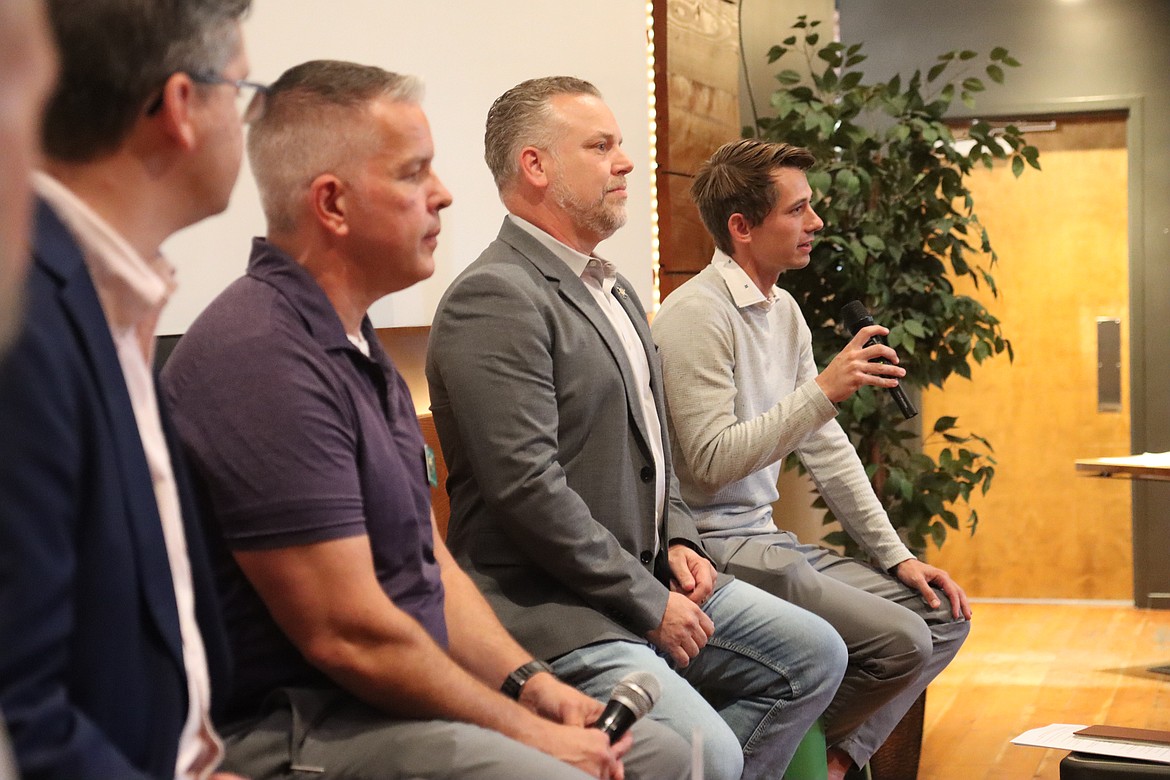
Local developer Noah Stam speaks during a panel discussion held in Coeur d'Alene on Thursday. Also on the panel, from left, are Post Falls Mayor Randy Westlund, Kootenai County Commissioner Bruce Mattare and Sen. Ben Toews, R-Coeur d’Alene.
RAY ERKU/Press
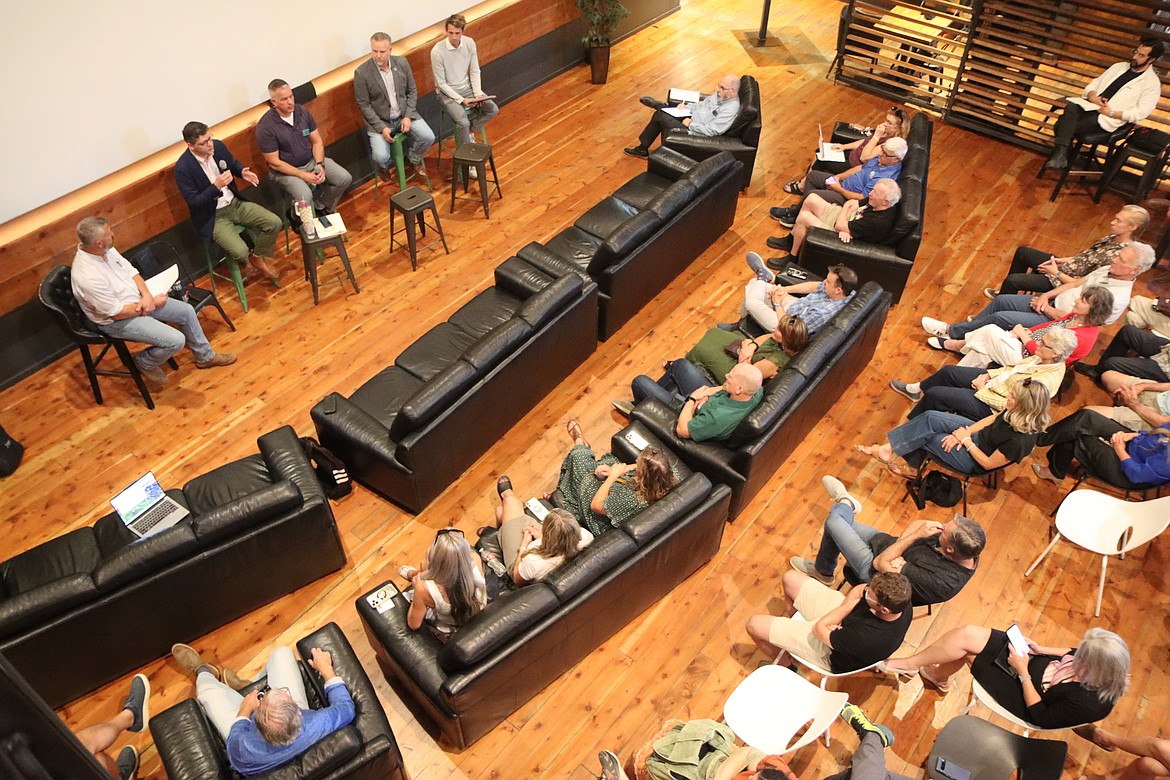
A panel discussion on housing affordability occurs in Coeur d'Alene on Thursday.
There isn’t just one single thing killing housing affordability, according to local developer Noah Stam.
“It’s the accumulation of costs, delays, decisions,” he said. “Land is expensive, labor is expensive, materials are expensive, interest is expensive.”
In Coeur d’Alene on Thursday, Stam joined a panel of politicians addressing affordable housing issues in North Idaho. Fellow panelists were Post Falls Mayor Randy Westlund, Kootenai County Commissioner Bruce Mattare and Sen. Ben Toews, R-Coeur d’Alene.
Stam owns and operates Stam Structures, which built 38 affordable housing units in Post Falls just last year. Contrasting Kootenai County’s median home sales price of $565,000, an average home price at what’s called The Arc begins at $325,000.
“You see these people wanting to buy a house, but they can’t swing the payments on a ($500,000), $600,000 starter home,” Stam said. “So now we have price points that start at ($325,000) and go up to that ($375,000) and we’re filling the doors on that price point for sure, and I think that’s what’s needed.”
Creating these affordable price points had its challenges, according to Stam. Amid all costs, he said fees and permits were greatest. Permitting cost $25,000 a door for The Arc. Another $280,000 was spent on park fees.
In response, Westlund said that developments like The Arc are a “great product” and that “I think we need a lot more of these starter homes” to solve affordable housing issues.
“A government charging arbitrary fees is never a good idea,” Westlund said.
Toews is a proponent of things like short-term rentals and accessory dwelling units and spent this past legislative session pushing for deregulating local control of certain housing requirements. On Thursday, he again advocated for short-term rentals and accessory units as a way for property owners to keep up with rising costs.
“Deregulation is a good thing, in my opinion,” he said.
He also spoke of the benefits of allowing smaller houses.
“There’s no reason why we can’t have smaller houses and people can’t own. I’m a big fan of what I call horizontal density. All my legislation that you see me sponsor will have to do with horizontal density — not vertical density. I want to see homeownership. I want to see the next generation have some place to live.”
On the flipside, Westlund suggested that short-term rentals actually decrease supply of the housing market by turning them more into a commercial property, such as hotels.
“In a lot of areas of Coeur d’Alene, here in the wonderful downtown, they’re all short-term rentals. There’s no one living here, there’s no community, there’s no community fabric,” he said. “I think if you're going to do short-term rentals for a portion of your house, or for an ADU or a duplex, I think that’s great and there should be no regulations on that. But if the property is not being used for any sort of ownership, it just becomes an investment.”
He later added, “Now that property's become more valuable than someone who’s buying it for a single-family home.”
Panelists also focused on whether growth pays for itself.
Mattare, who said “growth does not pay for itself,” spoke about the benefits of local control.
“I also believe that local land use should be delegated to local elected officials, because the people who live in the community are the ones who have to deal with the consequences of that every day,” he said.
Mattare also brought up how impact fees need to be in place in order to pay for added infrastructure, like ADUs or short-term rentals.
“The expense of this infrastructure is outpacing tax revenue and so without the ability to collect growth fees, in this case impact fees, what we’re doing in that sense is we’re shifting that cost burden onto the existing resident here, and I think there’s an inquiry there.”
Mattare added, “The biggest racket going on is cost-shifting.”
Toward the end of the panel discussion, which also highlighted issues like migration from neighboring states as well as whether Kootenai County should turn rural settings into suburban sprawl, Stam spoke of his overall feel of where entry-level housing is heading.
“If we’re going to solve this affordability crisis, we have to be willing to let builders get creative,” he said. “We can't keep building the same size lots, the same size houses, the same development patterns we’ve done for the last 30 years and expect housing to become affordable all of a sudden.”
Approving density is only half the battle, he added.
“If you let me put more homes on land, but then add enough fees, infrastructure costs, delays and requirements for those houses,” he said, “eventually, you’ve given the affordability right back.”
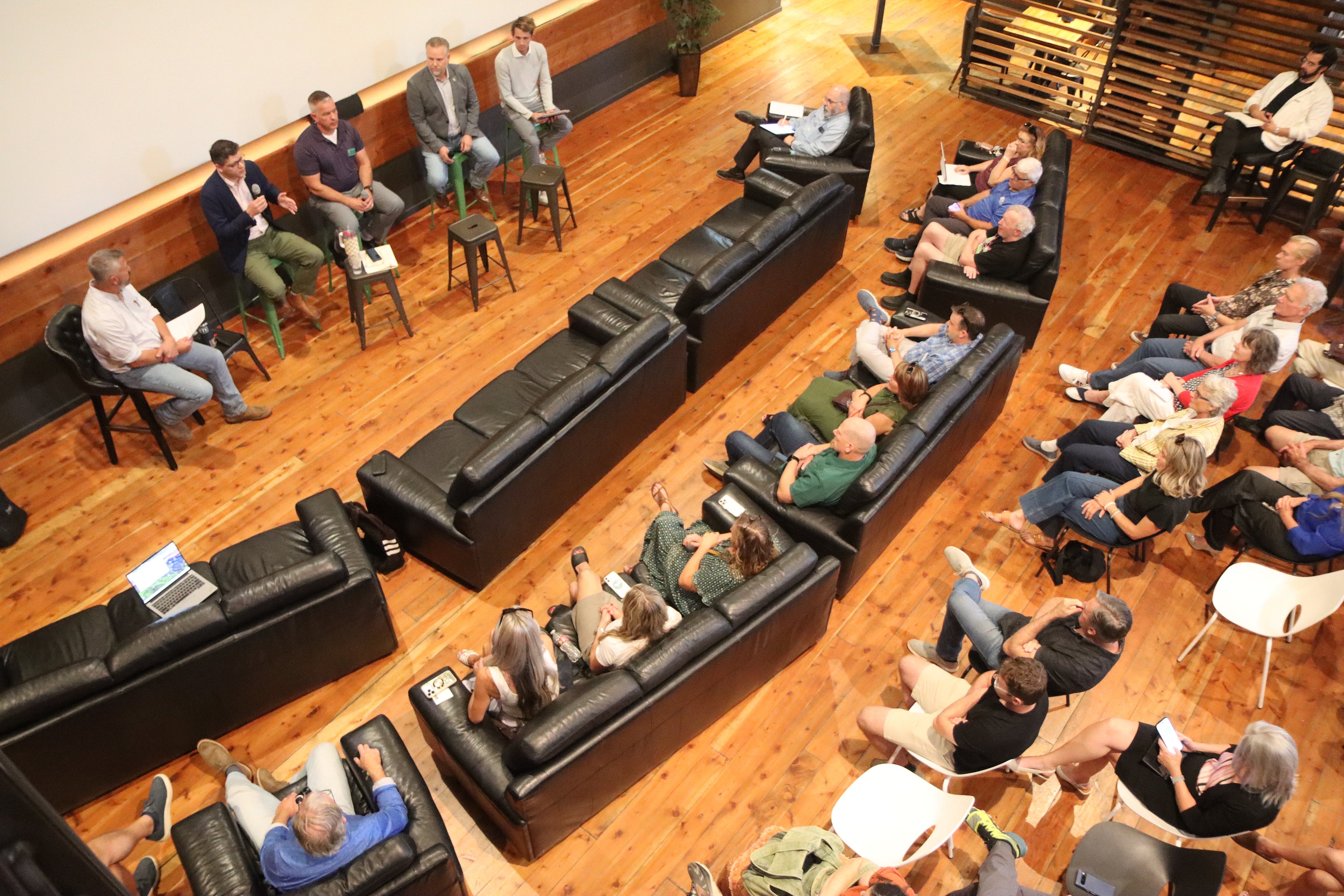 A panel discussion on housing affordability occurs in Coeur d'Alene on Thursday.
ARTICLES BY RAY ERKU

City unpacks ‘ambiguous’ state housing regulation
After Idaho lawmakers ease up on accessory dwelling units, Coeur d’Alene must comply by Feb. 1, 2027
For Idaho state law nowadays, residents can legally create larger guest houses, homeowners don’t need to obtain permits for renting out living spaces, and developers can build entire starter-home neighborhoods on far smaller lots than previous generations. These are just some of the new provisions that are the result of Senate Bills 1352 and 1354, as well as House Bill 583.

State proposal triggers response from local firearm gurus
State proposal triggers response from local firearm gurus
Idaho lawmakers are aiming for an official state firearm. Like the huckleberry being its state fruit, Idaho could have a Winchester Model 1873 level-action rifle as its state gun. What do local Coeur d'Alene gun gurus think about it?

Alarm rises over ‘door kick challenge’
Police investigate cases of people kicking in residential front doors
A popular and dangerous trend suspected among youth and young adults is raising alarms with the Coeur d’Alene Police Department and city officials.