
SEPT NIBJ: The cure for Idaho’s physician shortage? Medical residency expansion
RAY ERKU | Hagadone News Network | UPDATED 2 months, 1 week AGO
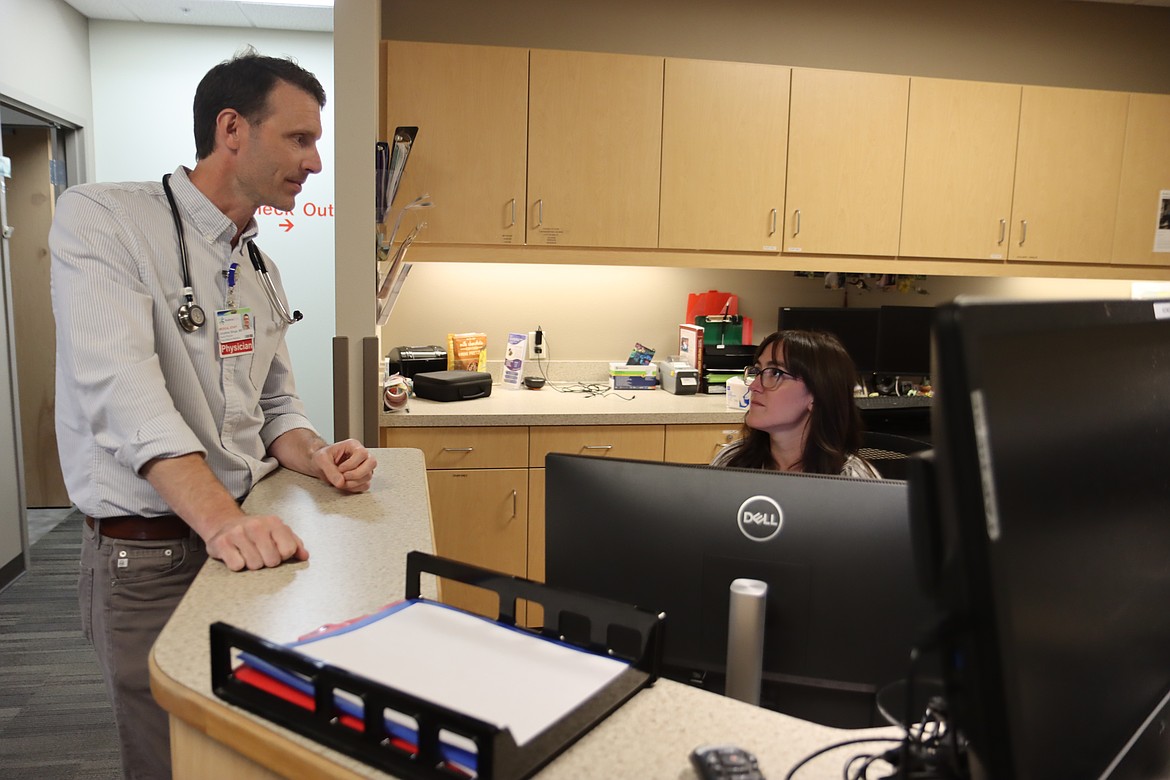
Jonathan Shupe, a Kootenai Health family medicine practitioner, speaks with Kootenai Health colleague Andrea Nagel in Coeur d'Alene on Aug. 10.
RAY ERKU/Press
Kootenai Health is always busy.
Over the past 12 months, its primary care clinics served 42,622 patients. The 10 northern counties of Idaho, including locations in Washington and Libby, Montana, have also averaged 275 transfers to Kootenai Health every month.
The high traffic coming to Coeur d’Alene is a product of an ongoing physician shortage in rural Idaho, according to Kootenai Health.
“That’s an immediate need, which will only be exacerbated by ongoing growth moving forward,” said Dr. Jonathan Shupe, a Kootenai Health family medicine practitioner. “In the state of Idaho, that’s kind of the same story.”
Shupe sits on the graduate medical education subcommittee for the Idaho Board of Education. For the past 10 years, the mission of this group is to close the local and state gaps of needed practitioners by creating more medical residency slots in Idaho.
A study conducted between Kootenai and Panhandle Health District organizations shows a need for between 40-50 more physicians needed in the five northern Idaho counties in which they cover.
“We’re always recruiting in primary care,” Kootenai Health spokesperson Andrea Nagel said. “For certain specialties, there's always gaps.”
The root of this problem stretches as far back as the 1970s.
Idaho officials began discussing the possibility of supporting a state-sponsored medical school. Financing such an expensive project, however, prompted legislators to place the idea on hold. In its absence, Idaho decided to purchase medical program seats at universities in Washington and Utah.
This sort of hybrid way of training prospective practitioners is partly why, like other Idaho healthcare providers, Kootenai Health offers a medical residency program. That program graduates seven people per year.
In total, Idaho medical providers account for 12 accredited medical residency programs. On the flipside, state-sponsored support has created between 60-90 accredited medical residency programs in Washington state.
“If we were to hire 1,400 positions tomorrow, it would only get us to the national average of physicians per capita, and my program graduates seven per year,” Shupe said. “What we need is an expansion of graduate medical education in our state.”
A lack of medical residency spots in the Gem State not only means more students of healthcare can’t come here for graduate education, but those also who graduate from programs elsewhere aren’t coming here either.
Shupe said where people get their medical training is the highest indicator of where they’ll likely practice. Although Shupe did his medical residency at the University of California Los Angeles, Kootenai Health counts its lucky stars that he’s originally from Moscow.
“We have tens of thousands of people in North Idaho looking for primary care physicians,” he said.
There are not only wellness benefits to increasing the amount of healthcare professionals in rural Idaho. There are economic benefits, as well.
Shupe said one practicing physician alone creates $1.9 million of economic input each year. Statistically speaking, it costs the system 50% less if residents can identify having a personal physician. Meanwhile, it costs ⅓ less for people to use a family physician rather than seeking specialty care.
“We know there’s a huge financial return when you have a local physician practicing,” Shupe said.
This past Idaho legislative session saw Gov. Brad Little set aside $1 million for medical residency programs. But with the need for more physicians in mind, Shupe agrees more can be done.
He said the medical community needs to show the Idaho legislature that, although the economic impacts of adding physicians are delayed, “it really does shine out in tax paying money.”
“What we’re doing is working,” he said. “But it’s not working enough. We need to expand.”
ARTICLES BY RAY ERKU
Coeur d'Alene to enforce new alleyway parking rule
Coeur d'Alene to enforce new alleyway parking rule
City motorists will now be required to park farther away from alleyways. Prompted by garbage trucks having trouble safely entering and exiting alleyways, Coeur d’Alene officials on Tuesday unanimously passed a new rule that prohibits anyone from parking within 15 feet of an alleyway.

Color coded: Why the hands on The Coeur d’Alene Resort clock tower are white
Why the hands on The Coeur d’Alene Resort clock tower are white
Mary Merrill is one of the few who can say she literally changed time. It was the 1980s. Merrill, her last name at the time Doughty, was working for North Idaho College when she noticed something was off with what’s now a prominent feature of downtown Coeur d’Alene. Her bugaboo had to do with the color scheme of the new three-sided clock tower built at Coeur d’Alene Resort.

'Without our people': Hagadone execs thank, praise employees
Hagadone execs thank, praise employees
Executives at the Hagadone Corporation had a warm collective message on Friday afternoon: appreciation and thanks for their employees. “You can put all the fancy brick and mortar together, but it’s great people like you that take care of the customers,” said Brad Hagadone, president of the Hagadone Corporation. “That really brings the guests back.”