
Six Lake County teachers receive STEM fellowships through MSU
Montana State University Newsroom | Lake County Leader | UPDATED 2 months AGO
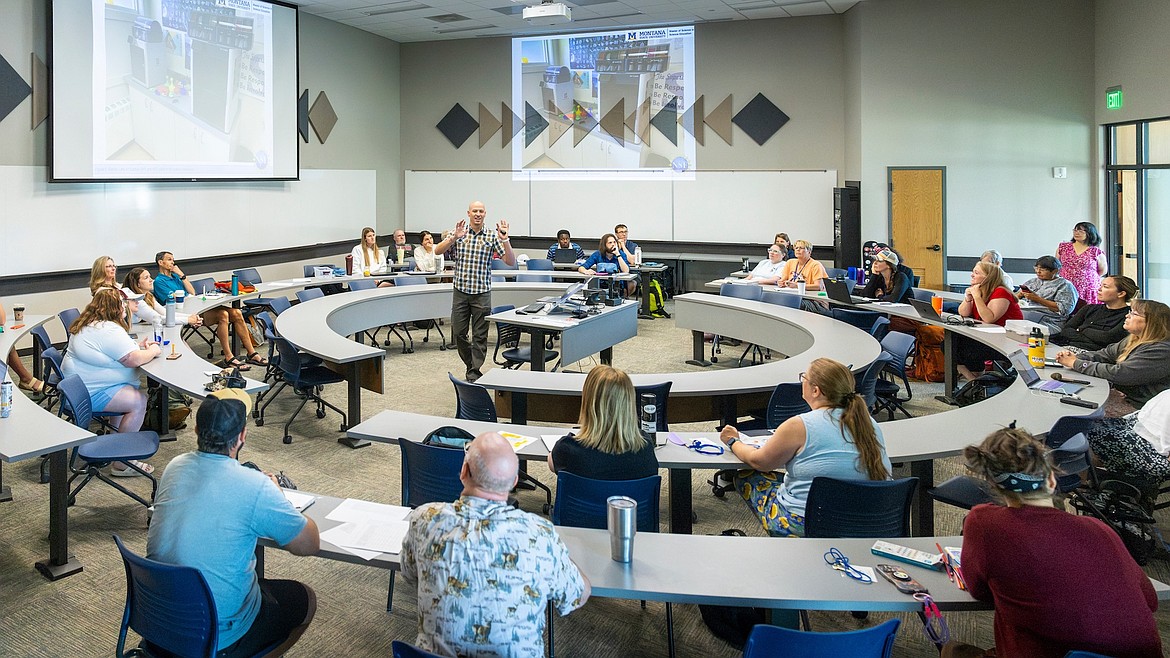
Christopher Quinlivan, a high school teacher for Superior School District, presents to teachers from around rural Montana during a training Thursday, Aug. 6, as part of the Noyce Master Teacher Fellowship program at Montana State University in Bozeman. The program seeks to improve the number, quality and experience of STEM teachers – including six from Lake County. (MSU photo by Marcus "Doc" Cravens)
Montana State University received a $3 million grant from the National Science Foundation’s Robert Noyce Scholarship Program in 2024 to support a project called the Noyce Master Teacher Fellowship for Rural and American Indian School Educators as STEM Leaders.
The project, which seeks to improve the number, quality and experience of STEM teachers in rural states like Montana, funded 27 Montana teachers through six-year fellowships, including six from Lake County schools.
Polson High math teachers Polly Dupuis and Becky Hoxie and science teacher Mike Sitter, Ronan Middle School math teacher Bill Becker and science teacher Charla Lake, and St. Ignatius Middle School math teacher Marissa Mock each received fellowships.
The participants, who were already working as Montana teachers, received tuition for master’s degrees and other resources such as monthly group check-ins, funding for travel to relevant conferences, and a weeklong in-person gathering at MSU each summer. Those who aleady hold master’s are in the program for the professional development, networking opportunities and stipend it provides.
This August, the annual gathering provided a chance for fellows to present their master’s research, attend informational sessions at the STEM Summer Institute and Montana Council of Teachers of Mathematics MCubed conferences held at MSU the same week, and participate in a team-bonding activity of rafting on the Madison River.
The opportunity for the 27 teacher fellows to gather in person is of huge value and aligns with the goals of the program, said Fenqjen Luo, professor of education in MSU’s College of Education, Health and Human Development and principal investigator on the grant. It provides a chance for them to learn from each other and cut through the isolation and loneliness that can sometimes impact people teaching in rural areas.
Overall, Luo said, the goal of the program is to support and retain teachers in rural Montana – especially those who are already serving as leaders and mentors of other teachers in their schools.
Data from the Institute of Education Sciences about Montana shows that more than half of school districts report difficult filling positions, and there are hundreds of teacher vacancies across the state. Additionally, upwards of 30% of teachers will change careers within five years of starting their teaching job.
Luo said that in eastern and other rural pockets of Montana, many math teachers come from countries including the Philippines, India and Ghana. That’s due to state incentives because there are simply not enough American math teachers in rural Montana to meet the demand.
Luo, who previously taught in a small village in Taiwan, shared the same challenge as the Montana teachers: feeling unable to forge connections or find support systems because there were few other teachers around.
That’s exactly what the Noyce fellowship aims to address. Ronan teacher Bill Becker said that a week of being surrounding by like-minded teachers who are professionally motivated to better themselves was “very rejuvenating.” He teaches mathematics and advanced electives in the Ronan School District on the Flathead Reservation.
Sometimes, due to stressors of the job, the teaching environment can be negative and unmotivating, Becker said, but being with the group of fellows was a breath of fresh air for him.
While on campus, he was able to exchange ideas with other teachers from Montana to benefit his classroom. Specifically, he presented his place-based lesson plan centered around the Confederated Salish and Kootenai tribal flag and its unique designs, customizable to many grade levels.
Not only do students learn about the cultural significance of the flag, but they are also exposed to mathematical equations. For example, by plugging in different numbers into the equation of a circle, students see how the circle changes size and position on the flag.
Becker’s presentation then pointed teachers to the starter templates he created for the other tribal flags in Montana for use in their own math classes.
NSF is funding the program through 2030. People can learn more at www.montana.edu/smrc/noyce/about/. MSU also houses the Center for Research on Rural Education which creates resources specific to the state’s rural teachers.