
Choosing plants for a drought-resistant garden
JOEL MARTIN | Hagadone News Network | UPDATED 1 month, 2 weeks AGO
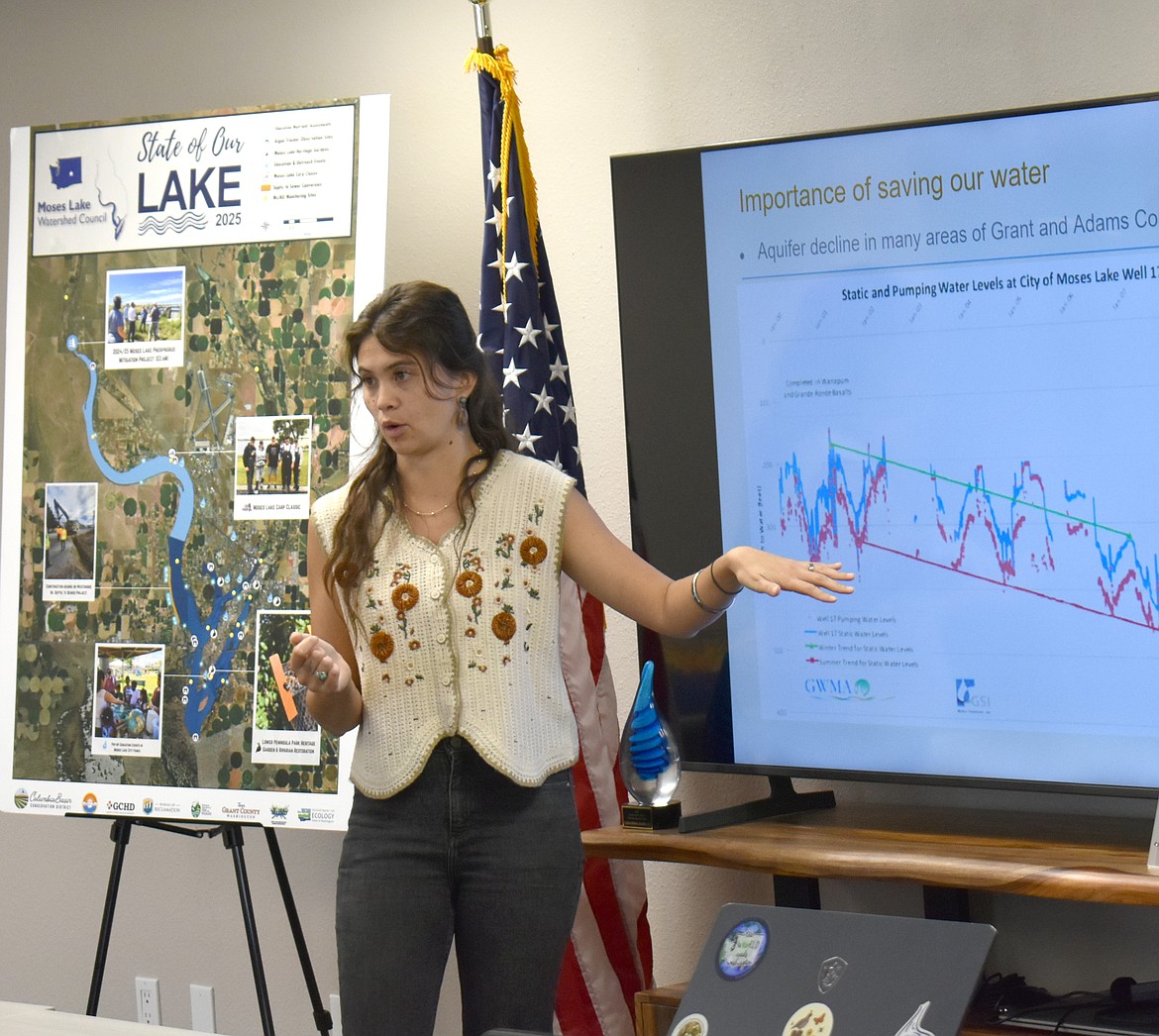
Dina Rouleau, conservation director for the Columbia Basin Conservation District, shows how a heritage garden can save dramatically on water bills at a class Aug. 11.
JOEL MARTIN/COLUMBIA BASIN HERALD
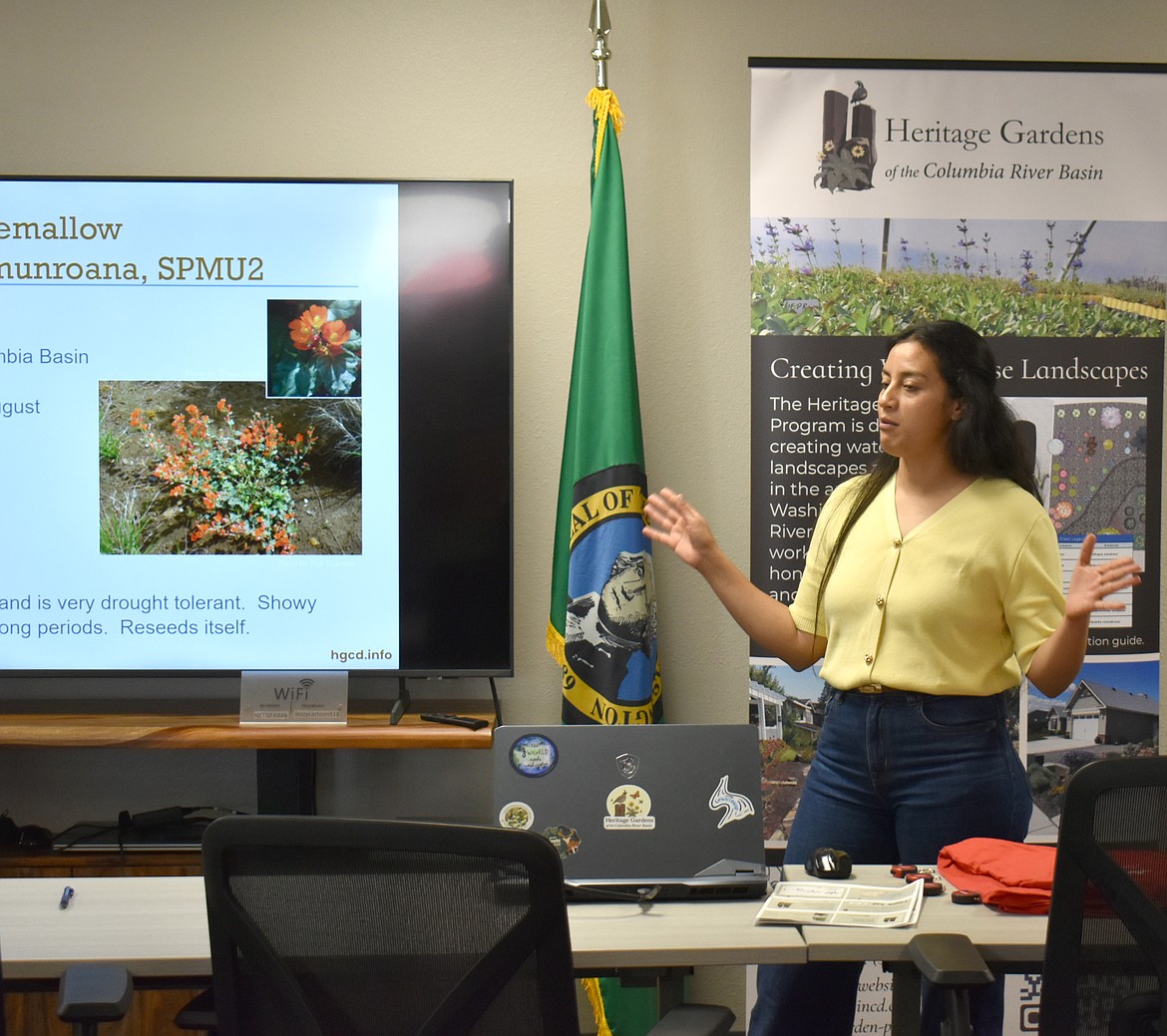
Columbia Basin Conservation District Heritage Garden Program Coordinator Yazmin Mejia discusses plants that grow well in heritage gardens in the Columbia Basin.
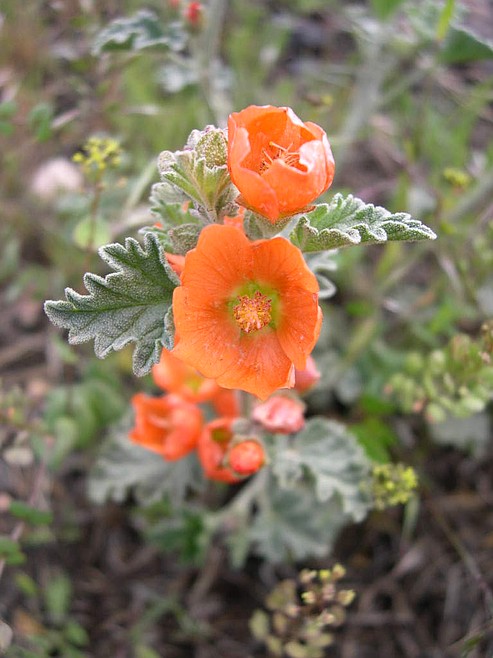
Munro’s Globemallow is a large, showy plant that thrives almost anywhere and provides a habitat for many kinds of pollinators.
Munro’s Globemallow is a large, showy plant that thrives almost anywhere and provides a habitat for many kinds of pollinators.
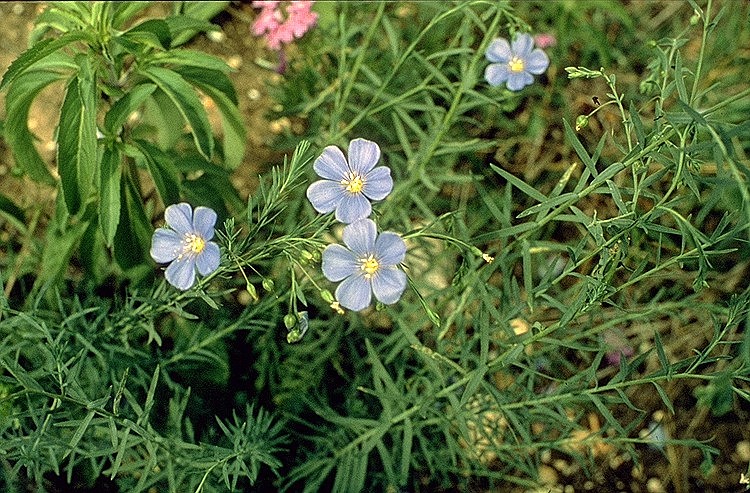
Lewis’ blue flax is not only decorative and water-thrifty, it can also be used to make fibers and even fabric.
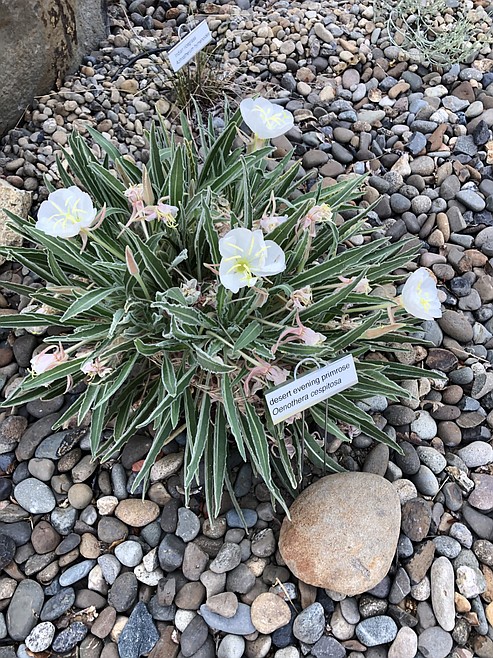
Evening primrose is a good flower to pant along pathways, and benefits hummingbirds and moths.
Joel Martin has been with the Columbia Basin Herald for more than 25 years in a variety of roles and is the most-tenured employee in the building. Martin is a married father of eight and enjoys spending time with his children and his wife, Christina. He is passionate about the paper’s mission of informing the people of the Columbia Basin because he knows it is important to record the history of the communities the publication serves. | August 28, 2026 3:25 AM
MOSES LAKE — Heritage gardens, with native, drought-resistant plants, aren’t just nice to look at, they’re economical, and they make a difference when the water bill rolls around, said Columbia Basin Conservation District Conservation Director Dinah Rouleau at a class hosted jointly by the CBCD and Habitat for Humanity Aug. 11.
“A reason behind the water bill increase is that the water level of our groundwater wells is clearly declining,” she said. “Everyone wants to do their share and save some water, even at a smaller scale … You’d be surprised how much water you can save just in a small area of land versus a lawn.”
It uses about 87,000 gallons of water a year, Rouleau said. A heritage garden, with mostly native, water-stingy plants, uses only 36,000, Rouleau said.
“You’re saving 50,000 gallons, which is a lot,” she said.
In the class, Rouleau and CBCD Heritage Garden Program Coordinator Yazmin Mejia introduced gardeners to plants that are especially well suited to low-water gardens in Grant and western Adams counties. The Columbia Basin gets about 7.5 inches of precipitation per year, Rouleau said, with some variation depending on location.
Sulfur buckwheat (Eriogonum umbellatum) is a semi-evergreen plant with bright yellow flowers that thrives in less than 10 inches of water annually, although giving it more to begin with will help it get established, Mejia said.
“You can go between 10 and 18 inches of water,” Mejia said. “The more water you give them within that range, the longer they’re going to bloom. But if you give them less than 10 inches of water, they can survive doping really well.”
After the first two years, it’s not necessary to water the plant at all, Mejia said. Sulphur buckwheat grows up to 12 inches high and three feet wide, Rouleau said.
Besides producing pretty flowers, sulfur buckwheat is an important pollinator and is a host for butterflies, Rouleau said. Indigenous tribes used the dried flowers to treat burns, she said, and it can be used to treat colic in horses.
Oregon sunshine (Eriophyllum lanatum) requires a little more water: between 10 and 30 inches, Mejia said. It blooms in the spring with showy, yellow flowers.
“They can be kind of short-lived, (but) they reseed really well,” Rouleau said. “Even after the flowers die, it has a nice shrub look and it’s compact greenery when it’s not flowering.”
Evening primrose (Oenothera caespitosa) produces large white flowers and does well along pathways, Rouleau said. “It’s a really good hummingbird and moth plant,” she said. “Moths really like it.”
Evening primrose likes 10-30 inches of water and blooms in early summer, Rouleau said.
Munro’s globemallow (Sphaeralcea munroana) is especially drought-resistant, Mejia said, requiring less than 10 inches of water a year. It blooms bright orange from spring through fall, she said, and can grow to 32 inches tall.
“This is kind of a big showstopper,” Rouleau said. “They almost seem like weeds, because they do really well in disturbed areas; vacant lots will have a lot of these. But if you give it some water, give it some pruning in the fall and shape it, they look really nice.”
Munro’s globemallow also provides a home for ground-nesting bees, including some species that rely on it exclusively for pollen and nectar, according to the U.S. Forest Service. It’s also resistant to grazing animals like deer and rabbits, according to the Washington Native Plant Society.
Lewis’ blue flax (Linum lewisii) produces bright blue flowers and grows to 2 1/2 feet tall, Rouleau said. It blooms during the summer and is self-reseeding. The seeds are edible, and when the plant dries out it can be used to make fabric, Rouleau said.
“People are bringing it back where they brush it and it makes strings like hemp,” she said. “That’s what I’m going to do with mine. They come back really fast, too.”
The cushion daisy (Erigeron poliospermus) is a small flower, less than a foot tall, that takes less than 10 inches of water, Mejia said. It’s purple blossoms attract lots of bees and pollinators, she said.
“These guys are so hardy,” Rouleau said. “When you go hiking up in Beezley or the sagebrush steppe, they like those rocky (places) where nothing else is flowering. What’s funny is, to get them established in your yard, the success rate has not been great. It’s ironic to me that they grow in some of these harder places where nothing else will grow, but to get them established in your garden, they take a little bit of love and care. I planted them for two years and I’ll get 50% percent survival.”
Great Basin wildrye (Leymus cinerus) grows tall, to six or seven feet, and doesn’t require much water, Mejia said.
“Birds can nest in that beautiful grass, and it can provide shelter for rabbits as well,” she said.
“This guy, he’s native and you give him some water and he could be a windbreak, he could be a privacy setting, and if you don’t water him for a while, he’ll still be there,” Rouleau said.
Heritage gardens take longer, but they’re worth it, Rouleau said.
“(The plants) that you buy at (a chain store) are commercial and meant to grow faster,” Rouleau said. “(Native plants) need like two years to invest in their root growth, to be drought-tolerant. They’re not commercial, so they take time and the mortality rates are higher. But once you get things established, they’re pretty hardy.”
The Columbia Basin Conservation District offers free assistance in planning a heritage garden. For more information, visit www.hgcd.info.
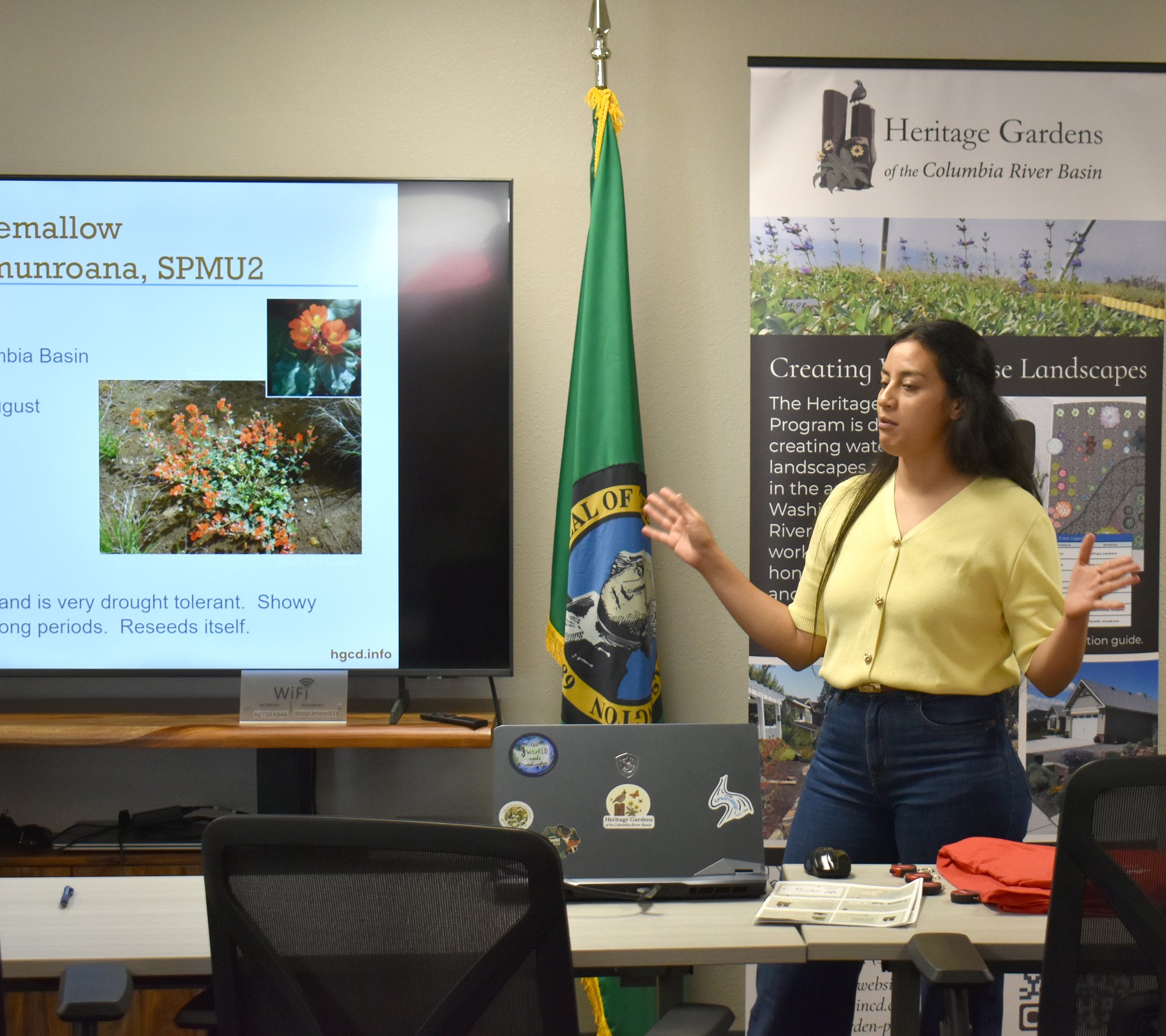 Columbia Basin Conservation District Heritage Garden Program Coordinator Yazmin Mejia discusses plants that grow well in heritage gardens in the Columbia Basin.
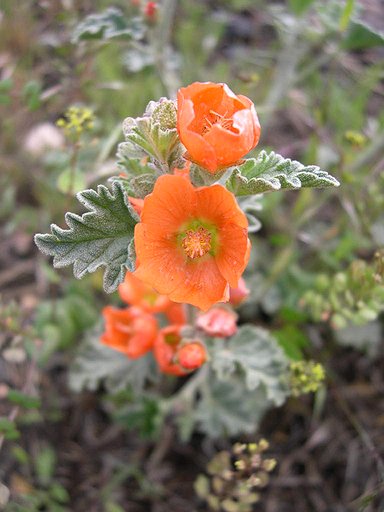 Munro’s Globemallow is a large, showy plant that thrives almost anywhere and provides a habitat for many kinds of pollinators.
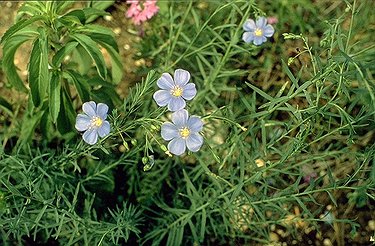 Lewis’ blue flax is not only decorative and water-thrifty, it can also be used to make fibers and even fabric.
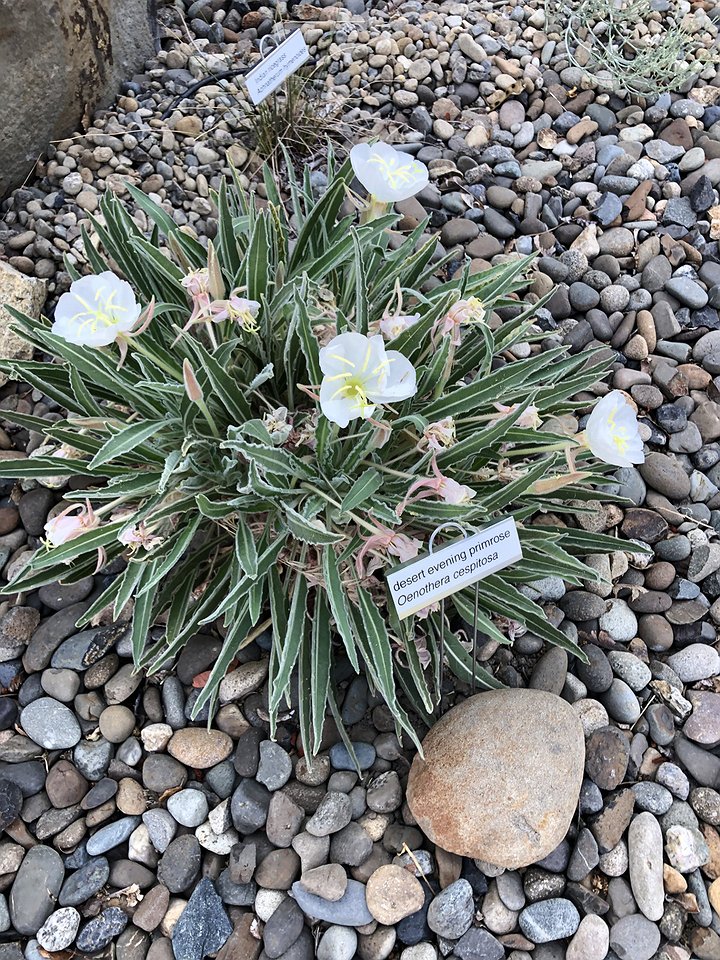 Evening primrose is a good flower to pant along pathways, and benefits hummingbirds and moths.
ARTICLES BY JOEL MARTIN
Endless battle
Noxious Weed Control Board works to keep invasive plants under control
MOSES LAKE — Some of the nastiest plants in Grant County were the topic of a class led by Jay Johnson, a consultant with the Grant County Noxious Weed Control Board, Tuesday. The Noxious Weed Control Board, as its name would suggest, is tasked with keeping weeds under control in Grant County. That’s not a small job; the board’s website lists 129 species of noxious weeds that are found around Grant County. A noxious weed is defined as an invasive, non-native plant that threatens agricultural crops, local ecosystems or fish and wildlife habitat, according to the Noxious Weed Control Board. Washington state law requires that these weeds be identified and their spread kept to a minimum, if not completely eradicated. “We’re one of those agencies a lot of people don’t really understand,” Johnson said. “We’re a county office and … our funding is tax-based assessment. When you get your tax bill and you look down at all the expenses that you pay for, there we are.”

BASIN EVENTS: Oct. 16-24
COLUMBIA BASIN — Whether you feel like shopping, crafting, learning or seeing a show, there’s something happening for you this week in the Basin. Oct. 16 ‘My Family (Mi Familia)’ screening Spanning three generations, “My Family (Mi Familia)” is a heartfelt drama that follows the Sánchez family as they build their lives in East Los Angeles. Through love, hardship, triumph, and sacrifice, the film explores the immigrant experience, the strength of family bonds, and the traditions that connect one generation to the next. Lowrider show and taco truck before the screening. Sponsored by Columbia Basin Allied Arts, EDUBS C/S and the Moses Lake Creative District. $12 per person. Doors open at 6 p.m., film begins at 7 p.m. at the Moses Lake Civic Center Auditorium, 401 S. Balsam St. Tickets and info: www.cba-arts.org.
Moses Lake author encourages women to look beyond church culture norms
MOSES LAKE — A Moses Lake author’s book, “A Christian Woman Striving to Live Her Faith in a Man-Controlled World,” takes aim at the role to which many churches relegate the female half of their congregations. “It’s to encourage women in the faith,” Linda Curran said. “A lot of churches say, ‘Teach Sunday school, do this, do that, but don’t (evangelize.)’" In her book, Curran recounts a time when she moved to a new community and joined a church there. She was surprised to learn that, as a new female member, she had been automatically assigned church cleaning duties. When she questioned it, she wrote, she was met with condescension and her objections were brushed aside. In other churches, she said, women who were capable of teaching were relegated to “women’s ministry.”