
State, feds work in unprecedented vaccine campaign for bats
The Western News | The Western News | UPDATED 1 month, 4 weeks AGO
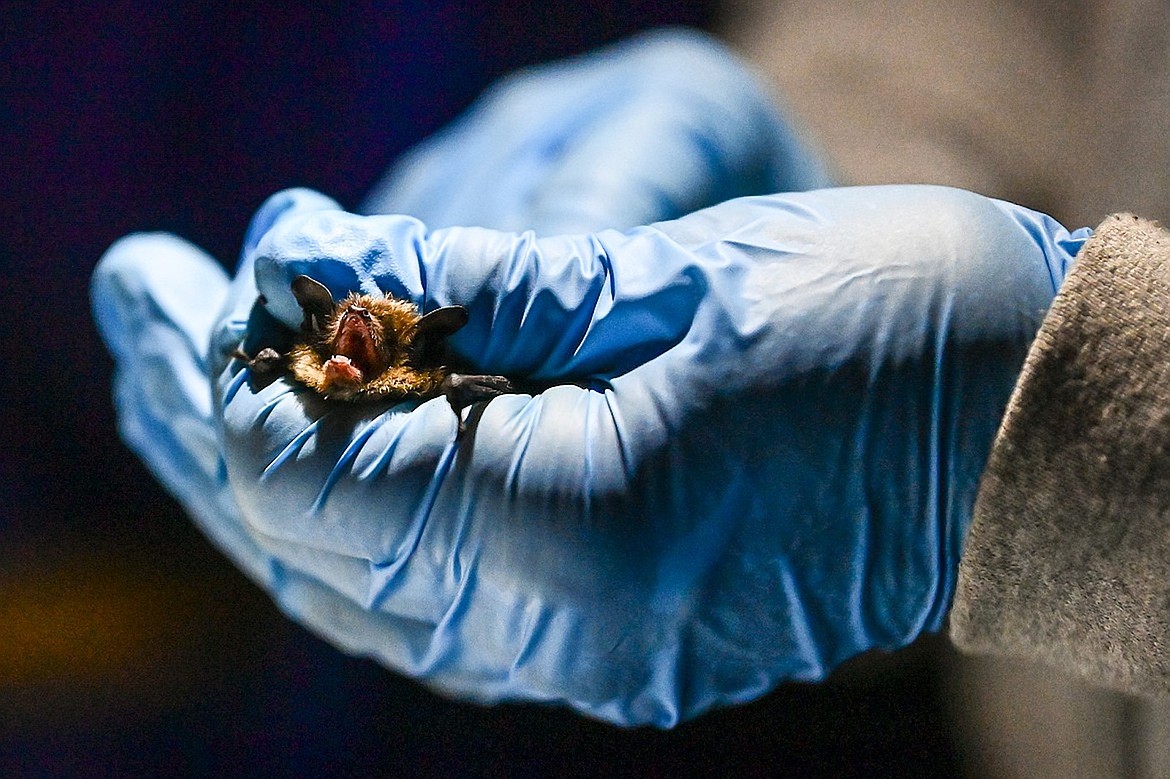
Glacier National Park biologist Lisa Bate holds a bat as she takes measurements during a "Going Batty" field trip in the park on Thursday, July 9. (Casey Kreider/Daily Inter Lake)
Two weeks ago, Montana Fish, Wildlife & Parks biologists, U.S. Army Corps of Engineers (USACE) staff, and partners from six additional government agencies and nongovernment organizations did something no one has ever done before. Anywhere.
On the night of July 29 between about 10 p.m. and midnight, 43 people worked together to trap and vaccinate 888 bats against white-nose syndrome (WNS) at Libby Dam.
Everyone had a job: removing bats from a trap, bagging them and placing them in boxes, delivering boxes with 25 bats to the vaccinators, vaccinating, recording data and delivering more vaccine and other supplies when needed.
The group used custom-made traps that were a combination of a harp trap and a funnel trap. The harp, the part directly on the bat box, consists of rectangular frames, made of PVC pipe in this case, with vertical lines of monofilament spaced about one inch apart. The lines are offset so when the bat drops out of the box, it hits the first or second panel of lines, causing it to fall into a bag. Staff shaped the bag into a funnel that ended in a large bucket.
This way, the bats would hit the harp, fall into the funnel, slide down and gently land in the bucket, where they could easily be removed from the ground. Once removed, each bat was placed in a paper bag. When 25 bats were bagged, they were put into a box and delivered to the vaccinators.
Researchers have demonstrated, in both lab and field studies, that the vaccine is safe for bats and increases their chance of survival. It doesn’t prevent bats from getting infected by the fungus that causes WNS, but it helps them fight the infection.
“Bats might be tiny, but they play an incredibly important role in Montana’s ecosystem health and agriculture production,” said Shannon Hilty, FWP’s statewide bat biologist and event organizer. “Many of us have been watching the massive population declines move westward with WNS. Having management tools, like the vaccine, has finally given me some hope that we can help bats persist.”
FWP’s bat monitoring works closely with partners to monitor the spread of WNS and assess the impact of the disease on Montana’s bat populations.
The fungus was first detected in eastern Montana in 2020, followed by confirmation of the disease in 2021. By 2022, 98 percent – about 2,000 – of the bats hibernating in Azure Cave had died. The same fungus was detected at Libby Dam in 2025. WNS does not impact all bat species. Of those impacted, some are hit harder than others.
“The bat colony at Libby Dam is one of the largest known maternity colonies of bats in the state,” Hilty said. “Our friends at USACE have been great stewards of this colony, and like the rest of us, want to see them make it through this hard time.”
Libby Dam is a mixed colony of Yuma myotis and little brown myotis, two species heavily impacted by WNS. When the fungus invades a bat colony, population declines typically happen within two to three years.
“If white-nose syndrome affects the bats at Libby Dam the same way as in other places, catastrophic declines in the bat population could happen in 2027-2028,” said Kristina Smucker, FWP nongame wildlife bureau chief. “Implementing actions like vaccination can buy bats time and help them get through the initial phase of disease invasion, perhaps helping with recovery and allowing FWP to keep bats on the landscape.”
Research suggests that the vaccine provides immunity for one winter, so biologists want to make sure they can continue vaccinating bats for several years to ensure success.
“The effort at Libby Dam will allow FWP and partners learn more about how the vaccine helps populations persist on the landscape,” Smucker said. “We have a chance at Libby Dam.”
Vaccinating bats against WNS is an interventive action identified in FWP’s recently updated State Wildlife Action Plan (SWAP). The plan also addresses concerns and needs of other species managed by FWP’s nongame program, which focuses on conserving, restoring and enhancing habitat for nongame wildlife.
“Helping bats get through WNS is an all-hands-on-deck situation and the clock is ticking,” Hilty said. “This event is such an awesome example of collaboration between agencies and nongovernment organizations to reach a hopeful goal.”