
Guest opinion: Union Pacific-Norfolk Southern merger good for Montana
Daniel Zolnikov | Daily Inter-Lake | UPDATED 1 month, 3 weeks AGO
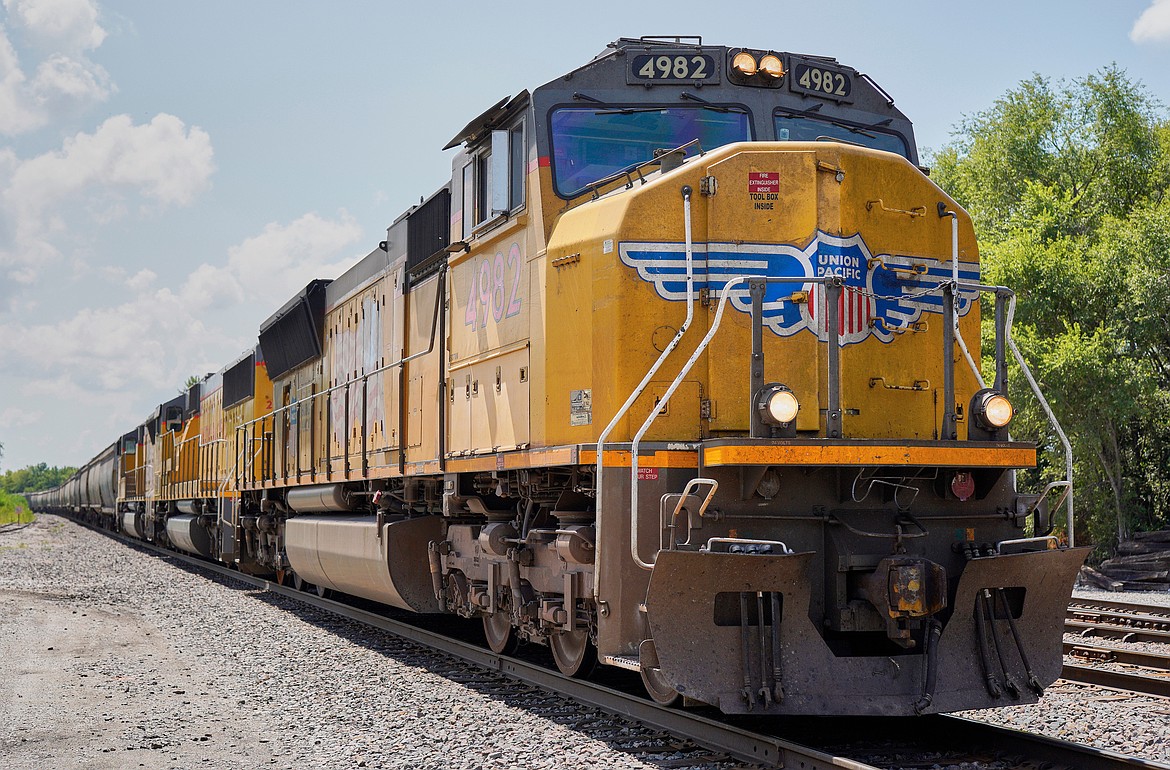
FILE - A Union Pacific train travels through Union, Neb., July 31, 2018. (AP Photo/Nati Harnik, File)
AP Photo/Nati Harnik
It may not be big news in Montana, but the proposed merger of two railroads, Union Pacific and Norfolk Southern, is a major deal for our nation. And Montanans could reap the benefits.
Right now, no single railroad carries freight from coast to coast. That means goods being transported across the country by rail need to switch hands at least once, frequently more times, at various interchanges, generally in the middle of the country. This inefficiency not only adds time to delivery, it adds cost for businesses and those costs get passed on to consumers.
What's most appealing about the proposed merger is that it flips that dynamic on its head. A coast-to-coast rail line would transform 10,000 existing lanes from interline to single-line service. Communities across the nation will be able to ship and receive products from point to point more seamlessly, including single-line access to roughly 100 ports.
How much less could businesses and shippers pay? The railroads' amended application estimates $3.5 billion in annual shipper savings. Savings on that scale work their way into the price of goods on the shelf, a meaningful benefit for the American consumer.
There’s also a real potential for new markets for Montana businesses. Right now, Montana shippers have almost nowhere else to turn. BNSF operates roughly 90% of the rail miles in this state, a share that grew when it took back the Montana Rail Link lines in 2024. Union Pacific runs a single line from Monida Pass north to Silver Bow, just outside Butte, serving the Port of Montana. Montana businesses may choose to bring more of their products directly to a new transcontinental railroad operating from Butte and benefit from these efficiencies.
While some, particularly other railroads and those close to them, have called this merger anti-competitive, it's not. Union Pacific and Norfolk Southern largely do not currently serve the same areas; there is very little overlap in their markets. And yet, by Union Pacific's own projections, the combined railroad would move about the same volume of freight, measured in ton-miles, as BNSF moves today. BNSF is the nation's largest railroad by volume, and it is not going anywhere.
The merger now sits before the Surface Transportation Board, a Washington, D.C. regulatory agency. The board rejected the railroads' first application as incomplete in January, so the companies filed an amended application in April. The board accepted that application in May and asked for more information, which the railroads supplied in July. This month the board set a schedule for judging the merits, with public comments due in November and a final decision expected in 2027.
At every step of the way, competitors have sought to derail this commonsense proposal with vague accusations and unfounded fears. Union Pacific and Norfolk Southern have responded with the most extensive set of voluntary commitments and customer protections in the history of American rail mergers.
They have offered a so-called “Targeted Access Program,” which ensures that, should the new combined railroad fail to meet identified performance thresholds during the integration phase, sole-served customers in a terminal area become eligible for access to a competing railroad. The railroads also committed to a Rate Alternative Dispute Resolution program that customers can invoke if the public benefits described in the application fail to materialize on schedule. And they doubled the shipments covered by their Committed Gateway Pricing program, from roughly 134,000 a year to roughly 258,000, extending it for the first time to agricultural and other bulk unit-train shippers. In a state that ships grain and coal, that matters.
The STB should not be swayed by the erroneous arguments of competitors who want to maintain the status quo. The Union Pacific-Norfolk Southern merger is in the best interest of the American consumer, the taxpayer and our nation's economy. Anyone who believes in the free market should support this merger. After all of the evidence is presented, and all of the claims assessed, the merger should be approved.
Sen. Daniel Zolnikov, R-Billings, is a Senate majority whip and is the chair of the Senate Energy, Technology and Federal Relations Committee.