
License plate readers spark debate
RAY ERKU | Hagadone News Network | UPDATED 1 month, 2 weeks AGO
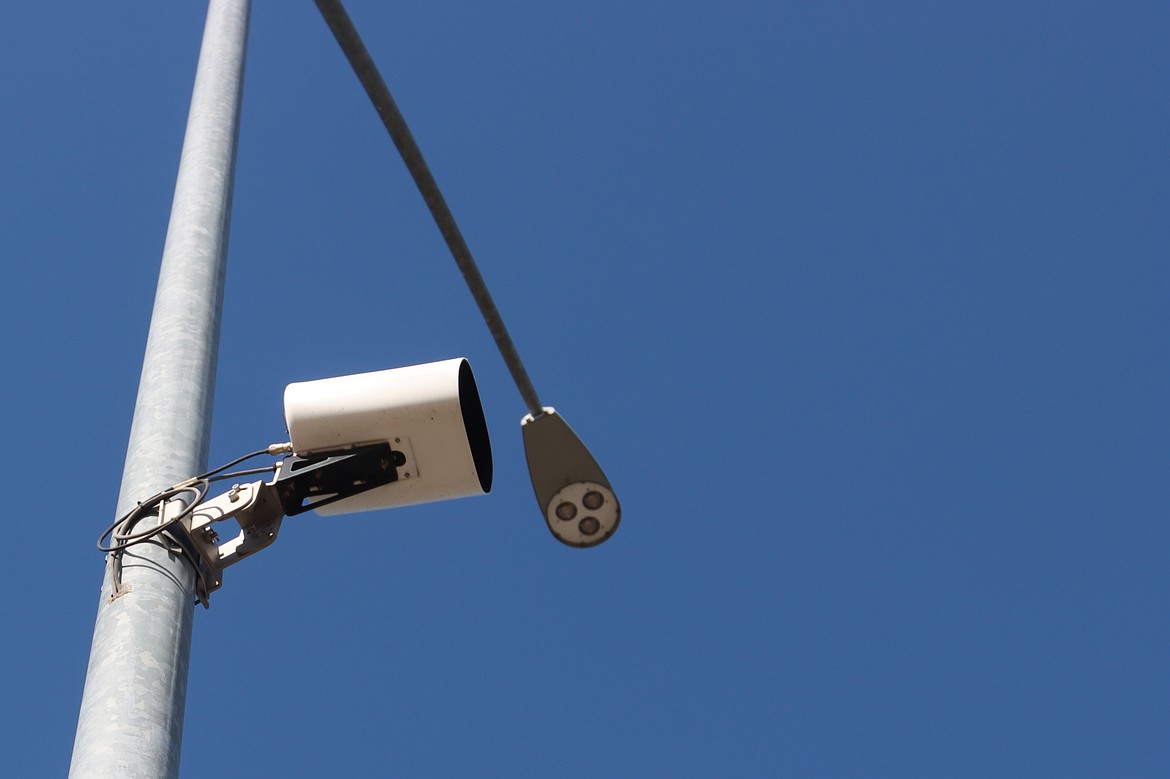
An automated license plate reader stands in Coeur d'Alene on Monday.
RAY ERKU/Press
Surveillance concerns are afoot.
City officials in Coeur d’Alene were questioned recently on the use of automated license plate reader devices, such as Flock cameras.
“These cameras can lead to false arrests,” local resident Tracy Mack said during public comment. “They can lead to ruining some people’s lives.”
There are 11 Flock cameras around Coeur d’Alene, according to dflock.org, an open-source project that maps license plate readers nationwide. However, these cameras are located on private property and are not operated by the city.
“These cameras collect data on millions of vehicles regardless of whether the driver is suspected of a crime,” according to dflock.org. “These systems are marketed as indispensable tools to fight crime, but they ignore the powerful tools police already have to track criminals, such as cell phone location data, creating a loophole that doesn't require a warrant.”
Mack said the public should be aware of this technology.
“The guise is under safety and license readers, that is one thing. But what these cameras are doing is taking multiple pictures of a car front and back, they can look into your car, see what you’re doing on your phone,” Mack said. “They can track you to different places. So, this is something I feel very uncomfortable with because as a private citizen, we should be able to be in our private areas and be respected.”
According to Coeur d’Alene Police Chief Greg Yeager, the city has used ALPRs since 2007. Of its 20 Motorola cameras, which cost the city $17,000 annually to operate, many are installed at eight fixed locations throughout Coeur d’Alene.
The police department also has three vehicles with a mobile ALPR unit and two trailers that use the surveillance technology.
Yeager said the Coeur d’Alene Police Department uses ALPR technology to mitigate traffic or to collect information when incidents, such as stolen cars, poaching, homicides or missing people, are officially reported. But they don't use it for minor traffic infractions.
“The missing and endangered people are a big part of that,” Yeager said. “We’ve had good success in finding elderly and underage people.”
Say a car is reported stolen in Missoula. The car’s reported license plate and vehicle identification numbers are plugged into what’s called the National Crime Information Center database, which is managed by the Federal Bureau of Investigation and used by law enforcement agencies across the U.S. and Canada.
If that same stolen car is then spotted by one of Coeur d’Alene’s ALPRs, Yeager said the information stored in the national database notifies the local police department and, thus, provides legitimate grounds for a traffic stop.
“If the vehicle passes one of our cameras, it's a shoulder tap,” Yeager said.
According to the Idaho Transportation Department, nearly 60,000 vehicles pass between Post Falls and Coeur d’Alene on Interstate 90 each day. An ALPR stationed at one of the freeway exits can theoretically photograph every one of these vehicles as it passes.
“People think that it is tracking their vehicle, it is not,” Yeager said of the city’s Motorola ALPRs. “It takes a picture.”
ALPR data is not legally open to public review in Idaho. The Coeur d’Alene Police Department’s retention policy for ALPR data also sets a one-year maximum.
“If your vehicle is never associated with an accident or crime, it’ll just delete and we’ll never even look at it,” Yeager said. “You do not have reasonable suspicion or probable cause to do anything just because of a license plate read.”
Still, public opposition to ALPRs persists.
Idaho cities Caldwell and Wilder are facing tort claims over their use of Flock cameras, which are argued to violate Fourth Amendment rights.
In more severe cases, people have attacked Flock cameras. In July, an individual was charged with malicious injury to property after ramming a truck into two Flock cameras in Pocatello.
“It’s vandalism,” Yeager said of the attacks on ALPRs. “They’re damaging a property of somebody else. They can be criminally charged if they are attacking that.”
Yeager said the best way for people to take a stance on ALPRs is to speak publicly at local government assemblies such as city council or county commission meetings.
“I think our council is very responsive,” he said.
ARTICLES BY RAY ERKU

City unpacks ‘ambiguous’ state housing regulation
After Idaho lawmakers ease up on accessory dwelling units, Coeur d’Alene must comply by Feb. 1, 2027
For Idaho state law nowadays, residents can legally create larger guest houses, homeowners don’t need to obtain permits for renting out living spaces, and developers can build entire starter-home neighborhoods on far smaller lots than previous generations. These are just some of the new provisions that are the result of Senate Bills 1352 and 1354, as well as House Bill 583.

State proposal triggers response from local firearm gurus
State proposal triggers response from local firearm gurus
Idaho lawmakers are aiming for an official state firearm. Like the huckleberry being its state fruit, Idaho could have a Winchester Model 1873 level-action rifle as its state gun. What do local Coeur d'Alene gun gurus think about it?

Alarm rises over ‘door kick challenge’
Police investigate cases of people kicking in residential front doors
A popular and dangerous trend suspected among youth and young adults is raising alarms with the Coeur d’Alene Police Department and city officials.