
Lake, health care and education take center stage at town hall
CAROLINE LOBSINGER | Hagadone News Network | UPDATED 4 days, 1 hour AGO
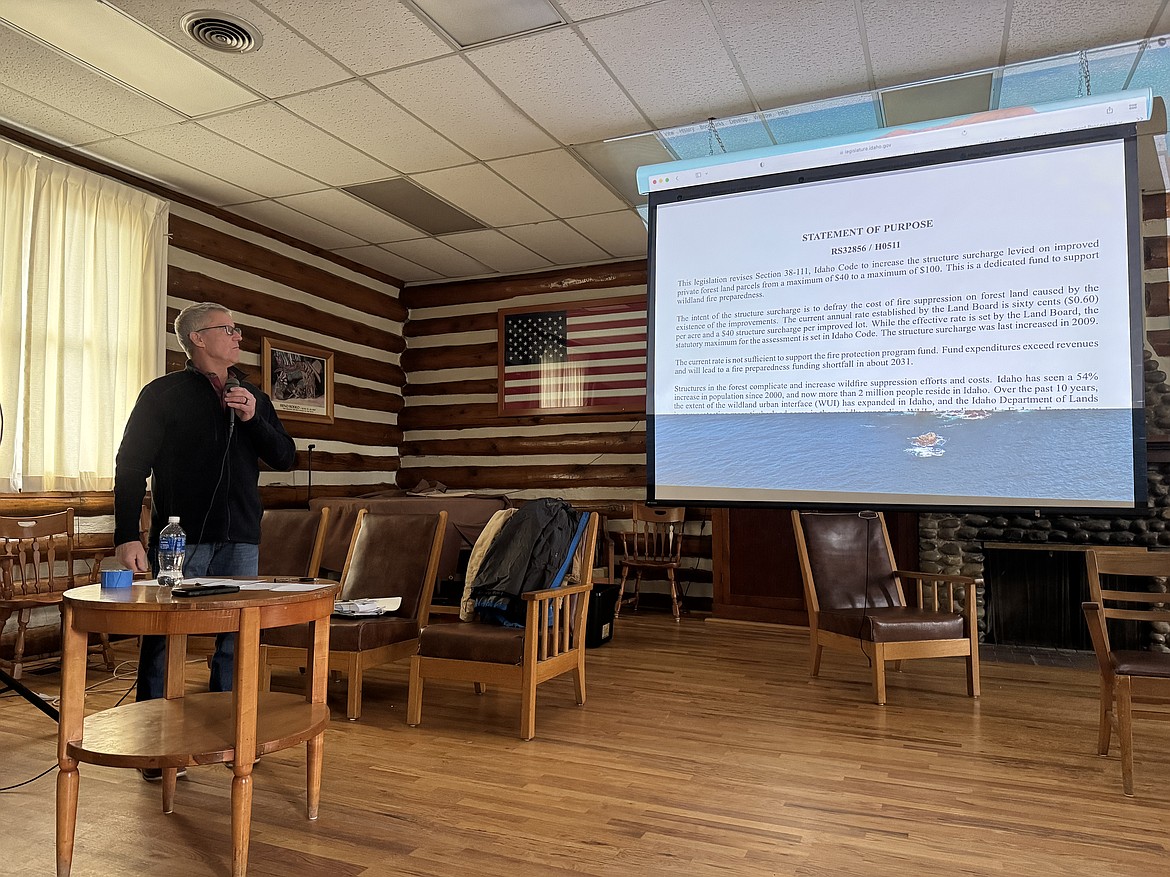
Rep. Mark Sauter, R-Sandpoint, discusses how residents can stay involved and informed during the legislative session at a Saturday town hall meeting.
Photo by CAROLINE LOBSINGER
I grew up in the Tri-Cities, Wash., and have always loved to write. I attended the University of Washington, where I earned a double major in journalism and political science, with an area of emphasis in history. I am the fifth out of six kids — don't believe any of the stories that my siblings tell. To be able to tell others stories and take photos for a living is a dream come true — and I considered myself blessed to be a community journalist. When I am not working, I enjoy spending time with family and friends, hiking and spending time outdoors, genealogy, reading, and watching the UW Huskies and the Seattle Seahawks. I am a servant to my cat, Frankie, who yes, will eat anything and everything in sight … even wedding cookies. | February 1, 2026 1:00 AM
SANDPOINT — While proposed legislation to clarify the state's abortion restrictions has yet to gain traction, Rep. Mark Sauter told those attending Saturday's legislative town hall that he will continue to pursue the issue.
With Rep. Brent Crane, R-Nampa, chair of the House State Affairs Committee, declining to hear the legislation, Sauter said he plans to talk with Speaker of the House Rep. Mike Moyle, R-Star.
"I've taken the whole issue and literally plopped it on the Speaker of the House's chair and said, 'OK, I need to talk to you about this. I don't think it's a good choice for our area.'"
The Sandpoint town hall was the second of three events, starting with a town hall in Bonners Ferry and ending with an event in Priest River. Attending the Boundary County event were Sauter and Rep. Cornel Rasor, with Sauter attending the Sandpoint and Priest River events. Sen. Jim Woodward was unable to attend due to a family emergency.
Rural health as a whole is also shaping up to be a key issue in the state, Sauter told the roughly 100 people gathered at Sandpoint Community Hall for the event.
"Our rural health care system is really struggling right now," he added. "Many of you probably know it, and it's not just a sign of the times, that not everyone's able to pay all their bills, but it's also the behavioral health issue."
The state's law enforcement agencies have expressed concern about $22 million in behavioral health cuts, which impact six programs. Law enforcement said the cuts could end up costing Idaho communities $100 million to $150 million.
"Everybody's concerned because if we don't take care of our behavioral health issues, we fill up hospital beds — it's expensive. It takes up space. We fill up jail cells," Sauter said. "There are other problems that come with behavioral health issues, so we don't want that from a public safety perspective. We're trying to take care of that issue, but it's a work in progress."
Sauter said a state committee was just formed to discuss how to use the expected $900 million that Idaho is expected to get as part of the Big, Beautiful Bill for rural health care.
"I'll just say it's to be determined how that's all going to work out," said Sauter, noting that many of those on the committee come from more populated areas than District 1. "I'm really concerned about how we're going to figure out how to use that money for the betterment of the rural areas of Idaho. I'll just leave it at that. It's something I'm going to have to follow very closely."
The issue — especially centered around women's health — prompted several comments, with residents contending the state has lost 35% of its OB-GYNs in two years and has a significant shortage per capita in terms of doctors.
"My fear is that that money is going to be spent on tech instead of staffing, infrastructure, equipment and doctors — things that matter to a hospital," one woman said. "I just want to voice my concern … I think we're in a kind of crisis, and I am just hoping that there's a real hard-core vision of where this money is going and how it's being spent."
Sauter said he understood residents' concerns, noting he plans to stay active in following the committee and encouraged residents to do the same.
"I've heard the same thing, that some of the paperwork on the grants is that they're looking for more kiosks and iPads than they are looking for caregivers," he added. "I can't answer where the committee will go yet, because they just started. I can say that many of us want to really be involved in this and see what we can do to direct those funds to where they will help our communities, especially our rural health care facilities."
Lake Pend Oreille's water levels also came up during the discussion, with Sauter pointing to a University of Idaho economic study, currently in draft format, which indicated that an additional $20 million to $25 million could be generated if the lake were managed differently. An additional study by the university's Idaho Water Research Institute is looking at whether the current operating plan makes the best use of the lake's water as a resource.
That information is needed for discussions with the U.S. Army Corps of Engineers and Bonneville Power Administration on how best to manage the lake. In addition to recreation and economic benefits, the lake's fishery habitat, flood management and energy needs also factor into how the lake is managed.
"Now we can, as a state, say, 'No, we've researched this. Here's the math. Here's the science,'" Sauter said. "Our communities up here deserve a better shake than they're getting, and I'm hopeful our federal government will continue to make improvements that will help our lake level situation."
Sauter said the USACE completed a "Band-Aid" repair on the damaged gate, which is now in service. Specifications for building new gates are completed, and it's likely that project could go out to bid this spring, Sauter said.
While some chuckled at Sauter's reference to the state's DOGE committee, he said it wasn't a laughing matter, pointing to the initial placement of the Lakes Commission on the chopping block and noting the organization's importance in representing the region's water issues.
Several residents questioned what could be done to put the focus on public education, criticizing spending $50 million of public tax dollars on private and religious-based education without the same accountability demanded of public schools.
Others criticized ongoing plans to transfer public lands to the states, saying such a move would inevitably end with that property — often high-value scenic and recreation lands — being sold to the highest bidders and ending up inaccessible to the public.
The state representative said while he likes current moves toward better collaboration on stewardship of public lands, he was not in favor of moves to transfer ownership to the states, noting a bad fire season would likely be financially catastrophic.
"Having the state involved, I think, is a good thing, but just giving us the keys to the car without any funding to take care of it so that it ends up being sold off — I don't think that's good business, and I really don't think the people in our region want that to happen."
While some called on District 1 legislators to file lawsuits to force what they said was compliance with the Idaho Constitution on education funding, Sauter noted such a lawsuit was already before the Idaho Supreme Court. He also noted that he argued against House Bill 93, which is at the center of the debate, and voted against it.
Also discussed at the town hall were short-term rentals, an Idaho Transportation Department open house on corridor safety issues, the role of the Idaho Department of Lands in firefighting, and creating a longer "runway" for insurance changes to give residents a chance to negotiate continued coverage or find a new provider.
Immigration issues were also an item of concern, with Sandpoint City Councilman Joshua Torrez asking what can be done to ensure the rights of minorities and gun owners, as well as ensuring any actions respect constitutional protections.
"I'm a minority man, a Hispanic man in Idaho, and I have a gun," Torrez said. "I'm worried. It's concerning to me. What can I do? What can you do? What steps are you taking for me, a minority in this community who's scared of these individuals who don't have any concern for people like me?"
While the issue hasn't generated any legislation in Idaho, Sauter told Torrez he would like to speak to him more about the issue and get his input.
As residents keep an eye on the legislative session, Sauter encouraged them to stay informed by talking to their legislators and paying attention to proposed bills and hearings. Legislators have been back in the capital for three weeks, with bills beginning to make their way through the process.
He encouraged them to email and communicate with local legislators, making clear they are from District 1.
"Put your ZIP code in the subject line so I see it right away and can see it right away," he said. "Oh, this is from home and I have to respond to this."
ARTICLES BY CAROLINE LOBSINGER

Priest River continues comp plan review
Priest River officials continue to review updates to the city’s comprehensive plan. Recent edits refine data, formatting, and appendices while preparing for future community input.
Lake, health care and education take center stage at town hall
District 1 residents raised concerns over rural health care, behavioral health cuts, education funding, lake management and public land policy during a Sandpoint town hall.

Event puts focus on corridor's safety needs
Open house looks at U.S. 95 from Sandpoint to Canada
State transportation and law enforcement agencies are reviewing safety needs along the U.S. 95 corridor from Ponderay to the Canadian border.