
Workshop looks at expected budget shortfall for Plains schools
TRACY SCOTT Valley Press | Valley Press-Mineral Independent | UPDATED 9 months, 4 weeks AGO
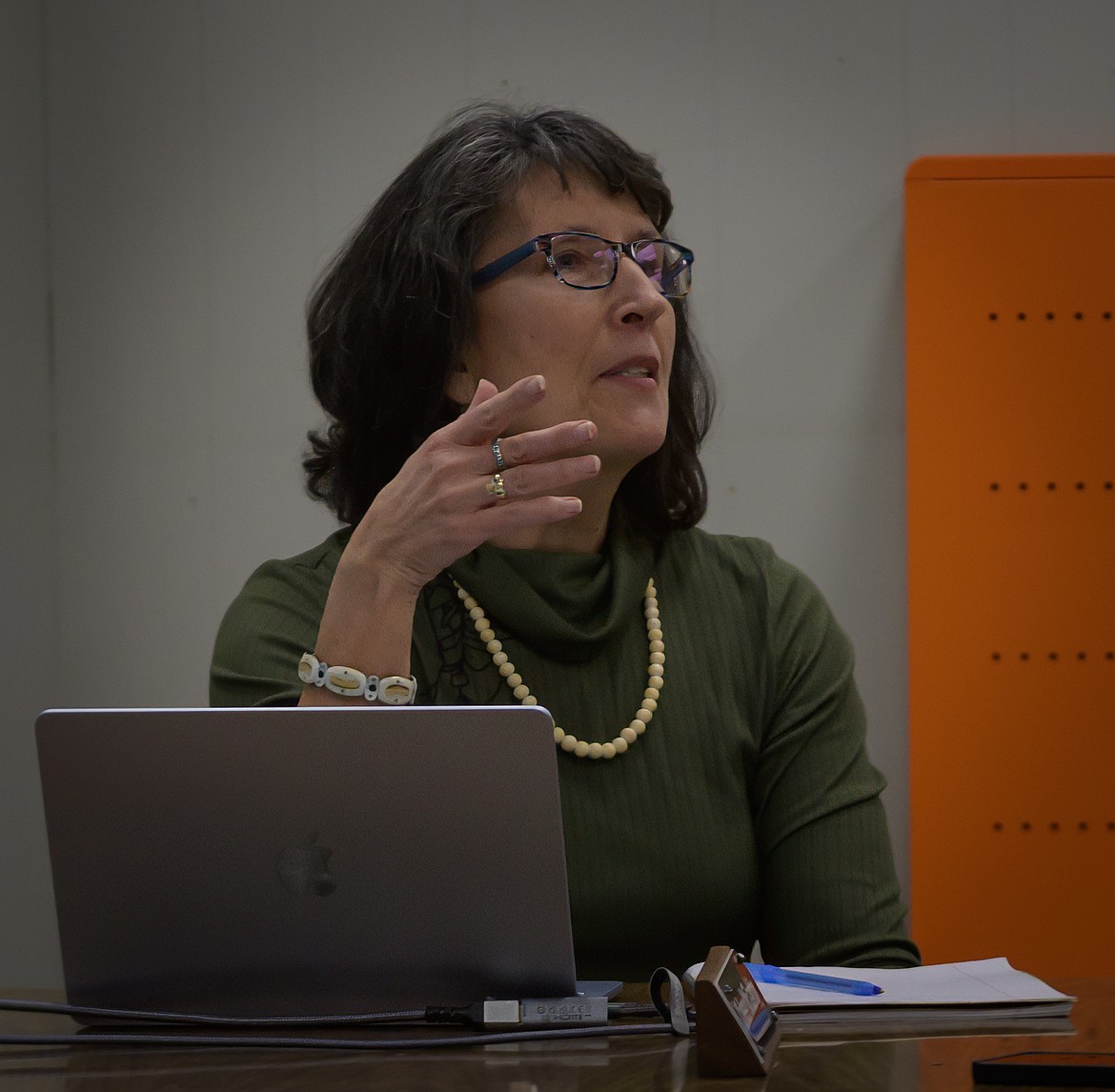
Plains School Board Trustee Colleen McCarthy leads a public discussion during a workshop on possible changes to school administration personnel. (Tracy Scott/Valley Press)
More than 30 Plains residents gathered last week for a public workshop to discuss anticipated budget shortfalls facing the Plains School District.
The evening workshop — the first of several planned — focused on administrative staffing. School board member Colleen McCarthy led the discussion and posed several guiding questions to attendees: What can the budget support? Does this option support staff and students? Does the community support the concept?
McCarthy presented three administrative staffing proposals along with the current costs.
Proposal No. 1 showed the district’s current administrative structure, which includes one superintendent, Dr. Kathleen Walsh, and two principals: Heidii Fettinger as high school principal and Kevin Meredith as elementary principal. The total cost of this model was $280,986.
Proposal No. 2 would reduce administration to one superintendent, one principal and one activities director. The estimated cost is $198,455, representing a savings of $82,531 over the current budget.
Proposal No. 3 included one superintendent, one principal, and a half-time administrator/teacher. This option would cost an estimated $234,801, a savings of $46,105.
At the first school board meeting of the year, Gwyn Andersen of ANB Consulting in Kalispell presented an overview of the district’s financial outlook. Andersen, who has been working with newly hired Plains School business manager Maren Winkler, warned that continued enrollment declines in the 2026-27 school year could force the district to cut programs or seek voter approval for a school levy.
“You can’t continue with the money that you have,” Andersen said.
All school board members were present at the workshop. Board Chair Lana Dicken noted that the district is required to employ a full-time superintendent.
“Anything outside of that, we would be out of compliance,” she said.
McCarthy then asked attendees to evaluate each proposal based on affordability, workability and public acceptance.
Discussion of the current administrative model revealed broad agreement that it is not financially sustainable, despite being viewed as workable. Attendees expressed concern that rising administrative costs could necessitate a levy, which they believed would not receive public support.
“What I don’t think we can do is cut more staff when we already don’t have enough electives in the high school,” said mathematics teacher Lisa Brown. “Why are we here? We are here for the kids. We might have to step up as a staff. We cannot keep doing what we have done this year without enough electives.”
Proposal No. 2 received positive feedback regarding affordability, but many attendees questioned its practicality. Meredith expressed concerns about workload, saying the structure would not be workable. Business teacher Kati Mitchell echoed that sentiment, noting her experience substituting in an administrative role.
“My eyes got opened very, very quickly,” Mitchell said. “Honestly, I agree with Kevin.”
Public support for Proposal No. 2 was described as moderate.
Proposal No. 3 emerged as the most favorable option among attendees. While cost remained a concern, it was considered acceptable, and both workability and public acceptance received positive ratings.
Participants were asked to rank the importance of evaluation criteria. Cost and long-term sustainability ranked highest, followed by workability, with staff and community acceptance ranked third.
Additional workshops are planned to address other district budget concerns.