
For Gilk, it’s been a career of making Park Service connections
Hungry Horse News | UPDATED 9 months, 3 weeks AGO
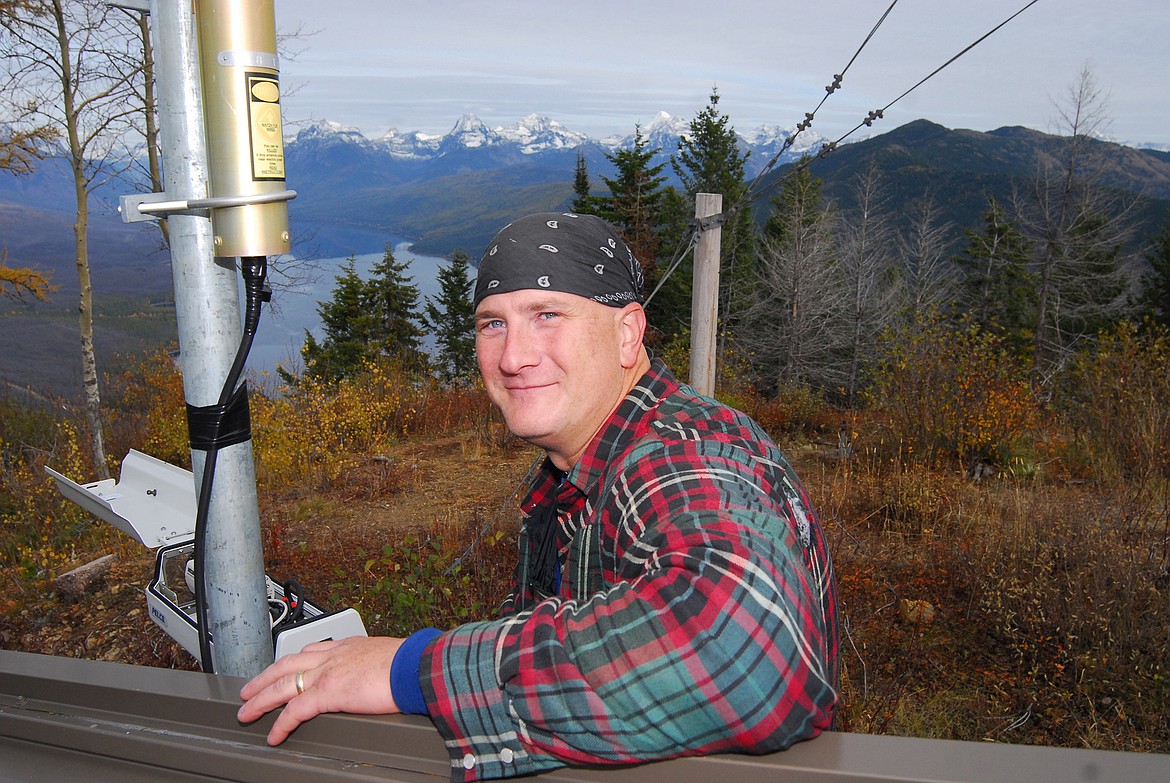
Tim Gilk works on the Apgar Lookout webcam in this 2007 photo. (Chris Peterson photo)
For Tim Gilk, his entire career at the National Park Service has all about fixing problems by using technology.
That may sound complicated, but for the Columbia Falls native, it’s also always been about keeping it as simple as possible.
Gilk graduated from Columbia Falls High School in 1980 and was good in math.
Dick Cowan, his math teacher back then, asked him and some others if they would be interested in getting into computers.
They used Radio Shack TRS-80s and started writing code. The computer was a box with a keyboard that attached to a TV.
It backed up the code to a cassette player.
“But I was hooked,” he recalled. “This was pretty cool stuff.”
So he went on to the University of Montana, got a degree in computer science and wrote code all through college. After a couple years of working for a local company, he got a job as a computer specialist, writing programs for Glacier National Park.
He recalled one of those early computers had a hard drive that held 40 megabytes of information and cost thousands of dollars. (To put that in perspective a single photo from one of the cameras the Hungry Horse News currently uses is about 100 megabytes.)
Back in those days, if the brass in Glacier Park wanted a program, Gilk went to work writing it, all from scratch. Storage was at such a premium that every character counted, and he recalled working with biologists to come up with abbreviations for species so they could track wildlife and still have the data be small enough to fit on the drives.
He recalled the early email system in Glacier sent messages to just one computer. He would print them out every morning and hand deliver them and then send replies as they were needed.
There was zero privacy in that, as one might imagine.
“I knew where all the bodies were buried,” he joked. “I knew everything that was going out and coming in.”
He wrote a lot of software over the years, from programs to track maintenance of the park fleet, to a program that helped human resources track retirement eligibility for employees, but perhaps the best known and most well-liked was the old backcountry (now wilderness) camping permit system.
He also wrote that from scratch and the program was much better than what is used today, as it not only told campers what campground were available in real time, once a permit was in hand, it gave the permit holder the elevation gain and loss of the trip as well as the total miles.
People at least got some idea of what they were getting into.
Today, the permit, spit out by the woeful Recreation.gov website just gives rules and regulations and some guidance of bears and safety, but none of that other, completely useful data.
Gilk also came up with a host of solutions for other Glacier Park amenities, like wiring in many of the park’s webcams in the early days.
“All I had to do was a little networking,” he said. And, of course, hike up a mountain and climb a tower, as in the case of Apgar Mountain, to put a webcam up there.
Gilk said he’s always liked hardwiring systems whenever possible. They last longer, they’re secure (no wifi hacking) and they stand the test of time.
The fiber optic system he put in the park 30 years ago is still in use today, he noted, though admittedly is getting a bit long in the tooth.
He left Glacier in 2014 and went to work for the Intermountain West Region of the Park Service, overseeing communication solutions for more than 80 parks.
Most recently he’s been working on systems that allow remote parks, which often have limited staff, to talk to each other where there’s little, if any cell phone coverage.
It uses systems that link radios through highly encrypted IP networks. Think private cell phone networks.
His standards are high for such systems.
“They have to be sustainable and manageable and reliable,” he said.
And more importantly, simple.
“Simple tends to last longer,” he said.
One of his last projects was a mobile and tactical radio and data system for Big Thicket National Park in Texas.
The whole thing, including a power supply, fits in the backseat of a pickup truck.
At 63, Gilk retires with 38 years with the Park Service. He and his wife Deb, who had a long career in Glacier and later the Bureau of Reclamation have two grown children. He said he plans on doing some hobby farming and perhaps consulting with local businesses.
He is also on call for about seven parks, as he designed communication systems for them but wasn’t able to fully implement them before retirement.
It was coming up with solutions for parks that was the most rewarding, while hiding almost all of it from public view, to adhere to the Park Service mantra of “preserve and protect for future generations.”
“That’s the part I’m going to miss,” he said. “That was the fun part.”