
Town hall focuses on health care, sign, budget
CAROLINE LOBSINGER | Hagadone News Network | UPDATED 22 hours, 31 minutes AGO
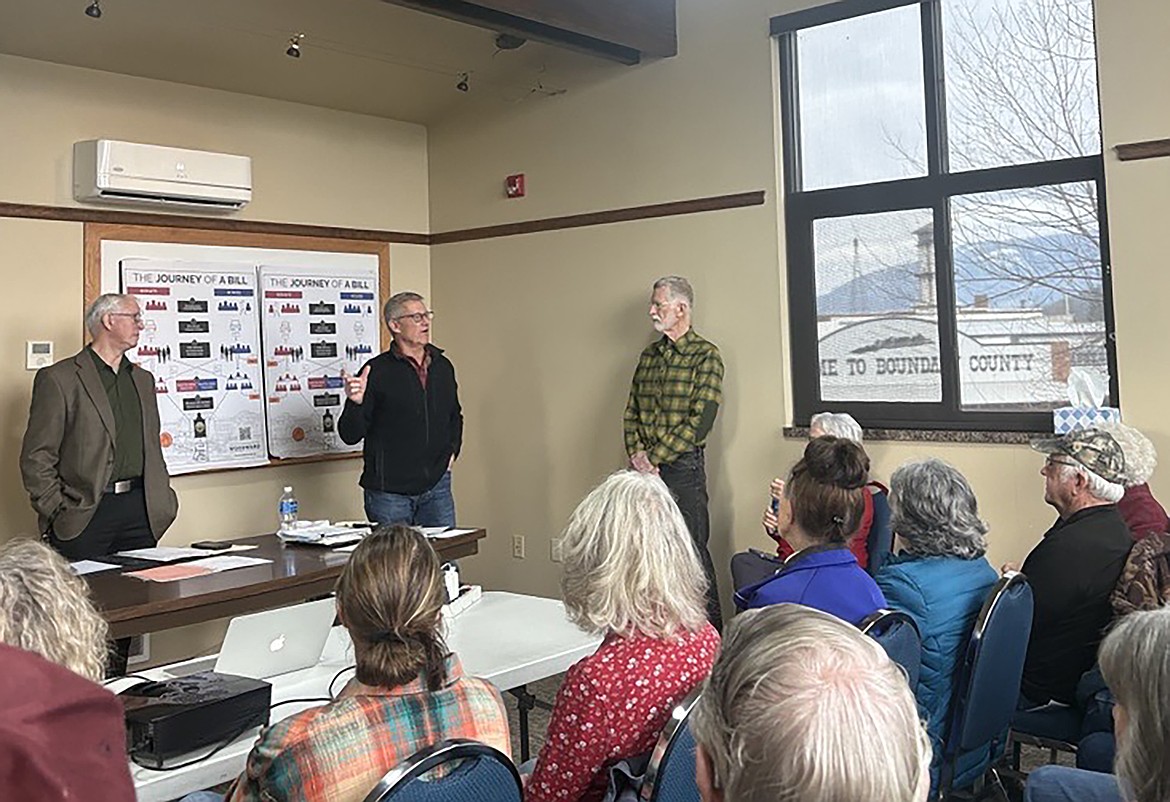
Rep. Cornel Rasor, R-Sagle, and Rep. Mark Sauter, R-Sandpoint, pictured at center, talk to Boundary County residents at a town hall meeting Saturday in Bonners Ferry.
Photo by NOAH HARRIS
I grew up in the Tri-Cities, Wash., and have always loved to write. I attended the University of Washington, where I earned a double major in journalism and political science, with an area of emphasis in history. I am the fifth out of six kids — don't believe any of the stories that my siblings tell. To be able to tell others stories and take photos for a living is a dream come true — and I considered myself blessed to be a community journalist. When I am not working, I enjoy spending time with family and friends, hiking and spending time outdoors, genealogy, reading, and watching the UW Huskies and the Seattle Seahawks. I am a servant to my cat, Frankie, who yes, will eat anything and everything in sight … even wedding cookies. | February 5, 2026 1:00 AM
BONNERS FERRY — Boundary County residents got a chance to both learn about the legislative process and share their concerns about potential budget cuts amid the state's budget challenges.
District 1's Rep. Mark Sauter, R-Sandpoint, and Rep. Cornel Rasor, R-Sagle, welcomed the many county residents who attended the Saturday, Jan. 31, town hall — the first of three in the two northern counties which comprise the district. State Sen. Jim Woodward was unable to attend due to a family emergency.
Sauter and Rasor told residents local input is important to all the district legislators, and encouraged them to email them their thoughts and input on proposed legislation — or on ideas for bill they could introduce.
"As a citizen who wants to watch these bills as they progress, can you give us an idea of when it's the most effective to try to get to you as our representative if there's a bill we're really concerned about in a positive way or a negative way?," one woman asked. "Because you've got so many different aspects of that bill as it's going through to so many different places, and you have so many bills to watch. What's the most opportune way for us to get a hold of you?"
Sauter and Rasor said when residents see or hear about a bill, the best way is to send an email to local legislators, including their ZIP Code in the subject line to indicate they live in District 1. Also helpful, including the bill number if known.
"The short answer? As soon as you see it on our website and you have a question about it or you want to weigh in on it, I think just send a message to us," Sauter said.
Rasor encouraged residents to ping them if they don't hear from them in a reasonable time, saying they get busy and may forget to reply that they received the email.
Residents asked the pair about tax cuts over the past several legislative sessions and their impact on the budget, the impact of the federal Big Beautiful Bill and well as the potential of the state budget challenges on local programs, such as the Senior Center's Meals on Wheels program.
"There are 60 to 80 meals that go out every week, two to three times a week by volunteers, … on top of that, this money is critical for some of our senior citizens," one resident said.
The pair said that while they didn't have an answer, they would look into the issue and stay on top of it.
One Boundary County resident said affordable housing, health care and education are big concerns among the county's youth and their parents. Affordable child care is also an issue, the woman said.
"They're the generation that going to be running the country and my generation, we have our concerns too but we need to realize these young families need our help," she added.
Rural healthcare is also shaping up to be a key issue in the state, Sauter told residents at the town hall events.
"Our rural health care system is really struggling right now," he said at the Sandpoint event. "Many of you probably know it, and it's not just a sign of the times, that not everyone's able to pay all their bills, but it's also the behavioral health issue."
The state's law enforcement agencies have expressed concern about $22 million in behavioral health cuts, which impact six programs. Law enforcement said the cuts could end up costing Idaho communities $100 million to $150 million.
"Everybody's concerned because if we don't take care of our behavioral health issues, we fill up hospital beds — it's expensive. It takes up space. We fill up jail cells," Sauter said. "There are other problems that come with behavioral health issues, so we don't want that from a public safety perspective. We're trying to take care of that issue, but it's a work in progress."
The pair told Boundary County residents the issue was broached by Boundary County Sheriff and other local officials at a recent Idaho Association of Counties event.
"They were talking with Boundary County and Bonner County officials … they were talking with legislators about allowing them to have a local option tax. The Boundary County Jail is outdated and needs a lot of help from what Sheriff Travis Stolley was telling (Boundary County) Commissioner Ben Robertson," Rasor said.
Sauter said Bonner County Sheriff Daryl Wheeler has also expressed interest in such a bond. All share a concern about placing such a large expense being paid for out of property taxes.
"That's a tough thing to saddle all the property owners who are saying 'I'm not involved with this jail. It's the people who drive through town that we have problems with and now we're forced to pay for that," Sauter said. "So there's an emphasis on the local option tax (as a possible funding mechanism)."
However, the legislator said there is some resistance to the idea among the House of Representative's leadership. But the issue is one the District 1 legislators will be keeping an eye on.
While tax cuts appear to be a good idea, one man said he's concerned about cutting them so much that they are hurting essential services.
"You know, they look good but in reality when you start losing essential services and I'm sorry that some people didn't plan for their future and they're wanting to tax cut everything," one man said. "We're paying the price now. I don't mind paying taxes as long as they're not too absorbent. But tax cuts have decimated the surplus that we have so now the state is in a deficit. I think we need to look at how those taxes are cut."
Rasor said one possible opportunity for savings is no trim funded positions that are sitting vacant in a wide array of the state's agencies.
'We're trying to get our heads around that because in some cases you need to have some extra seats just in case you're tasked with more work today … but the number of full-time employee positions that are funded is remarkable and so that's one area I think we're going to be looking at."
Sauter said a state committee was just formed to discuss how to use the expected $900 million that Idaho is expected to get as part of the Big, Beautiful Bill for rural health care.
"I'll just say it's to be determined how that's all going to work out," said Sauter, noting that many of those on the committee come from more populated areas than District 1. "I'm really concerned about how we're going to figure out how to use that money for the betterment of the rural areas of Idaho. I'll just leave it at that. It's something I'm going to have to follow very closely."
The issue — especially centered around women's health — prompted several comments, with residents contending the state has lost 35% of its OB-GYNs in two years and has a significant shortage per capita in terms of doctors.
"My fear is that that money is going to be spent on tech instead of staffing, infrastructure, equipment and doctors — things that matter to a hospital," one woman said. "I just want to voice my concern … I think we're in a kind of crisis, and I am just hoping that there's a real hard-core vision of where this money is going and how it's being spent."
Sauter said he understood residents' concerns, noting he plans to stay active in following the committee and encouraged residents to do the same.
"I've heard the same thing, that some of the paperwork on the grants is that they're looking for more kiosks and iPads than they are looking for caregivers," he added. "I can't answer where the committee will go yet, because they just started. I can say that many of us want to really be involved in this and see what we can do to direct those funds to where they will help our communities, especially our rural health care facilities."
Also brought up at the town hall was the issue surrounding the American Legion's sign, which was deemed by Idaho Transportation Department officials to not have approval.
"To me, it's capricious," Legion Commander Joanne Danner said, adding that she had been told that Gov. Brad Little is the only one who can grant a waiver to allow the sign to stay up.
"We have a very high percentage of veterans in this county and our sign is a joint venture between the VFW and the American Legion," Danner told the legislators. "The goal was to provide information to our veterans. They are not online and they're not doing lots of things but they do drive up and down the highway and this was just a two-sided reader board where we could keep them informed."
Both Rasor and Sauter said they would reach out to state officials to see what could be done.
In Sandpoint, several residents questioned what could be done to put the focus on public education, criticizing spending $50 million of public tax dollars on private and religious-based education without the same accountability demanded of public schools.
Others criticized ongoing plans to transfer public lands to the states, saying such a move would inevitably end with that property — often high-value scenic and recreation lands — being sold to the highest bidders and ending up inaccessible to the public.
The state representative said while he likes current moves toward better collaboration on stewardship of public lands, he was not in favor of moves to transfer ownership to the states, noting a bad fire season would likely be financially catastrophic.
"Having the state involved, I think, is a good thing, but just giving us the keys to the car without any funding to take care of it so that it ends up being sold off — I don't think that's good business, and I really don't think the people in our region want that to happen."
While some called on District 1 legislators to file lawsuits to force what they said was compliance with the Idaho Constitution on education funding, Sauter noted such a lawsuit was already before the Idaho Supreme Court. He also noted that he argued against House Bill 93, which is at the center of the debate, and voted against it.
Also discussed at the town halls were short-term rentals, an Idaho Transportation Department open house on corridor safety issues, the role of the Idaho Department of Lands in firefighting, and creating a longer "runway" for insurance changes to give residents a chance to negotiate continued coverage or find a new provider.
ARTICLES BY CAROLINE LOBSINGER
Town hall focuses on health care, sign, budget
Residents in Boundary County raised concerns over healthcare access, behavioral health cuts, education funding, public lands, and potential impacts of state budget challenges.

Priest River continues comp plan review
Priest River officials continue to review updates to the city’s comprehensive plan. Recent edits refine data, formatting, and appendices while preparing for future community input.
Lake, health care and education take center stage at town hall
District 1 residents raised concerns over rural health care, behavioral health cuts, education funding, lake management and public land policy during a Sandpoint town hall.