
Washington students work for state cactus
JOEL MARTIN | Hagadone News Network | UPDATED 8 months, 1 week AGO
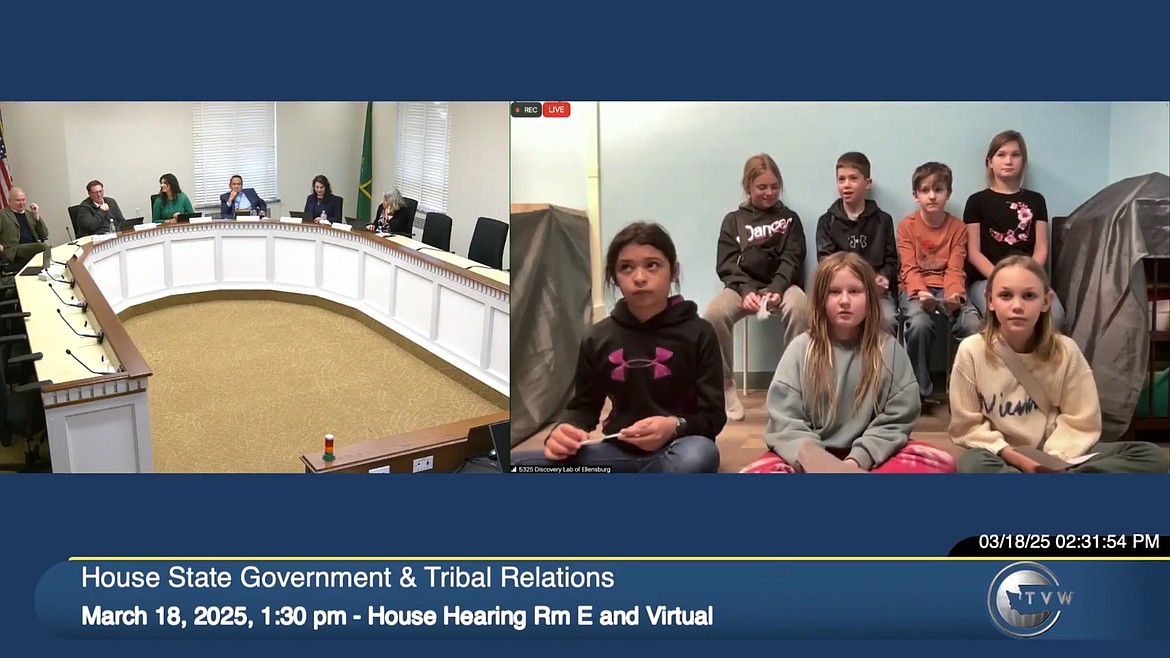
Discovery Lab students testify remotely before the Washington Legislature in support of designating Pediocactus nigrispinus Washington’s state cactus.
COURTESY PHOTO/DISCOVERY LAB
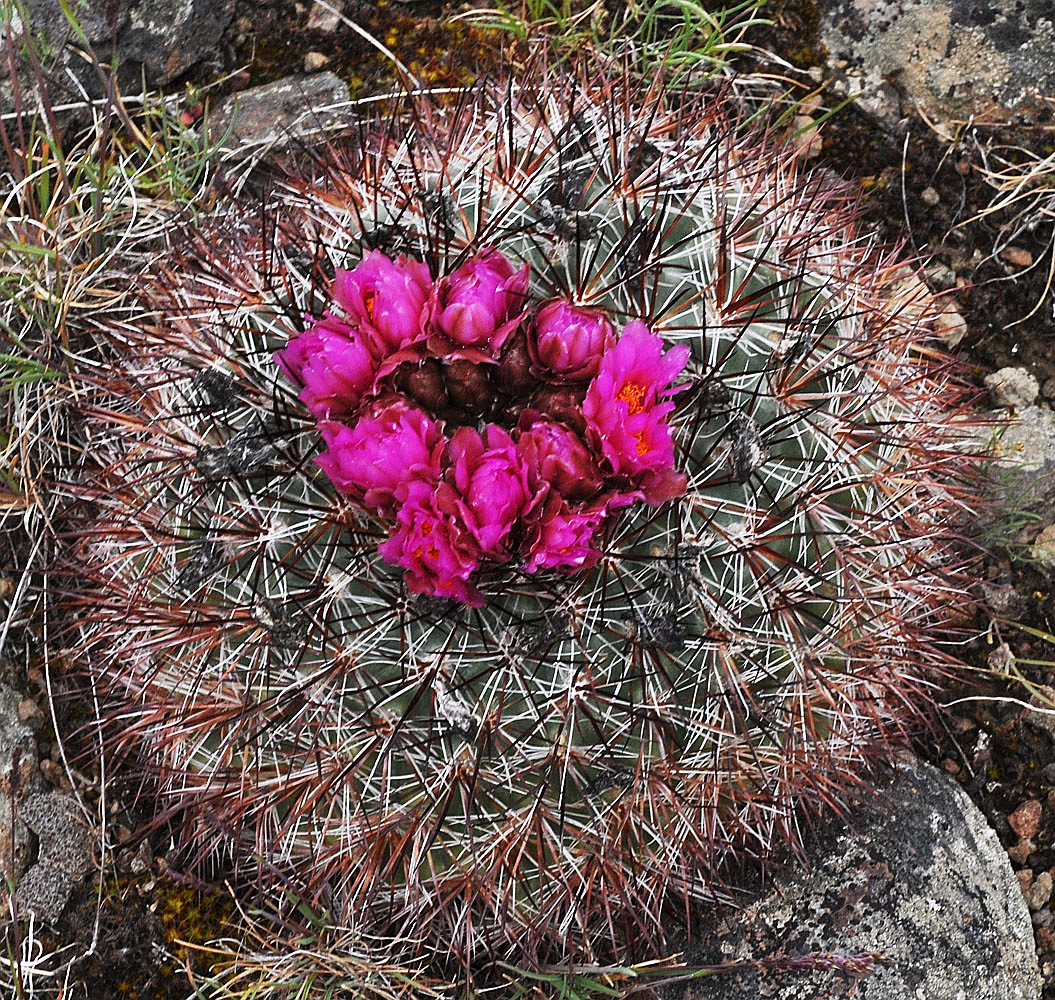
Pediocactus nigrispinus, also known as the Columbia Plateau cactus, the snowball cactus and the hedgehog cactus, grows in the fragmented shrub-steppe of central Washington.
Joel Martin has been with the Columbia Basin Herald for more than 25 years in a variety of roles and is the most-tenured employee in the building. Martin is a married father of eight and enjoys spending time with his children and his wife, Christina. He is passionate about the paper’s mission of informing the people of the Columbia Basin because he knows it is important to record the history of the communities the publication serves. | February 5, 2026 3:20 AM
OLYMPIA — The Washington State Legislature started the session with a prickly subject.
“Sometimes folks think Olympia is all about the thorny issues but today was about celebrating some pretty sharp kids,” Sen. Judy Warnick, R-Moses Lake, wrote in a Jan. 28 announcement about the passing of Senate Bill 5325, designating Pediocactus nigrispinus – also called the Columbia Plateau cactus, the basalt cactus or snowball cactus – as Washington’s very own state cactus.
The process began last year, when about 10 students at the Discovery Lab in Ellensburg were learning about the environment they live in.
“A couple of years ago, we started a project about the shrub-steppe, which is the sagebrush ecosystem,” said their teacher, Brooklynn Edgar. “And we just really fell in love with a lot of the animals of that habitat. We wanted to bring more attention to it because one of the biggest threats to those animals in the shrub-steppe is fragmentation.”
Fragmentation, according to the Washington Department of Fish and Wildlife, is when large portions of natural habitat are whittled away or broken up by things like agriculture, road building and urbanization. An estimated 80% of Washington’s shrub-steppe has already succumbed to that fragmentation, according to the WDFW.
Edgar’s students spoke with a researcher who told them about the role the Columbia Plateau cactus plays in this fragile environment.
“He kind of gave us the idea that this could be a really good opportunity to bring awareness to the shrub-steppe and the importance of this ecosystem,” Edgar said. “We just fell in love with it and are continuing our learning with that and connecting that cactus to the legislative process.”
The students wrote letters to their local legislators, including Warnick, who responded and helped them through the process. Warnick introduced the bill in January 2025, and Discovery Lab students testified via remote connection before the Senate State Government, Tribal Affairs and Elections Committee in February and the committee’s House counterpart in March.
“The reason why we want to make the basalt cactus the state cactus is that we want to bring awareness to the shrub-steppe ecosystem,” Vienna Borquez told the Senate committee on Feb. 4, 2005. “We need to bring awareness to the shrub-steppe ecosystem because that makes the basalt cactus more vulnerable. The reason why there have been more wildfires is that it has gotten hotter every single year in the summer because of global warming and human impact.”
“This is the only ball cactus in the state of Washington,” said Luke Romano-Moon. “It also grows very, very slowly. It lives up to 80 years. This beautiful cactus blooms for three to four days and is very beautiful.”
SB 5325 passed the Senate 48-1 but ran out of time in the House of Representatives.
“Now it’s over in the House for a hearing,” Warnick said. “I’m hoping that we can get it through this year for the kids.”
The bill passed the Senate this year by a vote of 47-2. One of the no votes came from Sen. Mike Chapman, D-Sequim.
“The Sequim valley, which I represent, has the only native cactus (Opuntia fragilis Brittle prickly pear) in Western Washington, thus in my humble opinion it should have been considered for the state cactus,” Chapman wrote in an email to the Columbia Basin Herald.
The Columbia Plateau cactus stands to be one in a long list of official symbols in Washington. The state flag and seal are familiar to most Washingtonians, bearing the likeness of the first president of the United States. The state tree is the Western Hemlock, the state flower is the rhododendron, and the state bird is the American goldfinch, according to the Legislature’s list of official symbols. Most states have those as well. Washington schoolchildren at various times have also convinced the Legislature to designate a state dinosaur (Suciasaurus rex), a state insect (the Green Darner dragonfly) and a state vegetable (the Walla Walla sweet onion). If the bill passes the House, Washington will become only the third state to boast a state cactus, after Colorado and Texas.
The Discovery Lab students have learned some valuable lessons through this effort, Edgar said, both about their environment and about the legislative process.
“I think it goes to show that perseverance and dedication to a topic can really go far,” she said. “When it didn’t pass the first time, the kids were pretty discouraged. But learning to overcome that and continue working toward something that they are passionate about, I think, is the biggest lesson of all. In the legislative process, things don’t happen overnight, and it does take people who care about things to move things forward.”
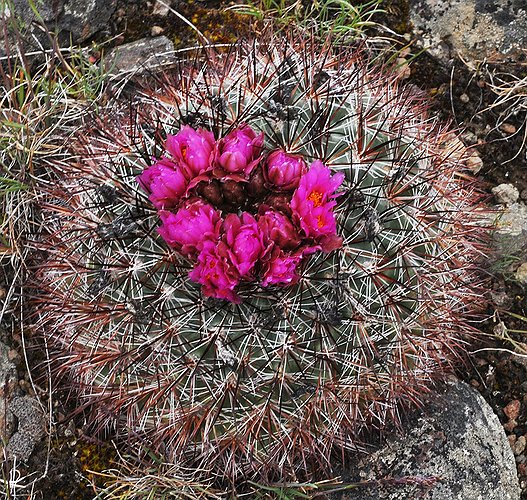 Pediocactus nigrispinus, also known as the Columbia Plateau cactus, the snowball cactus and the hedgehog cactus, grows in the fragmented shrub-steppe of central Washington.
ARTICLES BY JOEL MARTIN
Endless battle
Noxious Weed Control Board works to keep invasive plants under control
MOSES LAKE — Some of the nastiest plants in Grant County were the topic of a class led by Jay Johnson, a consultant with the Grant County Noxious Weed Control Board, Tuesday. The Noxious Weed Control Board, as its name would suggest, is tasked with keeping weeds under control in Grant County. That’s not a small job; the board’s website lists 129 species of noxious weeds that are found around Grant County. A noxious weed is defined as an invasive, non-native plant that threatens agricultural crops, local ecosystems or fish and wildlife habitat, according to the Noxious Weed Control Board. Washington state law requires that these weeds be identified and their spread kept to a minimum, if not completely eradicated. “We’re one of those agencies a lot of people don’t really understand,” Johnson said. “We’re a county office and … our funding is tax-based assessment. When you get your tax bill and you look down at all the expenses that you pay for, there we are.”

BASIN EVENTS: Oct. 16-24
COLUMBIA BASIN — Whether you feel like shopping, crafting, learning or seeing a show, there’s something happening for you this week in the Basin. Oct. 16 ‘My Family (Mi Familia)’ screening Spanning three generations, “My Family (Mi Familia)” is a heartfelt drama that follows the Sánchez family as they build their lives in East Los Angeles. Through love, hardship, triumph, and sacrifice, the film explores the immigrant experience, the strength of family bonds, and the traditions that connect one generation to the next. Lowrider show and taco truck before the screening. Sponsored by Columbia Basin Allied Arts, EDUBS C/S and the Moses Lake Creative District. $12 per person. Doors open at 6 p.m., film begins at 7 p.m. at the Moses Lake Civic Center Auditorium, 401 S. Balsam St. Tickets and info: www.cba-arts.org.
Moses Lake author encourages women to look beyond church culture norms
MOSES LAKE — A Moses Lake author’s book, “A Christian Woman Striving to Live Her Faith in a Man-Controlled World,” takes aim at the role to which many churches relegate the female half of their congregations. “It’s to encourage women in the faith,” Linda Curran said. “A lot of churches say, ‘Teach Sunday school, do this, do that, but don’t (evangelize.)’" In her book, Curran recounts a time when she moved to a new community and joined a church there. She was surprised to learn that, as a new female member, she had been automatically assigned church cleaning duties. When she questioned it, she wrote, she was met with condescension and her objections were brushed aside. In other churches, she said, women who were capable of teaching were relegated to “women’s ministry.”