
City Commission discusses protest vote against new Montana law
EMILY MESSER | Hagadone News Network | UPDATED 3 weeks, 4 days AGO
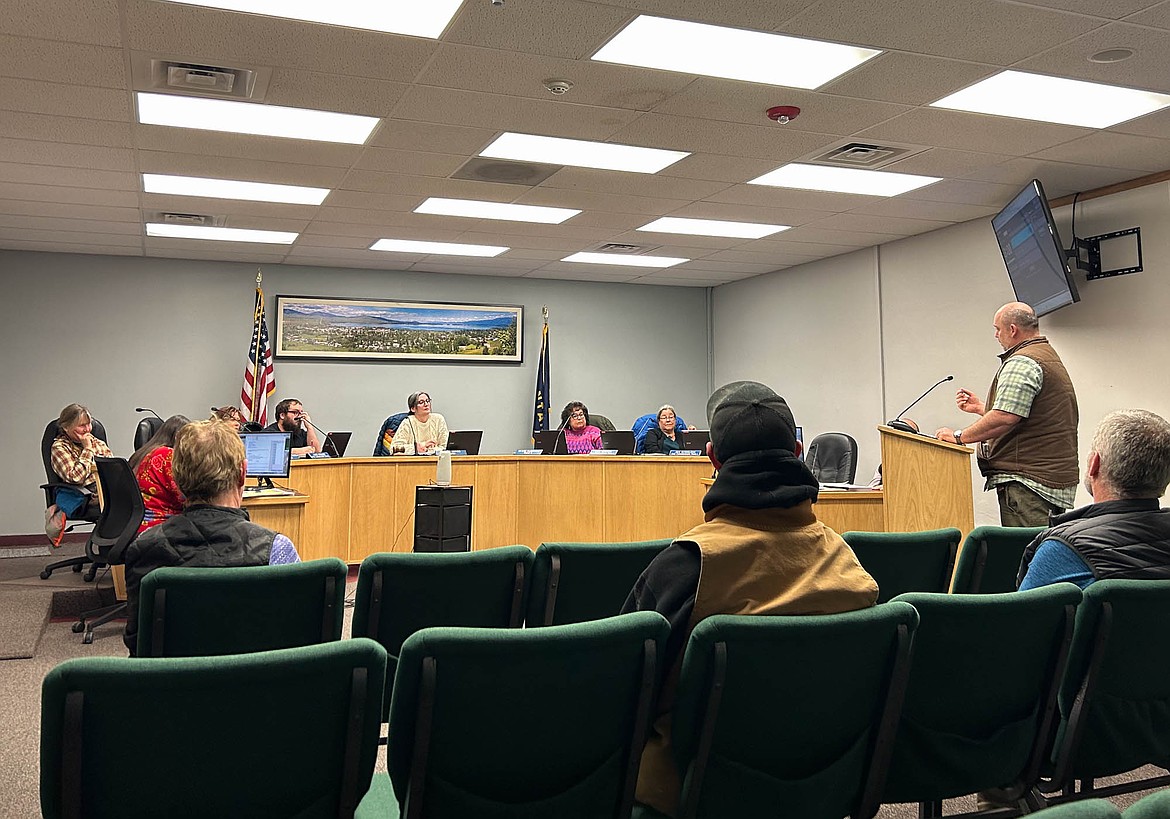
City attorney Dave Michie presents the first reading of the mixed-use development impact fees calculations during the Polson City Commission meeting on Feb. 2 (Emily Messer/Leader)
Emily Messer joined the Lake County Leader in July of 2025 after earning a B.A. degree in Journalism from the University of Montana. Emily grew up on a farm in the rolling hills of southeast Missouri and enjoys covering agriculture and conservation. She's lived in Montana since 2022 and honed her reporter craft with the UM J-School newspaper and internships with the RMEF Bugle Magazine and the Missoulian. At the Leader she covers the St. Ignatius Town Council, Polson City Commission and a variety of business, lifestyle and school news. Contact Emily Messer at [email protected] or 406.883.4343 | February 11, 2026 11:00 PM
The Polson City Commission discussed voting against adopting the new Montana zoning laws into the city code, even though the city would still have to comply with state law, during the latest commission meeting on Monday, Feb. 2.
Rob Edington, the city’s community development director, presented the 2025 Montana Legislative changes that would require the city to amend zoning codes. It is common practice for municipalities to update their codes to align with new state laws.
The lengthy presentation included 18 Senate or House bills along with nine outstanding 2023 bills that the City-County Planning Board reviewed last month, in order to make recommendations for the commission.
Each bill was reviewed, and the commission was provided with a staff analysis, a summary of proposed changes, and a summary of future changes. All but one review suggested no proposed changes, while some included future changes.
The only zoning item with a proposed amendment was the RV and mobile home subdivision laws. Senate Bill 174 required the city not to review RV parks as subdivisions,
One point of discussion was Senate Bill 243, which would allow 60-foot building heights in “downtown commercial,” which would apply to downtown Polson, according to Edington.
This would include the central business and general commercial-industrial zoning districts in Polson.
A resident, Lynn Kelly, asked, “Why did they pick five stories or 60 feet?”
“That would be a great question to ask your state legislator, because we don't have any say. We're powerless on these things, and it's the state telling us what to do,” Commissioner Carolyn Pardini said.
After the commission passed the first reading of this ordinance, Pardini said she understands they have no option but to adopt the state's changes, but she wonders whether voting unanimously for them makes them appear compliant.
“Maybe we need to start throwing up a few dissenting votes, because I think there's a feeling within the commission and with Ed (Meece, City Manager), that we're being played a fool, we're not being taken very seriously by the state,” Pardini said.
Pardini explained that if they occasionally voted how they feel instead of how they feel they need to, “we might be able to raise a little bit of public awareness about what’s going on,” she said. Mayor Laura Dever asked Meece what would happen to the city if the commission didn’t motion to approve the legislative changes.
Meece said the city would still have to comply with state law and would simply outdate the code.
“It's something to talk about and think about. I would agree with Commissioner Pardini’s effort to tweak back a little bit,” he said. “I don't know how we do that, but I think it's an interesting thought.”
Meece noted during the meeting that there is an “incredible amount” of Montana legislation directing local land use and planning enforcement. He said they witnessed a considerable amount in 2023 and a huge amount last year. The bills presented to the commission in Edington’s presentation are “very small,” compared to what was passed, according to Meece.
He noted that it is critical for the commission to pay close attention to the 2027 Legislature.
“It's critical that we stay involved in that legislative process, but it's also critical for our citizens to hear that they also need to be staying involved and paying attention,” Meece said.
He explained that this five-story building applies to all communities in Montana.
“A five-story building, that’s huge,” Meece said. “And that’s a mandated change. We have no choice about that.”
Commissioner Pardini believes the legislative changes are based on creating more affordable housing and streamlining the building process. But she said she hasn’t “seen that evidence,” Pardini said in a later interview.
“My real opposition is that we are just seeing this overreach. Where the Legislature, which is ultra-conservatively controlled, is taking away the decision-making ability of municipalities,” she said.
What’s next for Salt Cafe grant funding
Another point of discussion involved the next steps for Salt Cafe. On the consent agenda was a resolution for Meece to sign a maintenance agreement with the Montana Department of Transportation regarding the construction of a handicap ramp at the cafe on Main Street. This agreement makes the owners responsible for maintenance.
Andrew Perkins applied for and received approximately $65,000 in Tax Increment Finance District grant funds in 2023.
According to the June 3, 2023, meeting minutes, Perkins would need to obtain permits, replace the electrical, update plumbing, replace the exterior and add ADA access. In September 2024, Perkins requested a grant extension.
During Monday night's meeting, Commissioner Jake Holley asked Meece whether this maintenance agreement would allow Perkins to move forward with the project more easily. Meece said it is “one of the hoops that they would need to jump through.”
Meece explained that this agreement closes the book on MDOT, the city and the owners. MDOT was involved in this step because Main Street is a state-owned road.
To obtain the grant funds, Meece said Perkins would need to return with a letter stating that he believes he has met all requirements of the original grant proposal. Meece said that at that point, the commission can decide to award anywhere from $1 to the full grant amount.
During public comment, before the commission reached the consent agenda, Kelly urged the commission to release the grant funding.
“I am tired of waiting for the Salt Cafe to be open from 3 p.m. until 11 p.m., so that people can come together and have homemade pretzels and non-alcoholic drinks and a place for kids to do homework until 11 p.m.,” Kelly said. “I remember the excitement in the eyes of Kat and Andrew Perkins when they first shared what they were hoping to do with all of these things. I have watched that excitement dim into a grim determination to just hang in there.”
Other agenda items
The commission also passed the first reading of an ordinance to amend the water and sewer impact fees for mixed-use developments. The commission recently approved new fees for residential and commercial developments.
This would allow mixed-use developers to use the residential calculation on a separate meter or upgrade the meter to commercial and pay in the commercial increments.
During the city manager's comments, Meece presented a draft proposal for MIXT Industries to lease the golf course for 99 years. A commission workshop was scheduled for Feb. 17 at 5:30 p.m. in the commission chambers to discuss the proposal with the company’s managing partner, Dallas Tanner.
Commissioner Pardini followed up with Meece again on the financials for Bunkers Bar and Grill. The city owns and operates the restaurant and lost its manager last fall. It also suffered another setback when a motorist accidentally hit the building in November, damaging the walk-in freezer.
Pardini has asked Meece for the financials multiple times. During their Jan. 6 meeting, Meece said he would email the numbers to the commissioners, but she insisted he present them at a public meeting.
“It’s one of those unanswered questions,” Pardini said to Meece.
After apologizing, Meece asked whether she had seen the report in the agenda's supplemental pages. However, Pardini’s computer crashed, and she could not access the document.
According to the report, Bunkers was losing an estimated $10,000 to $83,000 per year until 2020. The following year, Bunkers went to “year-round status,” and the numbers changed from almost $20,000 in profit to more than $160,000 in losses in 2025. Halfway through this fiscal year, the report shows Bunkers at a loss of $1,152.
According to the city’s Fiscal Year 2025-2026 Budget that the Lake County Leader reviewed, the actual revenue from Bunkers during the previous fiscal year (2024-2025) was just above $650,000. The expenses are split into supplies, operations and maintenance, totaling almost $800,000. That income also reflects revenue from the Boettcher Park concession stand, the wine and beer cart and the golf simulator, which is housed in Bunkers.
Commission hears potential for sewer upgrade
A potential grant opportunity to expand sewer mains was presented to the Polson City Commission during a public hearing on Monday, Feb. 2, prior to the regular commission meeting.
City engineer Zachary Maassen introduced a matching grant opportunity through the Montana Coal Endowment Program to expand sewer mains from Sixth Avenue East to Fourth Avenue East along Seventh Street East. Maassen said these main lines are at capacity and that to support future growth they would need to be upgraded.
Massen said several years ago the city had completed the segment from Fourth Street to Highway 93, and last year the southern portion of Seventh Street was finished.
Grant awards range from $500,000 to $750,000, depending on the usage rate in the project area. Maassen said he believes the city would fall in the $625,000 range but plans to aim for the full amount.
There are seven statutory priorities on the application, each scored individually, that assess an applicant's eligibility for the grant, all of which Maassen said Polson aligns with well.
The endowment is a state-funded program administered by the Montana Department of Commerce and designed to assist local governments in securing financing for specific public facility projects.
Applicants must provide matching funds equal to at least the amount requested from the program. Matching funds can include public or private cash or loans, as well as state or federal grants.
Some statutory priorities include the government's need for greater financial assistance, long-term, comprehensive land-use planning, public facilities for business expansion, and the expansion of the tax base.
Maassen explained that these grants are awarded every two years, and applications are due by May 2026. The rankings will go to the Legislature at the beginning of 2027.
ARTICLES BY EMILY MESSER

Polson commissioners hear plan for reducing E. coli in Flathead Lake
Representatives from the Flathead Lakers and the Polson Bay Golf Course presented a plan to the Polson City Commission last Wednesday to reduce stormwater runoff, which had caused increased levels of E. coli in Flathead Lake near Boettcher Park.

City Commission finalizes Salt Cafe grant, hears from market vendors
The Polson City Commission council chambers were full of support Monday night for Andrew Perkins, owner of Salt Cafe, who has been awaiting funding from the Tax Increment Finance District grant he received nearly three years ago.

Foundation established for Polson Police
A non-profit called the Polson Police Foundation was launched at the end of 2025 to support the department by contributing to training, officer wellness, critical equipment and community initiatives.