
Project Icarus takes flight at Forrest Bird Charter School
JACK FREEMAN | Hagadone News Network | UPDATED 1 month, 3 weeks AGO
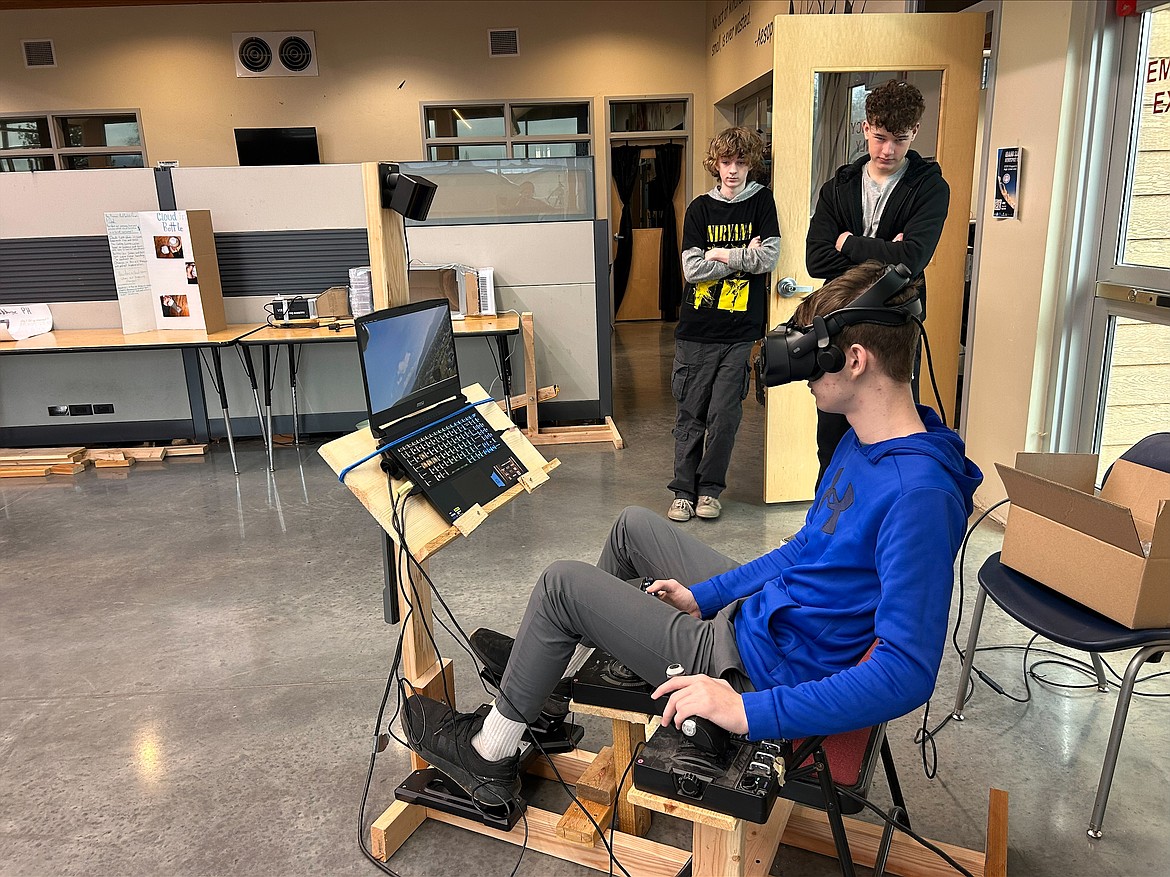
SANDPOINT — At the back of Forrest M. Bird Charter School, students climb into a Cessna 172, go through takeoff procedures and find themselves in the air.
Well, almost.
In reality, students step into a model of the cockpit equipped with the latest flight simulator equipment from Logitech and a VR headset to be transported into their very own CESSNA 172. Thanks to a grant from the Idaho Lottery, Kevin Kless, a science teacher at FBCS, is bringing a new hands-on learning experience to his classroom.
“It was like winning a scratch off,” Kless said. I've had this idea for quite some time. Yeah, I just never had the funding capacity to do so... once I started using the simulators about 10 years ago, I could see the educational value, and I could see its potential."
Kless, a retired Air Force veteran, said he’s had the idea for a flight-sim-based class for around a decade. Still in its early phases, Kless has lofty goals for the project, hoping to recreate an entire air traffic control center with students while others fly the planes.
The curriculum has been nicknamed ‘Project ICARUS’ by Kless, a codename he’s been wanting to use since his time in the Air Force. While naming a project around teaching children to fly after the most famous crash in mythos’ history, Kless said it couldn’t be more fitting.
“This is the first time I can get away with it, because this is literally a crash lab,” Kless said. “So really, they're learning from crashing. And I mean, they also actually look at some actual, like historic crashes, and we actually try to simulate them.”
Despite using simulator technology, Kless said the class is far from a video game lab. Kless said the class will lean on learning a variety of subjects and concepts, then applying that knowledge in real world situations.
For example, the class would learn about left hand turning tendencies and how to manage the natural lean of a plane. Then students would take that to the virtual cockpit to realistically experience the feel of the plane. Kless said he made sure to build a scale model of the cockpit so that students gained a feel for where everything is.
“You want to get that level of immersion up, because that's going to help them safety wise, too,” Kless said. “Because if they're in a stressful environment, you don't want them saying, ‘OK, all right, we're about to land right here. I got to do flaps down and, oh, wait, why is my hand going here when the actual flaps are here?”
Kless said this is just one of the many examples of how students can use applied physics knowledge in the real world. He added that this allows him as a teacher to connect with students of all types of learning disciplines.
“You get the pure academic that would see that, and they would ace that on a test,” Kless said. “But if you throw them in a cockpit, and they have to apply that, sometimes the academics do horrible, and it's interesting to see that versus somebody that just intuitively gets it, and when they have that feel for it.”
Prior to the acquisition of the simulator technologies, Kless said he was using as many physical tools as possible. That ranged from students building their own planes from balsa wood to launching weather balloons and water rockets.
Kless said his experience with those programs he hopes he can encourage a healthy spirit of competition in his classes.
“They're building on each other to try to get better,” Kless said. “We have different competitive exercises like that, where we give them a goal to figure out and how to maximize and to make it more efficient.”
That’s part of the reason Kless hopes to bring a dogfight competition to the class by the end of the year as a part of the competition. Kless said it would allow the students to apply their knowledge of flying planes and allow them to learn from each other through a fun avenue of flight.
In the future, Kless hopes to continue expanding the project, eventually allowing students to learn credit at flight school in his class. He said he also hopes to bring in real veterans to help teach the kids from their lived experience.
"Everybody loves fighter jets, I don't care who you are,” Kless said. “This is great for me, because I'm a physicist by training, I'm a physics teacher, so whenever I can see students get excited about something, that I can tie to physics for me, that’s a weapon for me right there.”
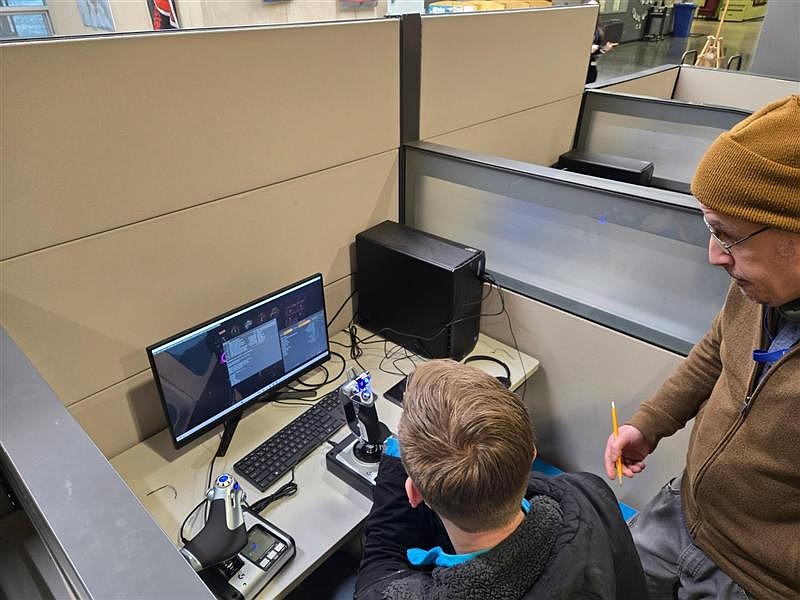
 A student gets direction to use Forrest Bird Charter School's new flight simulation technology.
ARTICLES BY JACK FREEMAN
Outgoing POP executive director wins statewide award
That effort combined with the construction of nearly 20 miles of new trail and a new trail management plan has earned her the 2026 Professional Award for Parks, Trails, or Conservation from the Idaho Recreation and Parks Association.

APRIL NIBJ: Nonprofits help people follow their life’s compass
Kanning’s story isn’t unique, ask any worker at one of the 500 nonprofits in Bonner County are you’ll likely hear the same reason for working: it feels right.
Ponderay to begin Black Rock clean-up project
With the approval of a memorandum of agreement with Sandpoint on Wednesday evening, the city of Ponderay is now able to begin its Black Rock clean-up project next week.