
Digging deep: Family roots are easy to find at the FamilySearch Center
JOEL MARTIN | Hagadone News Network | UPDATED 8 months AGO
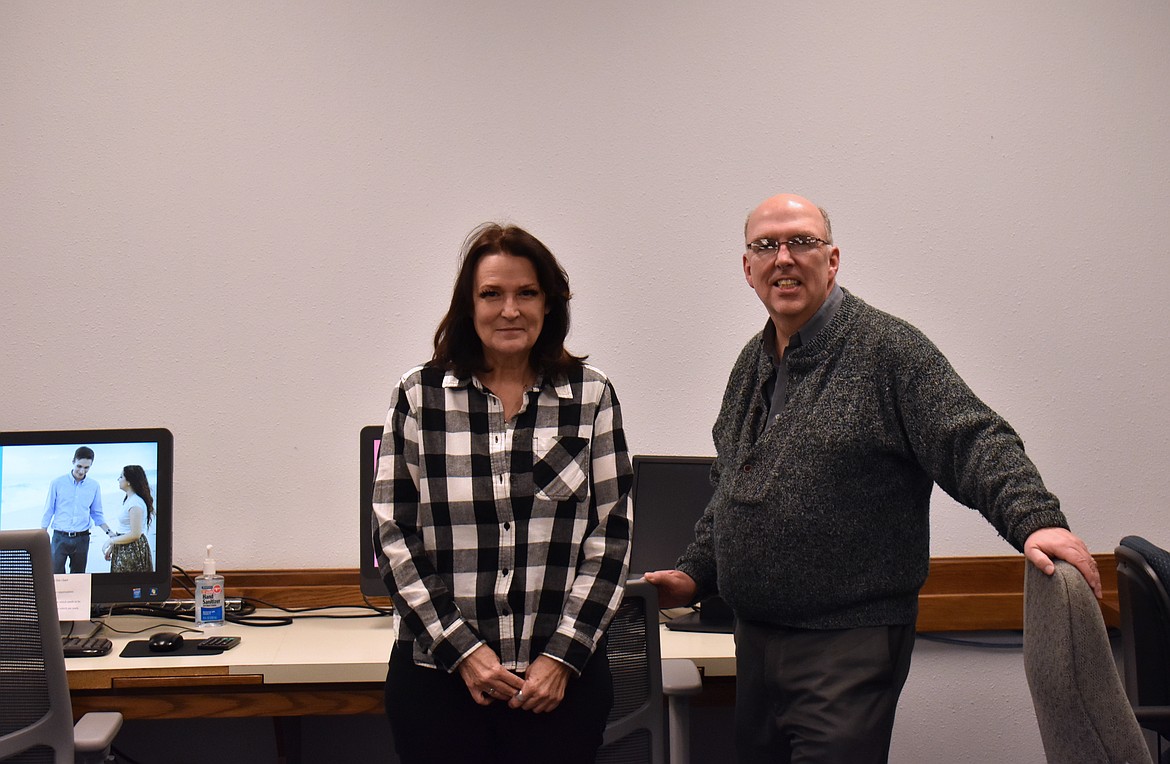
Gwen Bruce, left, and Jeff Stevens stand in the Church of Jesus Christ of Latter-day Saints FamilySearch Center on Division Street. They, and a team of occasional volunteers, help anybody who wants to research their family history at no charge.
JOEL MARTIN/COLUMBIA BASIN HERALD
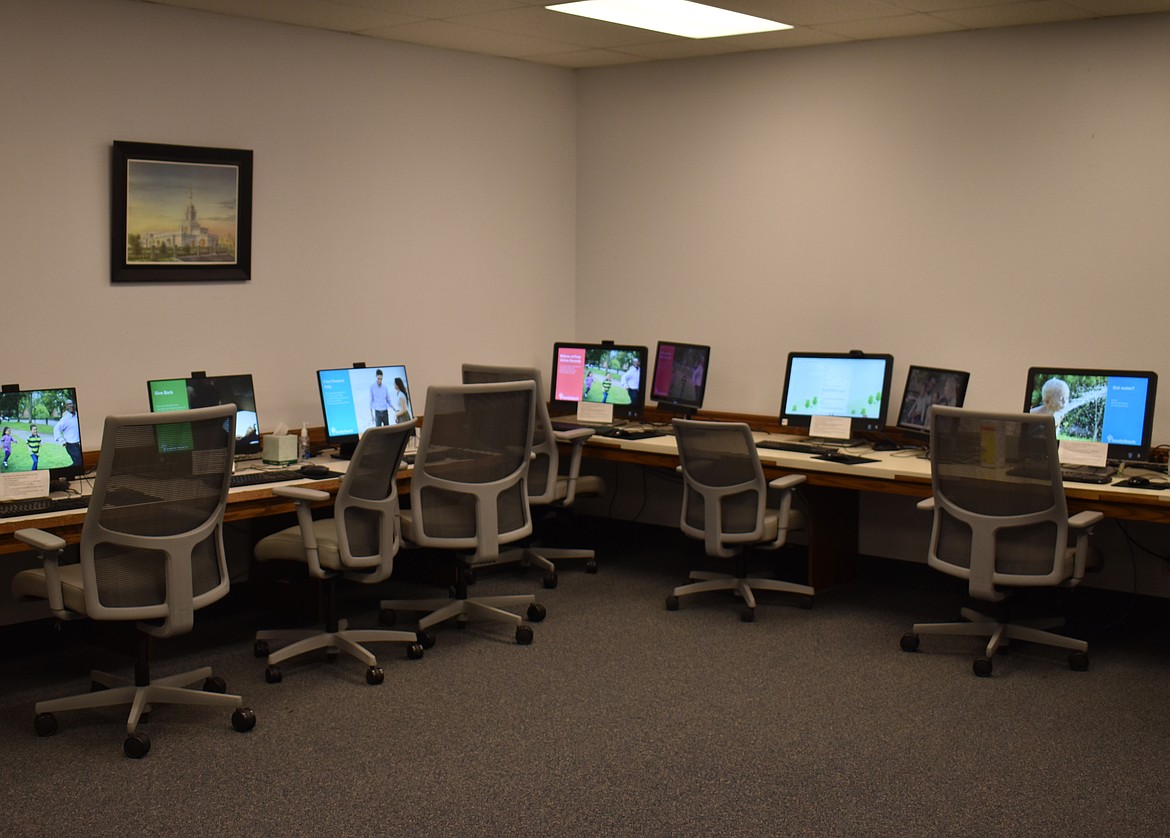
The FamilySearch Center has 14 computer terminals where users can search more than 16 billion records. The FamilySearch system itself can be accessed at no charge from a home computer, but the center has additional resources for free that home users would otherwise pay for.
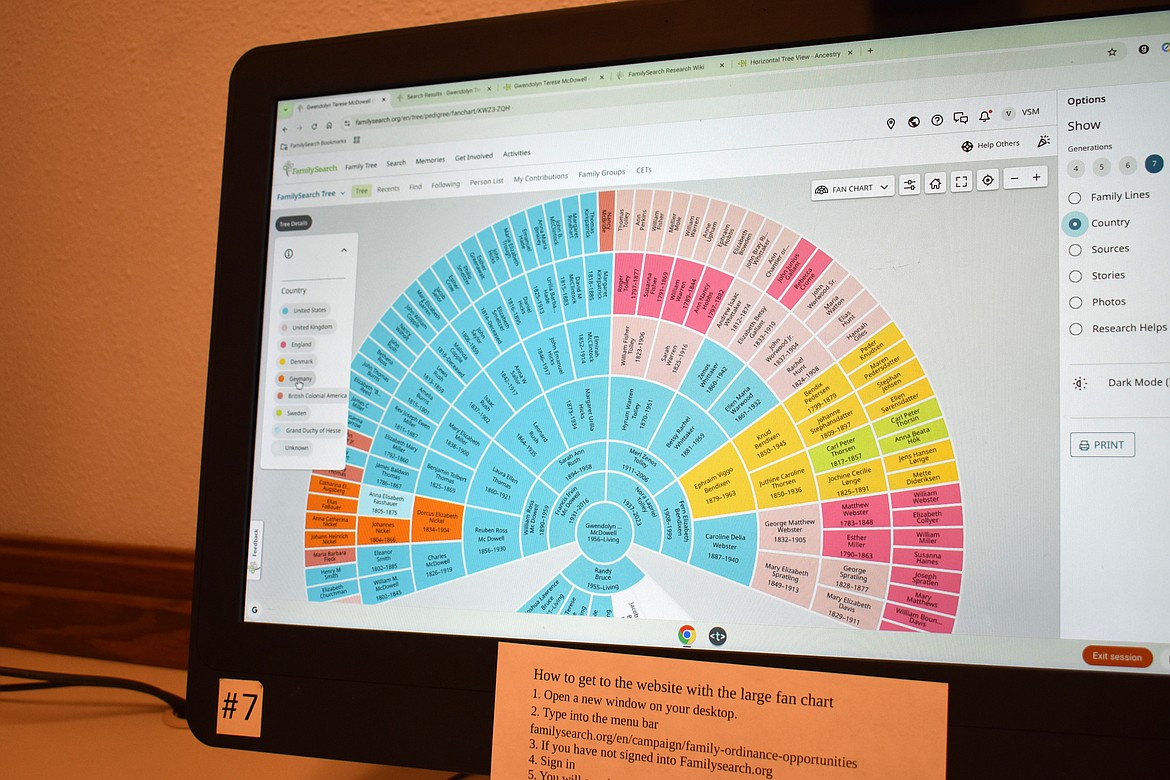
A sample fan chart showing a person’s ancestors above and children and grandchildren below. The entries are color-coded to show what country the person lived in when that information is known.
Joel Martin has been with the Columbia Basin Herald for more than 25 years in a variety of roles and is the most-tenured employee in the building. Martin is a married father of eight and enjoys spending time with his children and his wife, Christina. He is passionate about the paper’s mission of informing the people of the Columbia Basin because he knows it is important to record the history of the communities the publication serves. | February 16, 2026 3:15 AM
MOSES LAKE — Figuring out family roots and heritage can be a daunting task, but there is help out there for those looking to see where their families came from and what legacy they can try to maintain for them and their kin. The task used to be more difficult than it is now.
“(People) would spend all those hours and … they were doing it all on paper,” said Jeff Stevens, co-coordinator of the FamilySearch Center for the Moses Lake East Stake of the Church of Jesus Christ of Latter-day Saints. “They would go to the courthouses and go travel to cemeteries gaining information, put that information together and then share it with their family … Now you can go down the road here to the FamilySearch Center or sit at your computer in your living room and get the same exact information because it’s digitized.”
The center is tucked away in a corner of the Moses Lake East Stake Center on Division Street. Anyone who wants to, church member or not, is welcome to let themselves in a back door and step down a little hall to a quiet room with 14 computer terminals arrayed at neat desks. There they can sit down at a terminal and immediately access an unimaginable world of information for absolutely no cost.
“They come into the FamilySearch Center, and they want to discover their family,” Bruce said. “We sit down as a missionary and we take in their family information, and then we help them to create a family tree.”
FamilySearch is available for free also to anyone with an internet connection at home, although on-site users can also access paid services like Ancestry.com.
Finding roots
The process is fairly simple. A user creates an account with FamilySearch and enters the names and birth or death dates of their parents and whatever grandparents or great-grandparents they know about. Then the system uses AI to look for similar names among other users’ families – the Church doesn’t release how many users there are, but the site gets almost 25 million visits per month – and suggests them as possible ancestors. Within minutes, it’s possible to discover family connections reaching back centuries.
How many centuries? Well, that depends, Bruce said.
“It depends on the country (the ancestor) is from, and the records that are available and haven’t been destroyed, and also the records that families have kept,” she said. “Some families have been really good record keepers (with) family Bibles and birth certificates they’ve kept. My family was Protestant (in Colonial America). Those church records go back into the 1700s. A lot of the records have been church records, especially for the Catholic Church. The church records by the Catholic Church are magnificent.”
“If you’re from Europe, like a lot of us are, and your family line links into (nobility) of some sort, a lord or a duke or something, then it just goes and goes and goes,” Stevens said.
A farmer, say, might not have the same quantity of recorded information about him, but in western Europe, at least, most people had christenings, marriages and deaths recorded by their local church, of whatever denomination. Those records, sitting in parish churches all over the world, have been painstakingly photographed, scanned and transcribed by church volunteers. The same goes for courthouses in the U.S. and record repositories all over the world. By the time the records are loaded into the FamilySearch system, a user can call up an image of the original, the actual verbiage in the original language, and a translation if that’s not English.
Of course, not all families derive from cultures that keep meticulous – or even any – written records. “There are volunteers who are trying to capture the oral history, because that’s the only history they have,” Stevens said. “A tribe in Africa knows that this person came from this person (who) came from this person, but it’s all verbal. I worked on my mission … in some of those other countries (where) it’s all oral. They put (the histories) on a tape and you can access them on FamilySearch and listen to them give that oral genealogy.”
A world of information
The Church’s FamilySearch system contains more than 16 billion records. To give that a little more perspective, if you put each one on a sheet of ordinary paper, the stack would be more than 1,000 miles high.
“All the records that have been scanned from around the world, artificial intelligence is reading those records,” Bruce said. “And then it looks and says, ‘Hey, this person could be on your family tree? Why don’t you take a look?’”
The AI doesn’t add anybody without the user’s agreement, Bruce added. She gets notifications regularly for potential relatives that the AI has flagged as possibly connected to her, and she approves or denies each at her leisure.
Besides the records the volunteers compile, FamilySearch draws on its users to form a collaborative whole. Users who want to can scan their own family records and add notes to the ones already in the system if they happen to know something about a mutual ancestor that another relative didn’t.
“It’s a worldwide tree,” Bruce said. “Somebody in Seattle could be looking for a name, and somebody in England could have been scanning that record, and somebody in Africa could be saying, ‘Yes, we think this is a record (for our family).’ It’s a global effort and there (are) global volunteers who make this possible.”
Users can add notes and sources to information already there, and they can even upload photos connected to the people they find. That’s a way, Bruce said, to preserve and share some of those family photos of long-gone relatives, so even if the originals are lost or destroyed, they’ll always be available.
Through a chat function, a user can reach out to others who might have the same ancestors to share or compare information. Some people have found cousins they didn’t know they had, Bruce said. The Church maintains strict privacy protocols, she added, so methods are set to protect peoples’ personal information.
‘The family tree’
The Church of Jesus Christ of Latter-day Saints maintains family search centers all over the Basin, including Othello, Ephrata, Quincy and Ritzville. Some of those are only open by appointment, but Moses Lake’s has volunteers who keep it open regular hours four days a week. Besides Stevens and Bruce, there are 15 or 20 people who help out occasionally. The center’s primary purpose is for church members who research their own families for religious reasons, but non-members are completely welcome to use the information. One homeschool co-op uses the center to teach history lessons, Bruce said.
Once a user begins creating their family tree, they can view it several different ways, horizontally or vertically, starting from the user themselves or sowing descent from a single ancestor. But there’s another, visually striking way to show the family called a fan chart, which begins with the user and shows their ancestors fanning out like a peacock tail. The names emanating out for generations and centuries, sometimes from all over the world, show how many people it took to arrive at one individual.
“We don’t call it ‘my family tree,’” Stevens said. “We call it ‘the family tree,’ because we are all connected on the family tree.”
Moses Lake FamilySearch Center
1515 S. Division St.
Sun. 7:30-8:30 a.m., 2-4 p.m.
Tues. 11:30 a.m.-1:30 p.m.
Wed. and Thurs. 11:30 a.m.-1:30 p.m., 6-8 p.m.
Other times by appointment
509-765-8711
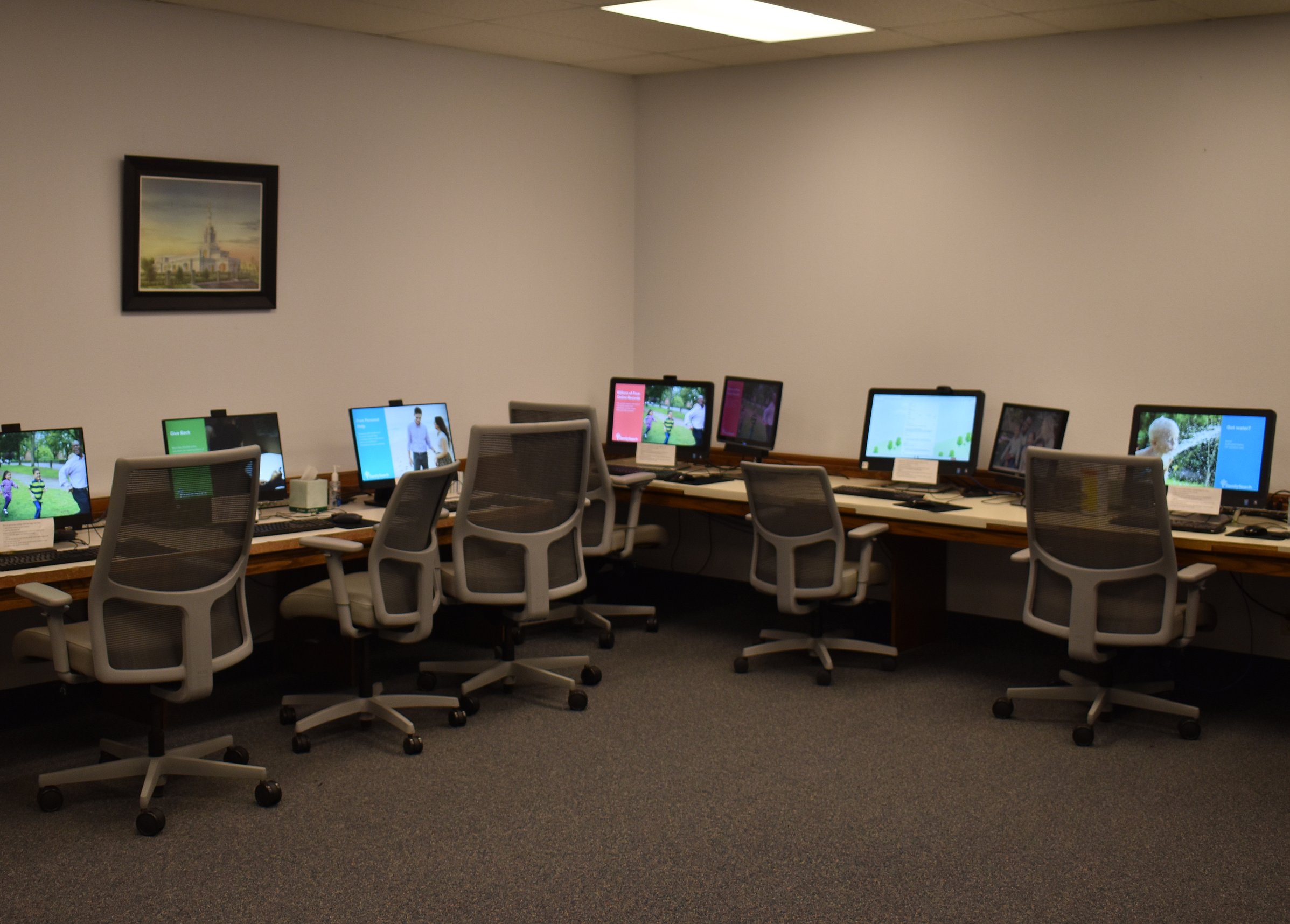 The FamilySearch Center has 14 computer terminals where users can search more than 16 billion records. The FamilySearch system itself can be accessed at no charge from a home computer, but the center has additional resources for free that home users would otherwise pay for.
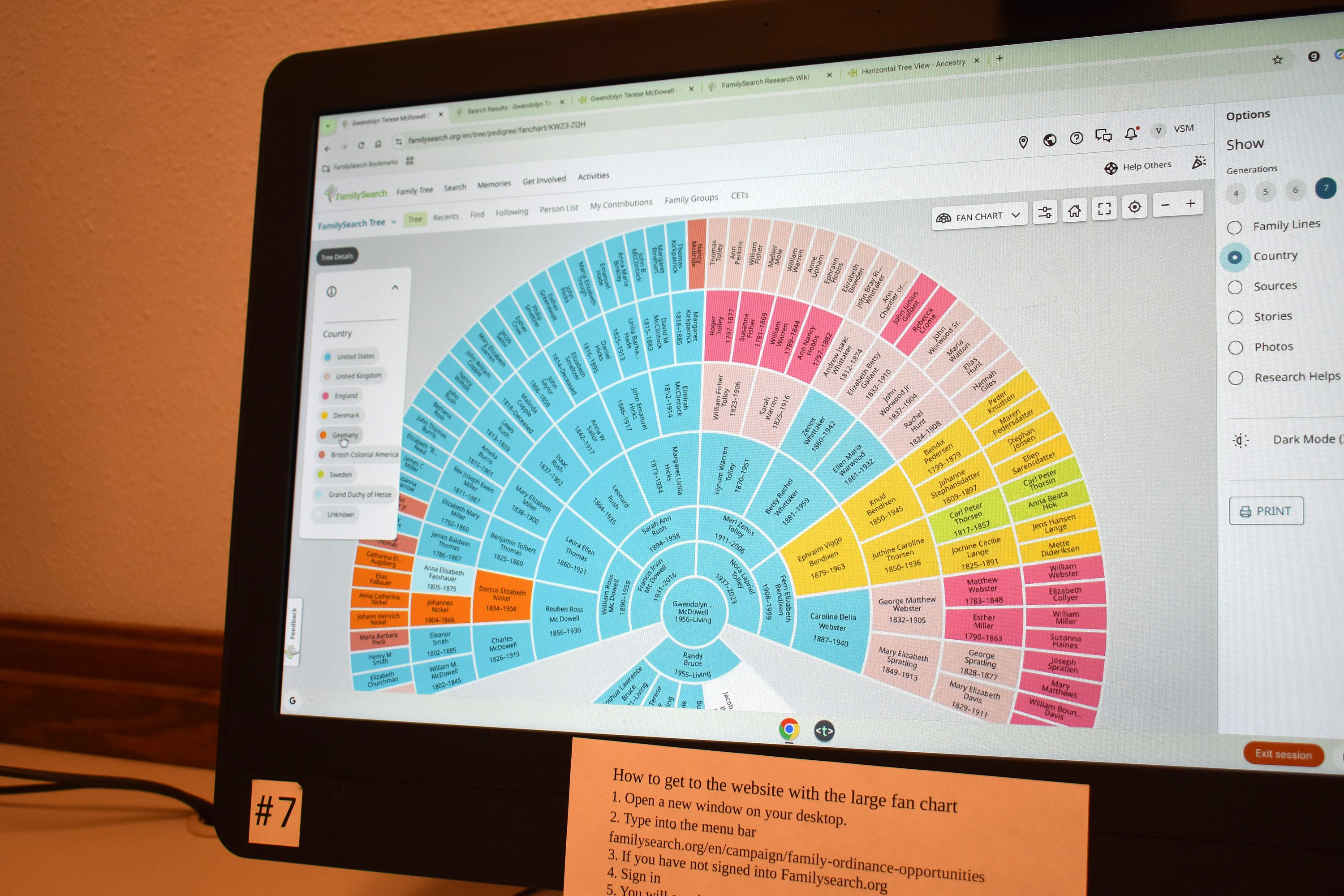 A sample fan chart showing a person’s ancestors above and children and grandchildren below. The entries are color-coded to show what country the person lived in when that information is known.
ARTICLES BY JOEL MARTIN
Endless battle
Noxious Weed Control Board works to keep invasive plants under control
MOSES LAKE — Some of the nastiest plants in Grant County were the topic of a class led by Jay Johnson, a consultant with the Grant County Noxious Weed Control Board, Tuesday. The Noxious Weed Control Board, as its name would suggest, is tasked with keeping weeds under control in Grant County. That’s not a small job; the board’s website lists 129 species of noxious weeds that are found around Grant County. A noxious weed is defined as an invasive, non-native plant that threatens agricultural crops, local ecosystems or fish and wildlife habitat, according to the Noxious Weed Control Board. Washington state law requires that these weeds be identified and their spread kept to a minimum, if not completely eradicated. “We’re one of those agencies a lot of people don’t really understand,” Johnson said. “We’re a county office and … our funding is tax-based assessment. When you get your tax bill and you look down at all the expenses that you pay for, there we are.”
BASIN EVENTS: Oct. 16-24
COLUMBIA BASIN — Whether you feel like shopping, crafting, learning or seeing a show, there’s something happening for you this week in the Basin. Oct. 16 ‘My Family (Mi Familia)’ screening Spanning three generations, “My Family (Mi Familia)” is a heartfelt drama that follows the Sánchez family as they build their lives in East Los Angeles. Through love, hardship, triumph, and sacrifice, the film explores the immigrant experience, the strength of family bonds, and the traditions that connect one generation to the next. Lowrider show and taco truck before the screening. Sponsored by Columbia Basin Allied Arts, EDUBS C/S and the Moses Lake Creative District. $12 per person. Doors open at 6 p.m., film begins at 7 p.m. at the Moses Lake Civic Center Auditorium, 401 S. Balsam St. Tickets and info: www.cba-arts.org.
Moses Lake author encourages women to look beyond church culture norms
MOSES LAKE — A Moses Lake author’s book, “A Christian Woman Striving to Live Her Faith in a Man-Controlled World,” takes aim at the role to which many churches relegate the female half of their congregations. “It’s to encourage women in the faith,” Linda Curran said. “A lot of churches say, ‘Teach Sunday school, do this, do that, but don’t (evangelize.)’" In her book, Curran recounts a time when she moved to a new community and joined a church there. She was surprised to learn that, as a new female member, she had been automatically assigned church cleaning duties. When she questioned it, she wrote, she was met with condescension and her objections were brushed aside. In other churches, she said, women who were capable of teaching were relegated to “women’s ministry.”