
Dam restoration planned for Kicking Horse
EMILY MESSER | Hagadone News Network | UPDATED 2 weeks, 4 days AGO
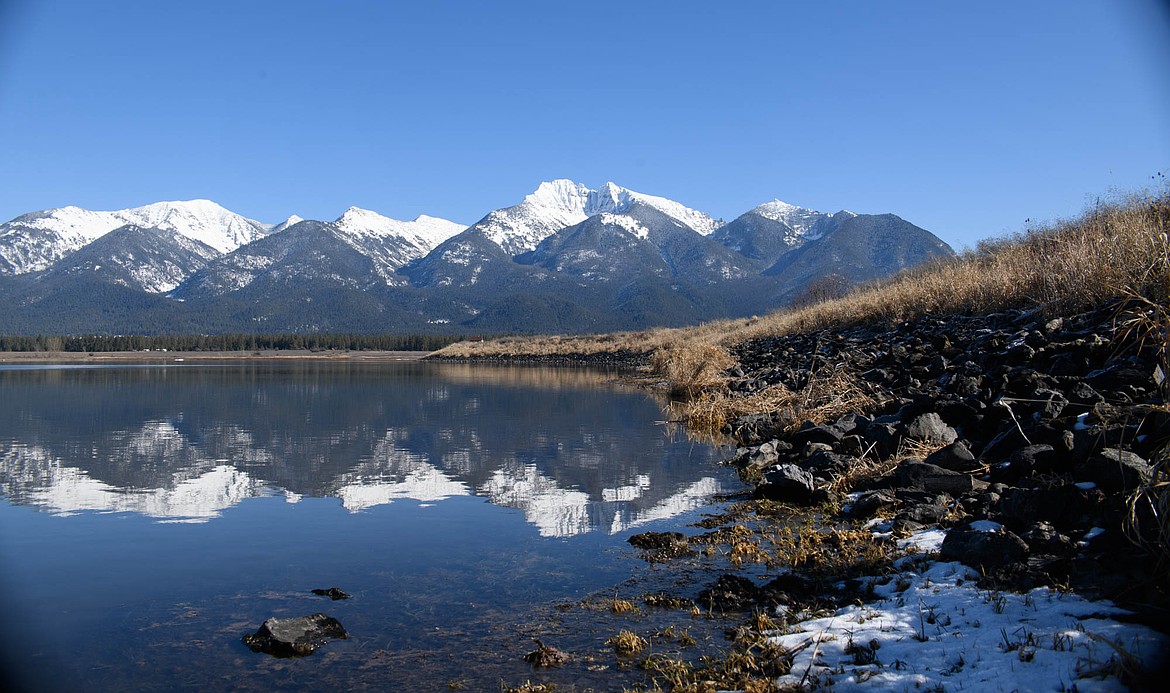
Kicking Horse Dam, which curves along the edge of the reservoir, located southeast of Ronan, and is slated for major renovations. (Emily Messer/Leader)
Emily Messer joined the Lake County Leader in July of 2025 after earning a B.A. degree in Journalism from the University of Montana. Emily grew up on a farm in the rolling hills of southeast Missouri and enjoys covering agriculture and conservation. She's lived in Montana since 2022 and honed her reporter craft with the UM J-School newspaper and internships with the RMEF Bugle Magazine and the Missoulian. At the Leader she covers the St. Ignatius Town Council, Polson City Commission and a variety of business, lifestyle and school news. Contact Emily Messer at [email protected] or 406.883.4343 | February 18, 2026 11:00 PM
The Confederated Salish & Kootenai Tribes Division of Engineering and Water Resources is undertaking an eight-figure, multi-year project to restore Kicking Horse Dam and improve water flow discharge.
The Kicking Horse Dam Safety Upgrades project includes excavating a trench along the dam and into the tight clay foundation, then filling the trench with cement-bentonite slurry – a reinforced structure that serves as a foundation in weak soil and high-water-table areas – to mitigate seepage through the dam and foundation, according to Trevor Bras, the project manager. The project also includes replacing the pipe through the dam that discharges water into the canals and replacing the check structure in the Ninepipe feeder canal located downstream of the dam.
The division plans to solicit bids for the project this spring and has a potential timeline to start construction by this fall, with the project projected to be completed by the summer of 2029. The area will be closed during construction for public safety, and the dam won’t store water for about eight months, from the middle of July 2028 to May 2029.
The man-made reservoir, primarily used for irrigation and recreation, has significant cultural importance to the Tribes. Casey Ryan, the CSKT Division of Engineering and Water Resources manager, described the area before the dam's construction as a natural prairie pothole ecosystem with pingo scars and noted that it serves as high-quality habitat for waterfowl and wildlife.
“It's now home to some of the last remaining untilled native prairie in the Mission Valley,” Ryan said.
It was built as part of the Flathead Indian Irrigation Project in 1930. It, like much of the project, has not been touched since its construction.
Funding for this dam project comes from the $1.9 billion CSKT Water Compact settlement, which was approved by the Tribes in 2020. The compact is a tribal-state-federal agreement to fulfill water rights for the Salish, Kalispell, and Kootenai people as guaranteed by the 1855 Hellgate Treaty.
The compact became effective in 2021 and was accompanied by a financial settlement. CSKT is using this settlement to repair the FIIP’s infrastructure and complete restoration projects around the valley.
The Flathead Indian Irrigation Project is owned and operated by the Bureau of Indian Affairs. The CSKT Division of Engineering and Water Resources was expanded to implement the Water Compact and is initiating and overseeing this dam project.
Kicking Horse captures water from the southern streams of the Mission Valley, including Mission Creek, Post Creek, South Crow Creek and their tributaries. Water also comes from the Jocko Valley into the Mission drainage to Kicking Horse.
Ultimately, it serves 28,000 acres of the Charlo area and 2,500 acres in Moiese, making it vital for irrigation.
Bras explained that the dam was not built to current industry standards, and a reservoir restriction was added in 2007 as a safety precaution to prevent dam failure. The restriction reduced the dam's capacity from approximately 8,000 acre-feet to approximately 6,000 acre-feet. This, along with safety inspections, led the Tribes to identify it as a needed rehabilitation project.
“Historically, a limiting factor on performing this sort of project is funding, and with the passage of the Compact, it allowed us to progress this project,” Bras said. “It's been in the works since 2007.”
Bras added that another identified risk factor was internal erosion, which is an engineer's way of saying that water may be carrying soil. He explained that the dam is not at immediate risk of failure, but the concern is sufficient enough to warrant a modification.
Keeping water flowing while reservoir is drained
Ryan explained that during the conduit work, the reservoir will need to be drained for approximately eight months, starting in July 2028. While the shutdown will affect some of the irrigation season for that year, Bras said they have plans in place to help mitigate that.
Those efforts include bringing the Crow Creek Pumping Plant back online, which will benefit Charlo irrigators, according to previous Leader reporting. They will also transfer Kicking Horse water into G-canal and Ninepipea feeder canal leading to Ninepipes Reservoir, which will keep irrigation operational and minimize potential impacts.
Ryan explained that during the planning and permitting phases of this project, they consulted with all relevant cultural and natural resource specialists. They identified a range of restrictions to minimize the environmental impacts of dewatering.
These measures include protecting nesting birds in compliance with the Migratory Bird Treaty Act of 1918, minimizing impacts on existing wetlands, and implementing best management practices for grizzly bear habitat, according to Ryan. He also noted that dewatering provides an opportunity for the CSKT Fisheries Program to remove the illegally introduced and invasive Northern Pike and Crappie.
“Once the dam work is complete, the fisheries program plans to restore and manage a mixed Largemouth Bass, Yellow Perch, and trout fishery,” Ryan said.
The division plans to host a public meeting in the near future to share information about the project. Ryan said they recently gave a presentation to the Flathead Irrigation District on the project and are evaluating additional public presentations to share information.
For more information on this project and other projects involving the Water Compact implementation, visit www.csktwatercompact.com.
ARTICLES BY EMILY MESSER

Polson commissioners hear plan for reducing E. coli in Flathead Lake
Representatives from the Flathead Lakers and the Polson Bay Golf Course presented a plan to the Polson City Commission last Wednesday to reduce stormwater runoff, which had caused increased levels of E. coli in Flathead Lake near Boettcher Park.

City Commission finalizes Salt Cafe grant, hears from market vendors
The Polson City Commission council chambers were full of support Monday night for Andrew Perkins, owner of Salt Cafe, who has been awaiting funding from the Tax Increment Finance District grant he received nearly three years ago.

Foundation established for Polson Police
A non-profit called the Polson Police Foundation was launched at the end of 2025 to support the department by contributing to training, officer wellness, critical equipment and community initiatives.