
Economists forecast slow but steady growth in Flathead County
JACK UNDERHILL / Daily Inter Lake | Coeur d'Alene Press | UPDATED 7 months AGO
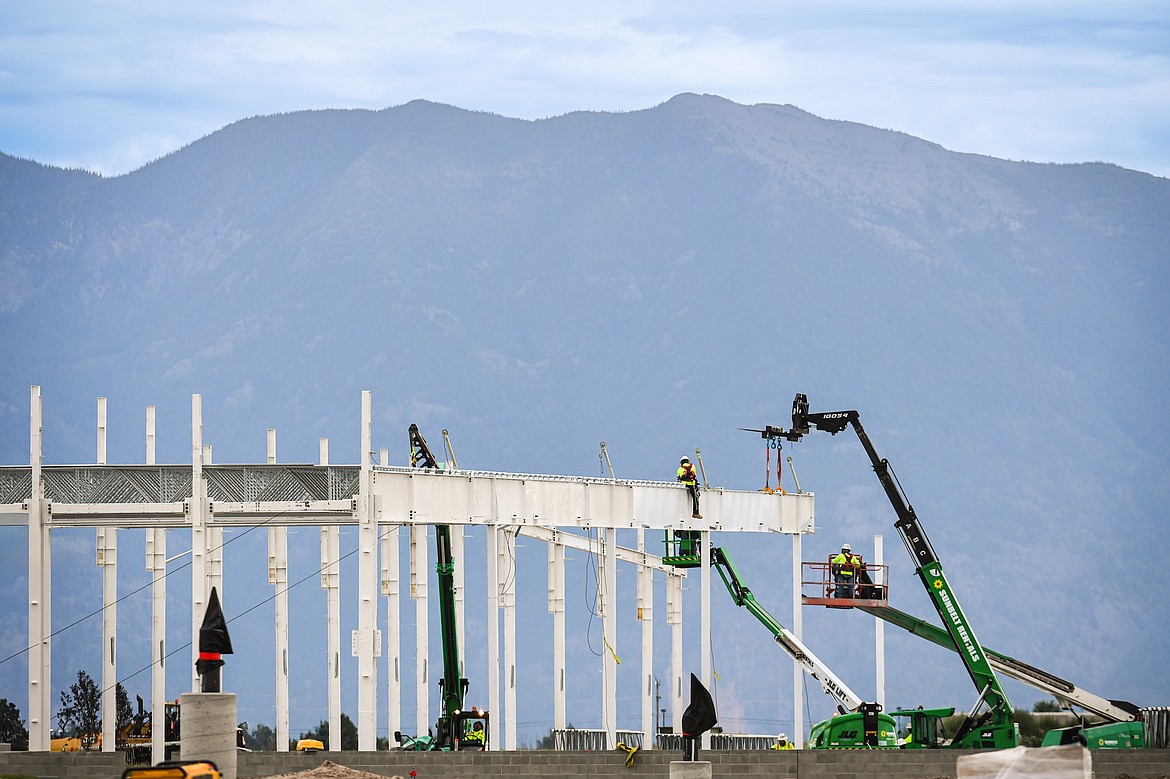
Construction crews work on the new Costco building located off US-93 north of Kalispell on Wednesday, Aug. 6. (Casey Kreider/Daily Inter Lake)
Casey Kreider
Flathead County should continue to experience slow but sustained growth, as in-migration drives construction, job growth slows, and wage growth and employment rise.
That was the prediction by economists with the University of Montana’s Bureau of Business and Economic Research during the 2026 Economic Outlook Seminar held on Feb. 10 at the Hilton Garden Inn in Kalispell.
Experts provided an update on Montana's economic outlook and weighed whether the state should impose a statewide sales tax.
Population growth in Montana fell to its lowest level in 12 years, with about 0.6% annual growth in 2024 and 2025 after hitting record highs during the pandemic. Despite the slowed growth, in-migration continues to drive construction in the Flathead Valley.
Similar to the rest of the state, multi-family housing permits peaked between 2020 and 2022 and began going online between 2023 and 2025. Zoning reform across the state, which promotes high-density development, is sparking a rebound in multi-family housing permits, according to Derek Sheehan, an economist with the economic bureau.
In 2024, Kalispell permitted only 27 multi-family units, but in 2025, there were 406.
“You can see that there’s a lot of investment pouring into our community,” said Kalispell Chamber of Commerce President Lorraine Clarno.
But single-family home building permits have dropped since pandemic highs, which “might not bode well for continuing to build that ladder out of the rental market,” Sheehan said.
Despite construction activity holding steady, the region has made little progress on affordability, as home prices and mortgage rates remain stubbornly high after surging during the pandemic.
Rents in the Flathead Valley have stabilized somewhat, but higher earners filtering down from the ownership market have kept prices from coming down, according to Sheehan.
Over the next couple of years, Sheehan expects the “locked-in effect” to begin to thaw as owners eventually sell and homes trickle back into the market.
Aging homeowners will also contribute to more supply.
“I won’t dwell on the mechanism for why that will impact supply, but it’s coming for all of us,” Sheehan said.
Looking forward, Sheehan expects migration to continue to pull back from its peak and stabilize at an elevated level.
Job growth nationwide has slowed substantially as employers retain existing workers while remaining cautious about hiring new ones.
“It’s not recessionary territory, but there’s not a tremendous amount of hiring going on in the U.S. for the past six or seven months,” he said. “It’s what people are calling the no hire, no fire economy.”
But Flathead County has weathered the stall well, leading the state with 1.8% employment growth from 2024 to 2025. The county has seen steady employment growth over the last decade, with jobs rising from 52,620 to 53,570 between 2025 and 2026.
Following nationwide trends, Montana’s health care sector accounted for the bulk of new jobs, while hospitality employment fell.
But the sluggish job market did not keep Montana from leading the country in wage growth. Flathead County’s average paycheck increased 3% between 2024 and 2025. However, the state still ranks 41st nationally in average wage per job.
“In recent years, the U.S. has had a hard time with wages beating inflation, but in Montana its up quite a bit,” said Jeff Michael, director of the economic bureau.
Weighing the implementation of a statewide sales tax, Michael noted that it could shift more of the tax burden onto tourists, diversify state revenue and support economic growth by avoiding taxes on savings and investments.
On the contrary, Michael said that sales taxes tend to disproportionately affect low-income households, which have low savings but high spending on taxable goods. He added that a statewide sales tax may also fall short of the revenue generated by other major taxes. The Montana Legislative Fiscal Division estimated that a 4% sales tax would generate about $1.3 billion annually, compared with roughly $2.5 billion in property and income taxes collected each year.
“You couldn’t just swap out this tax for another one very easily because the revenue generation isn’t at the same level,” Michael said.
Michael said replacing property taxes with a statewide sales tax would be a mistake, but using it to help diversify Montana’s revenue stream is an option that shouldn’t be ruled out.
“I’ve got an open mind about that one. I’m not quite ready to go there,” Michael said.
Instead, Michael proposed two alternative taxes to target Montana’s largest visitor-spending sectors: lodging and gasoline. People visiting the expansive Treasure State spent 23% of their total spending on gasoline in 2024, nearly double the average U.S. tourist rate. Conversely, Montana visitors spend half as much on shopping as the average U.S. tourist.
“That means there's a little bit less to gain from them when it comes to a general sales tax than we might see in other tourist-type areas,” Michael said.
Michael said a seasonal hike in the state’s gas tax could shift some of the burden to nonresidents, as nonresident spending peaks between June and September.
Lodging also accounts for the majority of visitor spending in Montana, so Michael suggested a local option lodging tax in addition to the statewide 8 to 12% lodging tax.
“This could be a hole that maybe could do something for some of our cities that don't qualify for resort tax,” Michael said.
• • •
Reporter Jack Underhill can be reached at 406-758-4407 and [email protected].