
Veteran Ron Grigsby pens book about his brain injury and hopes to help others
BILL BULEY | Hagadone News Network | UPDATED 2 weeks, 1 day AGO
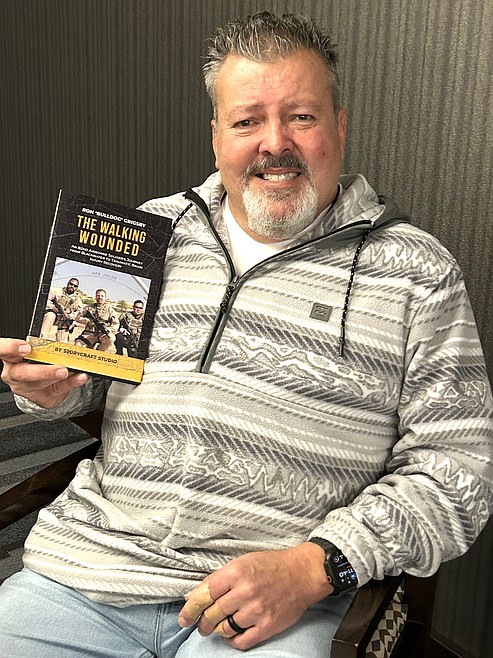
Ron Grigsby holds a copy of his book, "The Walking Wounded."
BILL BULEY/Press
Bill Buley covers the city of Coeur d'Alene for the Coeur d’Alene Press. He has worked here since January 2020, after spending seven years on Kauai as editor-in-chief of The Garden Island newspaper. He enjoys running. | February 22, 2026 1:09 AM
Ron Grigsby has a daily to-do list. It includes power naps.
“If I try to push myself too hard, I make mistakes,” the Coeur d’Alene man said. “I’ve learned to pace myself better. I’ve learned I have to take breaks. I don’t multitask well at all."
But when he sets his mind on a project, he says he can “create something pretty awesome.”
One of those things is his book, “The Walking Wounded: An 82nd Airborne Soldier’s Journey from Blackwater to Traumatic Brain Injury Recovery.”
It recounts what happened March 21, 2007, when Grigsby was working as an independent contractor for Blackwater in the Middle East. He was assigned to protect a convoy when it was hit by enemy fire. A blast threw him more than 40 feet. His helmet was caved in an inch and a half. He suffered multiple injuries that included a broken neck and a traumatic brain injury.
The blow to his head, “shut off my power,” Grigsby said.
He was flown to Germany, then spent months in hospitals in Idaho and Washington. He would have to relearn how to walk, talk, shop, drive, cook, and communicate. It would take many painful years.
He compared it to smashing a laptop and trying to put it back together.
“Basically, rewiring everything I lost,” Grigsby said.
Today, he considers himself blessed, one of the few to come back from the type of injury he suffered. The 64-year-old is an author, advocate, husband, part-time construction worker and a fine storyteller. He has lived up to his call sign, “Bulldog.”
Based on personal experience and research, he has become an expert on brain injuries.
“I should be after 18 years,” he said with a smile.
His book, which was published by Storycraft Studio and is available on Amazon, covers his military career, what happened the day of the explosion, how he recovered, his doubts and fears and outlines his hopes to help others dealing with brain injuries.
In it, he wrote:
“If there’s one thing I hope you take away from my story, it’s that the darkest valleys don’t last forever. The path forward might look nothing like you expected, but there is a path. You find it one step at a time. “
Grigsby, who has 14 years in law enforcement and was a paratrooper with the U.S. Army, moved to North Idaho from Southern California in 2004.
Today, he lives with what he described as a high tolerance for pain and no balance. He faces Post-Traumatic Stress Disorder with courage and determination. He wants to help others learn how to deal with “losing your mind and recreating the new you.”
“Every day is a new adventure,” he said.
His efforts have had an impact.
Grigsby shared a note that was sent to him by a reader of his book.
“My perspectives of life and living have always been difficult and confusing. The obstacles I’ve faced have never made sense to anyone. I guess it’s kinda like speaking in tongues, sounds like gibberish," the note reads.
“Your book has completely altered my existence of life to the core. MY PTSD was just a symptom. I recognize all the struggles of TBI ... OMG ... it’s me!’
That is what Grigsby hoped to hear.
“I think my story can help a lot of people,” he said. “You don’t have to be ashamed of PTSD. It’s not a disorder. It’s an injury.”
Another goal is legislation that creates a fund for brain injury patients to pay for counseling, medical care or a speech pathologist.
“Whatever is involved," Grigsby said.
Traumatic brain injuries are tough on the victim and their families; Grigsby said veterans often avoid letting people know of their injuries for fear of being stereotyped. They worry others will avoid them and won’t hire them.
Receiving help quickly, at least within six months, after a brain injury is critical, he said.
“After that, it starts getting pretty tough to wake things up. So, you have to attack it hard," he said.
Sounds like a job for Bulldog.
Ron Grigsby said he can be reached at [email protected], “if you need someone who understands.”
ARTICLES BY BILL BULEY

Terry Gurno launches 'Unyielding Hope' nonprofit to encourage others
Terry Gurno launches 'Unyielding Hope' nonprofit to encourage others
At the center of this effort is Terry Gurno, whose own life journey shaped the heart behind the organization.
Panhandle drought conditions continue
Report: Snowpack well below normal at 60%
Idaho’s snowpack is well below normal on March 1. Normally by this time of year, the snowpack would have accumulated 80% of its typical peak amount, but this year, is only about 60% of the way there, the report said.
Panhandle drought conditions continue
Report: Snowpack well below normal at 60%
Idaho’s snowpack is well below normal on March 1. Normally by this time of year, the snowpack would have accumulated 80% of its typical peak amount, but this year, is only about 60% of the way there, the report said.