Experts warn of avalanche danger across Bitterroots, Silver Valley
JOSH McDONALD | Hagadone News Network | UPDATED 3 days, 16 hours AGO
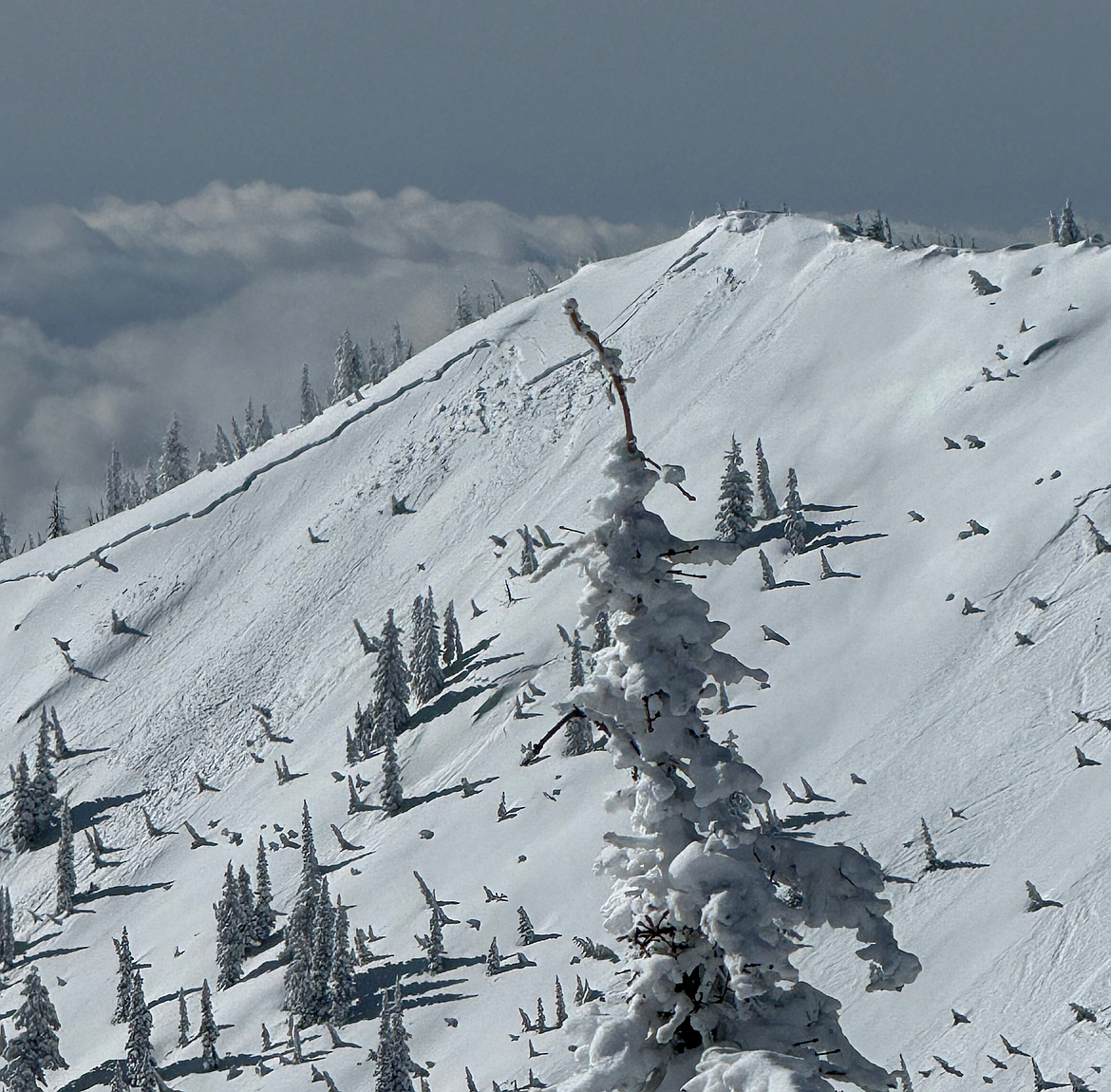
This photo shows the aftermath of a large, natural avalanche that likely occurred Feb. 19 on the southeast face of Trout Lake Peak in Idaho’s Selkirk Mountains. According to IPAC, the slide was estimated to run roughly 1,000 feet downhill. You can see where the soft top layer of recent snowfall broke away near the top of the ridge.
Photo Courtesy of IPAC
Rapid changes in weather, snowpack and temperatures have regional experts watching local hillsides closely as avalanche danger remains at considerable to high levels.
Over the weekend, the Idaho Panhandle Avalanche Center (IPAC) issued a backcountry avalanche watch for the Bitterroot Mountains and the Silver Valley above 4,000 feet, warning that dangerous conditions could develop as a warm, moisture‑laden storm moved in Sunday night. The watch continued into Monday, and IPAC’s danger monitor indicated elevated risk could persist into Tuesday.
During an avalanche watch, forecasters monitor precipitation, temperatures and snowpack stability. IPAC reports that recent snowfall may overload fragile layers buried within the snowpack. Dense new snow combined with warming temperatures could trigger widespread snowslides and avalanches on slopes between 30 and 50 degrees. The danger level was set to high, the second-highest on the five‑point scale. While many snowslides release naturally, forecasters remain concerned about ungroomed trails and popular backcountry areas, including ridges, long open runs that descend into forests, valley floors and flat terrain.
For visitors to area ski hills, the in‑bounds danger remains minimal.
At Silver Mountain, IPAC’s warning applies only to uncontrolled backcountry terrain, not groomed and patrolled runs that receive daily mitigation. Most of the resort’s trails stay low‑risk due to grooming and avalanche‑control work. Steeper, ungroomed expert zones on Wardner Peak, which feature more than a dozen natural chutes and bowls, open only after hazards have been addressed and may remain closed during or after major storms.
"Silver Mountain Ski Patrol mitigates avalanche risk through multiple means, including run closures, explosives, and ski cutting," Silver Mountain Marketing Manager Gus Colburn explained. "The process for any given day is determined by our snow safety team and executed by ski patrol. Factors such as precipitation rate, intensity, and duration, along with temperatures and wind, are all factored into the operational plan. Conditions found in the backcountry are not necessarily representative of what is found within resort boundaries due to continuous mitigation and skier traffic."
Lookout Pass Ski and Recreation Area Marketing Director Matt Sawyer said Lookout does not have any in‑bounds terrain affected by the watch.
“Fortunately, Lookout Pass does not have any inbounds terrain that is susceptible to avalanche,” Sawyer said. “Yes, there is terrain outside our ski area border, both in Montana and Idaho, on the National Forest, that is steep enough that it could and occasionally does avalanche. But those areas are outside of our ski area boundary and not within our permit area. So, for us, it’s not something we have to deploy resources to mitigate.”
For anyone traveling in the region during an avalanche watch, safety officials urge extra caution. Backcountry users should carry essential avalanche equipment, including a beacon, shovel and probe. Skiers and snowmobilers should avoid traveling on or beneath slopes steeper than 30 degrees and steer clear of gullies, drainages and terrain traps where even small slides can have severe consequences. Experts also recommend traveling one at a time across exposed areas, watching partners closely and maintaining wide spacing to reduce risk. Anyone unfamiliar with avalanche terrain should stay on low-angle slopes, stick to groomed resort runs or postpone backcountry travel until conditions stabilize.
IPAC continues to urge the public to avoid travel in or below avalanche terrain, including slopes steeper than 30 degrees and areas where runouts may reach lower elevations. Officials note that similar hazards may exist outside the forecast zone. Updated conditions can be found at idahopanhandleavalanche.org and avalanche.org.
ARTICLES BY JOSH MCDONALD

Shoshone County Sheriff Eddy resigns
During his time in office, Eddy faced several major challenges, including severe flooding, a windstorm, and the Dec. 26 shooting at the SCSO in downtown Wallace.
Eddy resigns from SCSO