
VETERANS PRESS: The story of the Four Chaplains
JEAN BLEDSOE/American Legion Post 154 | Coeur d'Alene Press | UPDATED 9 months AGO
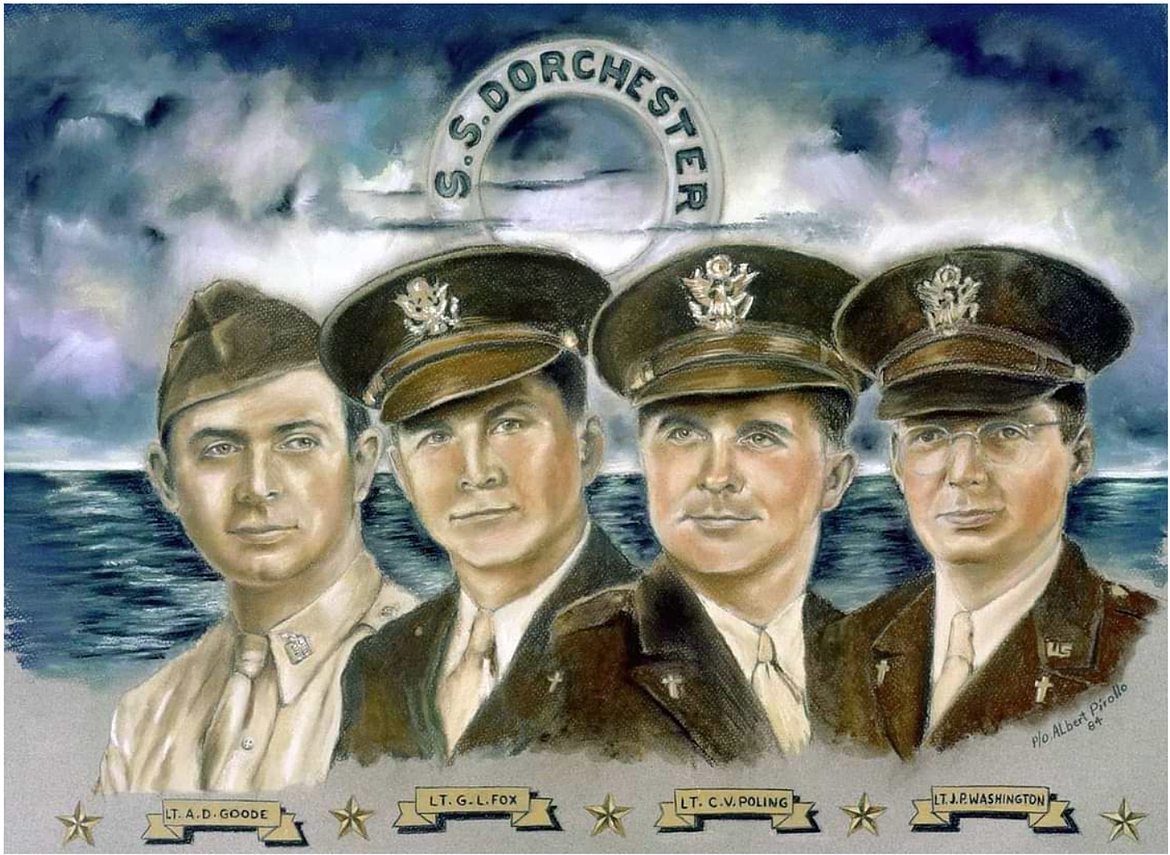
Reverend George L. Fox (Methodist), Rabbi Alexander D. Goode (Jewish), Father John P. Washington (Roman Catholic), and Reverend Clark V. Poling (Dutch Reformed) — four chaplains aboard the U.S. Army Transport Dorchester when it was torpedoed by a German submarine in the North Atlantic on February 3, 1943. As the ship sank, these chaplains helped others to safety, distributing their own life jackets to soldiers in need, before ultimately perishing together as they prayed and sang hymns.
Courtesy of AMERICAN LEGION POST 154
The Atlantic was a black mouth that night — open, cold and waiting. The transport ship pitched through winter seas, its decks slick with ice and its holds crowded with young men who smelled of wool, oil and the nervous hope that comes from pretending not to be afraid. Some had tucked letters into their boots. Others carried small photographs — sweethearts smiling from summer lawns, mothers standing beside front doors, fathers with their hands folded tight. War had gathered them from farms and cities and laid them shoulder to shoulder; strangers bound by the same crossing.
Below decks, the chaplains moved quietly among them. There was a rabbi with gentle eyes, Alexander D. Goode, who remembered every name he learned. John P. Washington, a Catholic priest whose hands were never still, always finding a shoulder to squeeze or a rosary to press into trembling fingers. Two Protestant ministers — one soft-spoken and thoughtful, George L. Fox a Methodist minister, and the last was Clark V. Poling of the Reformed Church, quick to laugh, quick to listen — who knew that sometimes courage began with being heard.
They spoke of ordinary things. Home cooking. Baseball scores. Snowstorms back where the streets were familiar. They prayed with some men and simply sat with others. They wrote letters for those who couldn’t find the words. No one was asked what he believed. Only what he needed.
Then the ship shuddered. A violent crack tore through the hull, followed by a sound like the ocean itself screaming. Men were thrown from their bunks, many naked, all terrified, as the lights vanished and darkness slammed shut. Steam hissed through the corridors. Metal twisted. Somewhere, someone cried out for his mother. Cold water poured in. Panic surged like a living thing. Men ran blind through smoke and darkness, slipping on tilting decks, calling names that dissolved into the chaos. Some froze where they stood, overwhelmed by fear they could not outrun. And into that fear came voices.
Calm. Steady. Human. “This way, son.” “Hold on to me.” “You’re not alone.”
Survivors later said they saw the chaplains everywhere; moving against the tide of panic, lifting the wounded, guiding men toward ladders and lifeboats. When someone faltered, one of them stayed. When someone broke down, one of them knelt. Life jackets began to disappear. Men reached for empty racks. Hands closed on nothing. The realization spread quickly and cruelly: there were not enough. That was when the chaplains made their choice.
One by one, they removed their own life jackets. Men protested. Some tried to push them back. Some cried openly. But the chaplains would not take them back. They fastened the straps themselves, tugging them tight with hands that did not tremble. Survivors remembered their eyes — clear, focused, gentle — never panicked, never afraid. One man later said that moment haunted him for the rest of his life: standing there, wearing a life jacket he had not earned, while the man who gave it to him turned away to help someone else.
As the ship listed harder, the chaplains gathered on the deck. Those who survived said they saw them link arms. They prayed aloud — not quietly, not privately, but so the men around them could hear. Hebrew prayers rose into the wind. Christian hymns followed. Different words, one purpose. Comfort. Courage. Peace. From lifeboats and from the freezing water, men looked back and saw them there — four figures standing against the night as the ship slipped lower and lower. Still praying. Still calling out. Still giving. Then the sea took them. The ship vanished beneath the waves, and silence fell where voices had been.
The survivors were pulled from the Atlantic, half-frozen, wrapped in blankets that could not warm the hollow inside them. Many clutched their life jackets long after it was safe to let go. Some wept. Some stared into nothing. All of them remembered.
Years passed. The war ended. The men went home. But that night never left them. They spoke of it to their children, and sometimes to strangers, their voices soft with awe. They said they had seen what faith looked like when stripped of symbols and titles. They said they had watched men choose love over life. Some said they tried to live differently afterward — more grateful, more patient, more aware that goodness can appear even in the darkest hour.
Four chaplains died in the Atlantic that night. But they did not vanish. They lived on in the men who breathed because of them. In every quiet act of courage inspired by their sacrifice. In every life shaped by the knowledge that, when the world was breaking apart, four men stood together and chose compassion until the very end. And the ocean, vast as it is, has never been able to swallow that.
• • •
This article was taken from American Legion Post 154 January 2026 newsletter and edited by Jean Bledsoe.