
Search for Browning man reveals complexities of Murder and Missing Indigenous people cases
JOHN McGILL | Hungry Horse News | UPDATED 1 week, 5 days AGO
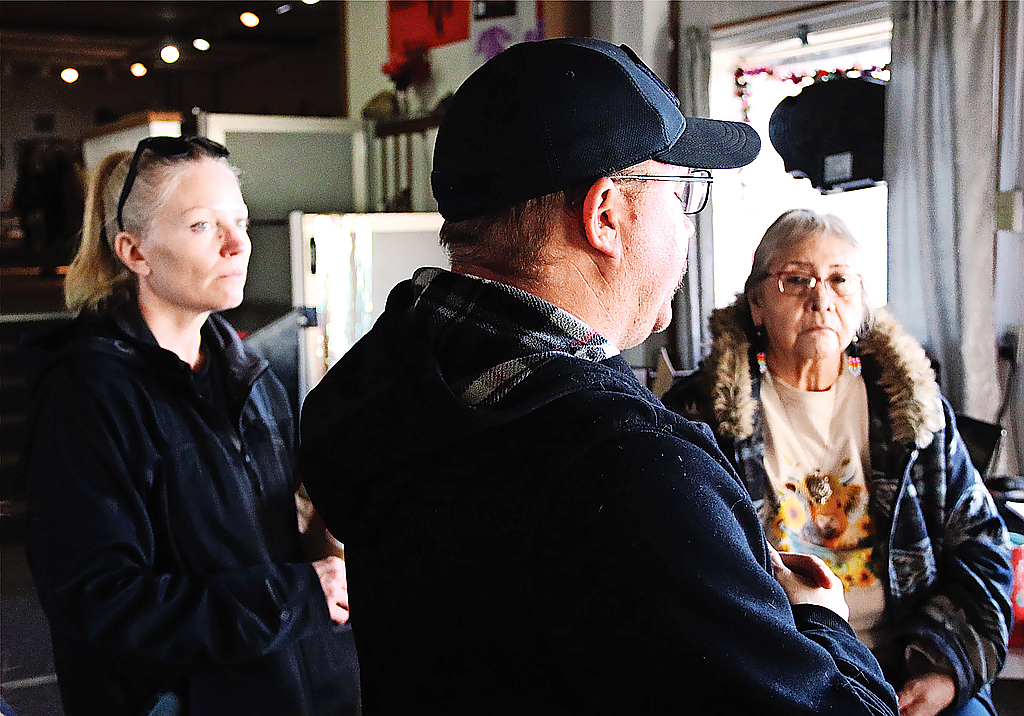
Stephanie Romero and David Sidle of Central Montana K9 explained the day’s search to those gathered at the MMIP headquarters, including Theodora Weatherwax. (Photo by John McGill)
“We’ve been searching since shortly after he went missing,” Rhonda Grant-Connelly said of efforts to find out what happened to Gabriel Calf Boss Ribs. The 6-foot, 2-inch, 42-year-old was declared missing on Aug. 3, 2024. Living on the streets of Browning, he nevertheless kept in contact with his relations until his disappearance was reported.
Two months later the Glacier County Sheriff’s Office responded to a report of human remains having been found near the area of the Blackfeet Boarding Dorm. The discovery led to nearly 18 months of investigation by Deputy Jolee Bullshoe of the GCSO, along with Blackfeet Law Enforcement, the Bureau of Indian Affairs and the Federal Bureau of Investigation to determine whose they were.
The remains were finally identified as belonging to Gabriel Calf Boss Ribs although they were unable to determine the cause of death.
The identification raised at least as many questions as answers.
Rhonda Connelly heads up the Missing and Murdered Indigenous Persons program in Browning. She said just 3% of Gabriel’s remains had, in fact, been found. Finding more evidence has been her program’s aim, along with Gabriel’s family.
“We started searching in Browning, then expanded to the Boarding Dorm area,” Connelly said. “It was mostly family and MMIP, and then [Blackfeet] Homeland Security for a while. Now, it’s just myself and family, and Haley Omeasoo helps with identifying animal versus human bones.”
Trained in forensics, Omeasoo may be a bridge that shortens the time needed to accomplish a DNA match on missing persons.
“All of these unsolved cases are opportunities for Haley to evaluate,” Connelly observed.
“Three percent of his remains is not satisfactory,” Gabriel’s aunt-by-marriage, Theresa Calf Boss Ribs, said. “We’re going to keep looking because there’s nothing else, but kudos to [former Sheriff] Maurice Redhorn. He always returned our calls.
“My husband and grandkids went through basements and crawl spaces – places we were warned about contamination. We’d take the kids and grandkids with us, and MMIP was always helping.
“Gabriel wouldn’t be way out there,” she said. “He had no car, no money. I know he was murdered.”
Another search was announced for Saturday, Feb. 14, with some of the volunteers meeting together at the MMIP headquarters to discuss aims and procedures with a canine crew of assistants.
“Central Montana K9 is focused on providing highly trained search and rescue K9 teams to support law enforcement agencies in locating missing persons,” notes David Sidle, K9 handler at CMTK9. “We deploy both ‘live find’ K9s and HRD (Human Remains Detection) K9s, with a range of specialties and capabilities. We do not self-deploy. All deployments are conducted in coordination with the authority having jurisdiction, such as county sheriff, Montana Department of Investigation and federal entities such as Blackfeet Law Enforcement or the National Park Service.”
David and trainer/handler Stephanie Romero shared their expertise at the MMIP establishment early Friday morning, Feb. 13, explaining their methods and how the group of volunteers would be helping. Their operating assumption is the remains were dropped there by an animal, perhaps a neighbor’s dog or some wild creature. Using statistics regarding how far a dog might carry a weight of the remains’ size determined the scope of the search areas. Those in question were graphically displayed on David’s laptop, and each area to be searched was highlighted. They also met the search dogs, Krash and Bane.
Everyone realized the sensitivity of the process, as collaborators might be subject to reprisal.
The search crew on Valentine’s Day comprised 14 humans and two dogs, who spent the day eliminating places nearby the site where the remains were discovered. As scientists would concur, negative results are as important as positive as the efforts move forward.
“The operation went well from our side with the K9s,” Sidle reported. “We covered the vast majority of the primary objectives we intended to address. For future operations, there are several areas we have discussed at length and are continuing to evaluate.”
But despite the extensive effort, the search did not find any more of Calf Boss Ribs’ remains.
“We appreciate the progress made during our search, despite not having a discovery,” Grant-Connelly said. “We’re planning to make one final attempt and will broaden our search scope to include areas previously mentioned.”