
Get ready for longer growing seasons, WSU potato expert says
JOEL MARTIN | Hagadone News Network | UPDATED 7 months, 3 weeks AGO
Joel Martin has been with the Columbia Basin Herald for more than 25 years in a variety of roles and is the most-tenured employee in the building. Martin is a married father of eight and enjoys spending time with his children and his wife, Christina. He is passionate about the paper’s mission of informing the people of the Columbia Basin because he knows it is important to record the history of the communities the publication serves. | February 26, 2026 3:10 AM
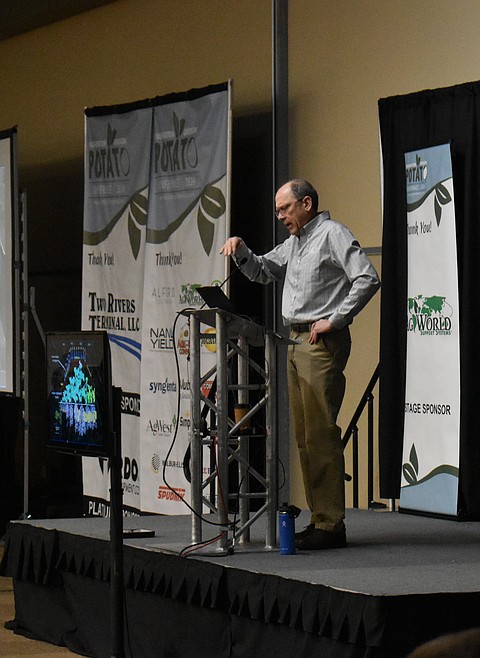
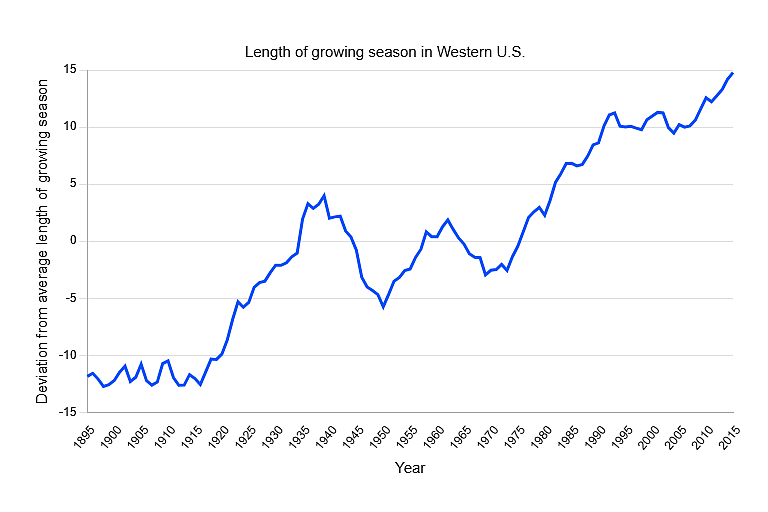
KENNEWICK — The topic of climate change is a hot-button issue, but there’s no question that the trend in temperature has resulted in longer growing seasons. The savvy grower will prepare for that, said Mark Pavek, a professor and potato specialist at Washington State University, at the Washington-Oregon Potato Conference in January.
“It goes back to cultural management,” Pavek said. “And successful cultural management is a package deal.”
Successful cultural management includes good plant stand establishment, Pavek said: spacing, row width, planting direction. It also encompasses how much fertilizer and when is applied, the health of the soil and keeping disease, insects and weeds under control. And it also includes the climate, the year-to-year environment in which plants are cultivated.
“If you get any of those wrong, it can throw everything else off,” Pavek said.
While climate data often focuses on average temperatures year-round, Pavek and his team at WSU looked specifically at the first and last day of each year, as well as how long high temperatures last in the summer. Those temperatures are the ones that affect a grower’s culture, he said.
Pavek and his team at WSU examined National Oceanic and Atmospheric Administration data for Pasco from 1895 to 2025, and found that, in those 135 years, the earliest date in which the high temperature was 80 degrees Fahrenheit or more was March 19 in 2024, and the latest day that was over 90 degrees was Oct. 6, 2020. The year that had the most days over 100 degrees was 2022, with 27 days, and the most days in a year over 110 degrees was five, in 2021, giving the region two exceptionally hot years in a row, Pavek’s team found.
Those increases in temperature affected potato yields, according to WSU post-harvest quality evaluations. The percentage of U.S. No. 1 and No. 2 potatoes in the 2018 russet Burbank harvest was 81%, dropping to 77% in 2019, 72% in 2020 and 59% in 2022. The 2022 harvest improved slightly with 67% U.S., No. 1 and 2, but the numbers still clearly show that extreme heat during sensitive growing periods decrease the quality of the potatoes.
Low temperatures tell a story as well.
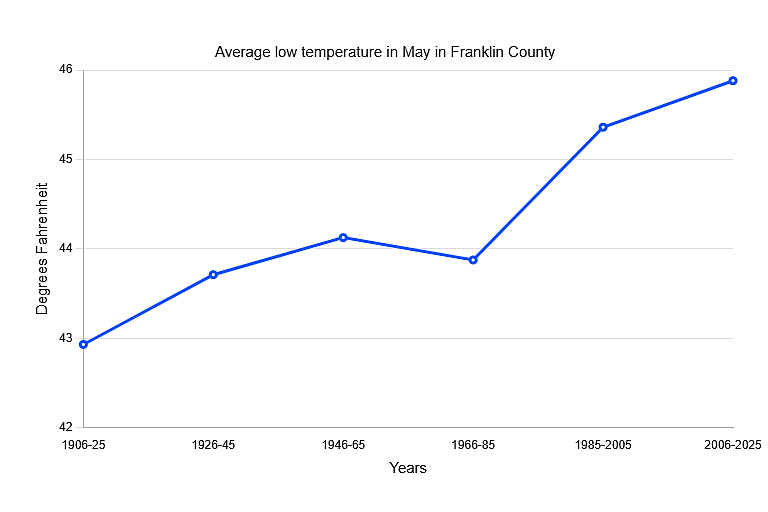
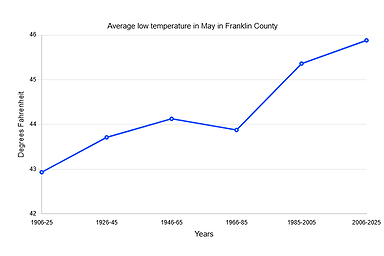
Taking Franklin County as an example, the average low temperature in May was 42.93 degrees Fahrenheit 1906-1925. From 1926 to 1945, the average was 43.71 degrees, from 1946-65 was 44.125. 1965-86 averaged 43.875 degrees; 1986-2005 averaged 45.36 degrees; and 2006-2025 averaged 45.88 degrees. That doesn’t sound like much taken incrementally, but it’s a jump of 6.87% in low temperatures. Low temperatures for September show a similar increase.
“I don’t know if it will cap off at any point, but what that is doing is its actually increasing the length of our growing seasons,” Pavek said.
The timing of the heat is the key, Pavek said. Warmer temperatures in the earlier months accelerate vine growth.
“Prime your plants with nutrients and soil moisture and capture what you can in early season heat,” he said. “Adequate pre-plant fertilizer is essential if you can hold it in the soil. In Othello, we have a little heavier soil than the sands in south part of the Basin. I put down about a third of our season total. And often it's because I can't keep up with the plant demand through the water, or I haven't been able to apply irrigation quite as much. So it really helps to have a bank in the soil and then add moisture to dry soils prior to heat. Maintain moisture during rapid growth. A couple of years ago most of the crop around Othello (had) just barely come out of the ground, and I saw the forecast for the next week and it looked like 80s and 90s. But as I drove around, I noticed a lot of fields were still dry. They hadn't irrigated since they planted. And I was thinking they should probably get on that irrigation and get ready for that heat that was coming.”
Once the plant water use starts to decline, Pavek recommends tapering off the nitrogen as well.
“You want to allow the plant to physiologically mature at the end of the season,” he said. “If you pump too much nitrogen in it, you can have problems with the plant not maturing, but you can also go the other way and have a plant that's over-mature and we can have tuber issues.
Prime your plants with early-season soil moisture. This is important. Irrigate in the fall if you can; 60%-75% of available soil moisture pre-plant irrigation may work for you until it dries out the soil, so every time you do tillage in the spring, make sure you might add some moisture back. Do pre-emergence irrigation (and) pre-emergence herbicides. A lot of times just because you're applying herbicides, you're putting that irrigation down anyway during a hot year. … So hot years aren't necessarily good, unless we get the heat at a crucial time, which again is the spring.”
Different varieties of potato will react differently to the longer seasons, Pavek said.
“What we should do as an industry is focus on potato varieties that take advantage of longer seasons, where the vines stay healthy until you shut them down and they don’t shut them selves down. An example here is Clearwater versus Burbank. Burbank seems to go down by itself (compared to) Clearwater. You can keep (Clearwater) alive longer and plant a crop progressively early. Where we’re at in Othello, I’m seeing growers get out in the field earlier.”
Pavek also suggested planting closer together, in 32-inch rows, and upping irrigation efficiency.
“Some people are dong bed planting,” he said. “That’s something you’d have to experiment, with, but sometimes bed planting can be more efficient with irrigation. Improve your irrigation management. Get on top of your game.”
ARTICLES BY JOEL MARTIN
Endless battle
Noxious Weed Control Board works to keep invasive plants under control
MOSES LAKE — Some of the nastiest plants in Grant County were the topic of a class led by Jay Johnson, a consultant with the Grant County Noxious Weed Control Board, Tuesday. The Noxious Weed Control Board, as its name would suggest, is tasked with keeping weeds under control in Grant County. That’s not a small job; the board’s website lists 129 species of noxious weeds that are found around Grant County. A noxious weed is defined as an invasive, non-native plant that threatens agricultural crops, local ecosystems or fish and wildlife habitat, according to the Noxious Weed Control Board. Washington state law requires that these weeds be identified and their spread kept to a minimum, if not completely eradicated. “We’re one of those agencies a lot of people don’t really understand,” Johnson said. “We’re a county office and … our funding is tax-based assessment. When you get your tax bill and you look down at all the expenses that you pay for, there we are.”

BASIN EVENTS: Oct. 16-24
COLUMBIA BASIN — Whether you feel like shopping, crafting, learning or seeing a show, there’s something happening for you this week in the Basin. Oct. 16 ‘My Family (Mi Familia)’ screening Spanning three generations, “My Family (Mi Familia)” is a heartfelt drama that follows the Sánchez family as they build their lives in East Los Angeles. Through love, hardship, triumph, and sacrifice, the film explores the immigrant experience, the strength of family bonds, and the traditions that connect one generation to the next. Lowrider show and taco truck before the screening. Sponsored by Columbia Basin Allied Arts, EDUBS C/S and the Moses Lake Creative District. $12 per person. Doors open at 6 p.m., film begins at 7 p.m. at the Moses Lake Civic Center Auditorium, 401 S. Balsam St. Tickets and info: www.cba-arts.org.

Moses Lake author encourages women to look beyond church culture norms
MOSES LAKE — A Moses Lake author’s book, “A Christian Woman Striving to Live Her Faith in a Man-Controlled World,” takes aim at the role to which many churches relegate the female half of their congregations. “It’s to encourage women in the faith,” Linda Curran said. “A lot of churches say, ‘Teach Sunday school, do this, do that, but don’t (evangelize.)’" In her book, Curran recounts a time when she moved to a new community and joined a church there. She was surprised to learn that, as a new female member, she had been automatically assigned church cleaning duties. When she questioned it, she wrote, she was met with condescension and her objections were brushed aside. In other churches, she said, women who were capable of teaching were relegated to “women’s ministry.”