
Marketing the No. 1 veggie
JOEL MARTIN | Hagadone News Network | UPDATED 7 months, 3 weeks AGO
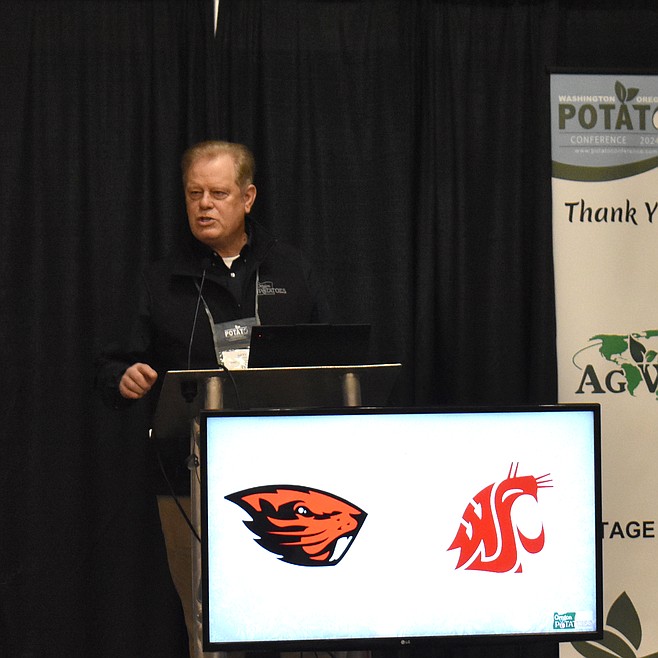
Gary Roth, executive director of the Oregon Potato Commission, discusses efforts to increase awareness of the benefits of potatoes at the Washington-Oregon Potato Conference.
JOEL MARTIN/BASIN BUSINESS JOURNAL
Joel Martin has been with the Columbia Basin Herald for more than 25 years in a variety of roles and is the most-tenured employee in the building. Martin is a married father of eight and enjoys spending time with his children and his wife, Christina. He is passionate about the paper’s mission of informing the people of the Columbia Basin because he knows it is important to record the history of the communities the publication serves. | February 26, 2026 2:25 AM
KENNEWICK — The humble potato may sometimes come across as a little too humble, so marketers have to find ways to make sure people don’t take it for granted.
“Americans love potatoes,” said Tim Rendell, associate research director for Potatoes USA, a national potato marketing and advocacy organization. “We are America’s favorite vegetable, America’s favorite side dish and the No. 1 vegetable sold in America.”
Research by several organizations, including Potatoes USA, the Washington Potato Commission and the Oregon Potato Commission, shows that consumer appreciation of the noble tuber is improving.
“More consumers understand that potatoes are healthy, nutritious, versatile, a good value and grown locally,” said OPC Director Gary Roth.
In fact, some people aren’t aware sometimes that they’re even consuming potatoes, Roth said, as evidenced by the recent rebranding of Lay’s Potato Chips.
“Lay's rebrands because customers apparently didn't know that chips were made with real potatoes,” he said. “How many customers? Forty six percent of U.S. customers did not know that Lay's chips were made from potatoes. Their recent rebrand is the largest rebrand they have done in 100 years.”
Lay’s had done the rebrand because they were surprised at how many consumers in the U.S. were unaware that their chips were made with potatoes, he said.
Roth also cited a farming community in the Northwest, which he didn’t name, in which the student representatives to the local school board were unaware that french fries were made from potatoes.
Ladies and gentlemen, we have a problem,” Roth said. “I've heard farmers for generations say that people don't know where their food comes from … When you hear something like this, it really, really slaps us back into focus.”
The OPC has commissioned advertising spots featuring athletes from Oregon State University discussing the health benefits of potatoes, Roth said.
The Washington Potato Commission is also pushing education about potatoes through athletes, WPC Executive Director Chris Voigt said. The commission has inaugurated Team Potato, its program for showing the world that potatoes are healthy. Participants in running and biking events are given a Team Potatoes jersey to wear at the event. If they post photos of themselves in the shirt at the event to their social media, they can be reimbursed for their registration fees.
One of the best vehicles for getting the word out is a video series called “Washington Grown,” now in its 13th season, in which hosts visit farms, restaurants and factories to highlight how the foods consumers enjoy are produced. Potato growers and processors are a frequent feature of that program, Voigt said.
Oregon has a similar program called “Oregon Harvest,” Roth said, that travels to local food festivals and promotes agritourism and Northwest-grown produce. The potato was named the official state vegetable in 2023, which Roth said has helped with marketing.
“We're always coming across ways, when appropriate, to use the designation for Oregon State Vegetable, (to remind people) that potatoes are indeed a vegetable,” he said. “They're nutritious and they power up not just your athletic performance, but your everyday life. We remain relentless in the messaging of these facts, and they're woven into almost everything that we do.”
ARTICLES BY JOEL MARTIN

Endless battle
Noxious Weed Control Board works to keep invasive plants under control
MOSES LAKE — Some of the nastiest plants in Grant County were the topic of a class led by Jay Johnson, a consultant with the Grant County Noxious Weed Control Board, Tuesday. The Noxious Weed Control Board, as its name would suggest, is tasked with keeping weeds under control in Grant County. That’s not a small job; the board’s website lists 129 species of noxious weeds that are found around Grant County. A noxious weed is defined as an invasive, non-native plant that threatens agricultural crops, local ecosystems or fish and wildlife habitat, according to the Noxious Weed Control Board. Washington state law requires that these weeds be identified and their spread kept to a minimum, if not completely eradicated. “We’re one of those agencies a lot of people don’t really understand,” Johnson said. “We’re a county office and … our funding is tax-based assessment. When you get your tax bill and you look down at all the expenses that you pay for, there we are.”

BASIN EVENTS: Oct. 16-24
COLUMBIA BASIN — Whether you feel like shopping, crafting, learning or seeing a show, there’s something happening for you this week in the Basin. Oct. 16 ‘My Family (Mi Familia)’ screening Spanning three generations, “My Family (Mi Familia)” is a heartfelt drama that follows the Sánchez family as they build their lives in East Los Angeles. Through love, hardship, triumph, and sacrifice, the film explores the immigrant experience, the strength of family bonds, and the traditions that connect one generation to the next. Lowrider show and taco truck before the screening. Sponsored by Columbia Basin Allied Arts, EDUBS C/S and the Moses Lake Creative District. $12 per person. Doors open at 6 p.m., film begins at 7 p.m. at the Moses Lake Civic Center Auditorium, 401 S. Balsam St. Tickets and info: www.cba-arts.org.

Moses Lake author encourages women to look beyond church culture norms
MOSES LAKE — A Moses Lake author’s book, “A Christian Woman Striving to Live Her Faith in a Man-Controlled World,” takes aim at the role to which many churches relegate the female half of their congregations. “It’s to encourage women in the faith,” Linda Curran said. “A lot of churches say, ‘Teach Sunday school, do this, do that, but don’t (evangelize.)’" In her book, Curran recounts a time when she moved to a new community and joined a church there. She was surprised to learn that, as a new female member, she had been automatically assigned church cleaning duties. When she questioned it, she wrote, she was met with condescension and her objections were brushed aside. In other churches, she said, women who were capable of teaching were relegated to “women’s ministry.”