
THE DIRT: Historic pollution study of the Coeur d’Alene Basin Pt. 2
Shoshone News-Press | UPDATED 1 week, 3 days AGO
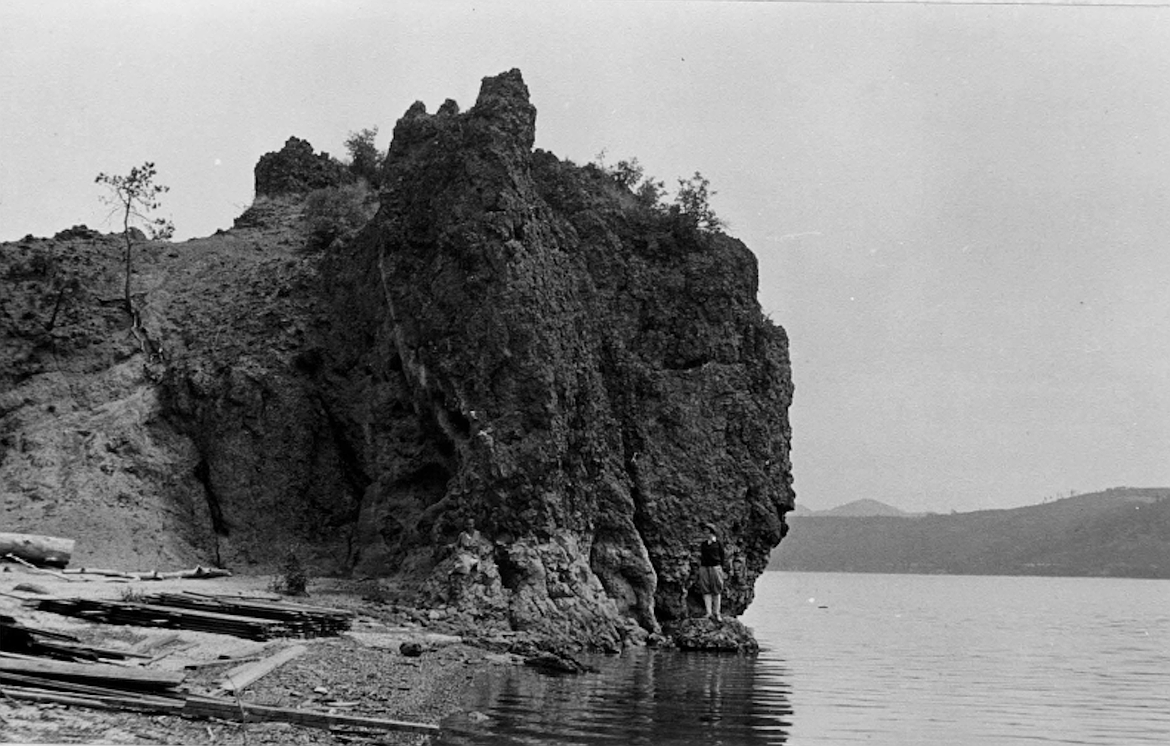
The area on Coeur d'Alene Lake known as Black Rock. If you look near the base of the rock, you can see the high water mark where contaminated lake water effectively removed the coloring from the base.
Courtesy photo
After mounting local and political pressure, the Idaho state legislature authorized a study of the pollution problems created by Silver Valley mines directly discharging waste into the area's waterbodies. The Coeur d’Alene River and Lake Commission was created to direct the study, and the commission requested the assistance of the United States Bureau of Fisheries who authorized a survey and a team of four fisheries scientists to investigate the issue. The study was to be conducted during the summer months of 1932, with results reported back to the Idaho State Legislature in 1933. Commissioner Cathcart, as the acting Secretary of the Coeur d’Alene River and Lake Commission, began preparing for the Bureau’s research team in the spring of 1932. Cathcart had a fully functional field laboratory constructed inside a boat house in Harrison; he also secured a small boat and vehicle for the team’s day trips and hired a local man familiar with area waterways to guide them. The team, led by Dr. M.M. Ellis, arrived in Harrison on July 9th and started work the next day.
Ellis and his crew began by surveying the river system and learning about the disposal practices of the mines. He learned that for the first forty years of operation, the mills in the district used the jig table method to process their ores. This method was quite inefficient, and considerable quantities of lead and zinc ore were lost with these tailings as they were dumped in the river. The jig method produced larger rock particles and a finer rock powder. Due to their larger size and heavier weight, the jig tailings did not travel as far and completely settled out by the time they reached the Mission Flats in Cataldo, where the river widened slightly and created a natural sedimentation area. Ellis noted that the entire Mission Flats area, consisting of several thousand acres, was now entirely covered with mining tailings and slimes that had settled out there. He interviewed several steamboat captains in the area who told him that 15 to 20 years ago, they could drive their steamboats and tugboats to the Old Mission, but the channel and the mainstream became so obstructed by large bars of mine waste and tailings that this could no longer be done. Inundated with so much waste, the river continued to carry enormous amounts of finer tailings into the Lower Basin, miles downstream, and into Lake Coeur d’Alene.
By the early 1920s, all the mills in the district had converted to a much more efficient selective floatation method. While metal recovery rates improved, the flotation method created new issues. First, the ore-bearing rock was reduced in ball mills to a tailings powder much finer than the powder formerly created from the jig tables. When mixed with water, these tailings became slimy in texture and were called mine slimes by locals. Because of their small particle size, these new tailings did not readily settle out and were carried farther by the river, and were also more susceptible to chemical changes. The floatation method also allowed for ore of much lower grade to be profitably handled, which increased mining efforts and thus increased the amount of waste in general. Lastly, the flotation process required the use of chemicals for separation and floated substances that promoted bubbling and frothing, all of which presented new pollution problems.
Next, the science team began taking inventory of living organisms throughout the watershed, including the mine-impacted sections of the river, Coeur d’Alene Lake, and the nearby Chain Lakes. They also assessed streams and waterbodies within the basin that were not impacted by mining activities. They collected data on fish fauna, bottom species, plant life, and the microscopic phytoplankton and zooplankton, which are necessary to sustain fish populations. The primary focus was to assess numbers and types of fauna present in the contaminated waters and compare those to nearby streams and lakes not impacted by the mine waste. No fish or plankton were found in the portions of the river actively carrying mine waste, and it was practically devoid of all aquatic animal life. In contrast, the nearby unimpacted side streams and sections above the mining district were found to be thriving with aquatic life. In areas where the mine waters mixed with clean water sources, such as the chain lakes of the Lower Basin, species counts also dropped considerably, with no life in the heavily mixed areas, and increasing life as the water became more diluted. It was clear that these waste materials were taking a toll on the Coeur d’Alene River ecosystem, so now the scientist attempted to find out why.
The sheer number of tailings moving through the river system was enough to be deadly to aquatic species, but the chemical makeup of these sediments also played a significant role. The ore deposits in the Coeur d’Alene district are primarily sulfides, but when exposed to air, sunlight, and moisture, these metals begin changing chemically into sulfates and oxides, making them even more toxic. Area farmers explained that the tailings deposited on their farms and left along the shores of the river after high water events produced toxic, crystalline substances that killed crops and stock, particularly horses, and to some extent cattle, dogs, and chickens. In addition to studying the tailings themselves, chemical analyses of other conditions that impact fish life were completed, including measuring dissolved gases, pH levels, and specific conductance of the mine-impacted waters versus non-impacted waters. It was determined that mine waste had not greatly disturbed the balance of dissolved gases, relative acidity, or specific conductance, so the absence of aquatic life could not be ascribed to these conditions but rather to the contents of the waste itself.
Part 1 of this series was published on Dec. 23. Check back for Part 3 to see what the scientist found.
The Dirt is a series of informative articles focused on all aspects of cleanup efforts associated with the Bunker Hill Superfund Site. Our goal is to promote community awareness of contamination issues, to provide tools for protecting public health, and to keep the community informed of current and future cleanup projects. The Dirt is a group of committed and local experts from multiple agencies, including the Basin Environmental Improvement Project Commission, Panhandle Health District, Shoshone County, Silver Valley Economic Development Corporation, and the Idaho Department of Environmental Quality.